
Researchers turned a classic theory of information into a near-perfect Wordle strategy that solves 99% of puzzles.
Millions of people play Wordle every day, trying to identify a hidden five-letter word in six guesses or fewer. Now, researchers at Binghamton University, State University of New York, have developed a mathematical approach that can solve the popular New York Times game with an impressive 99% success rate.
How Wordle Works
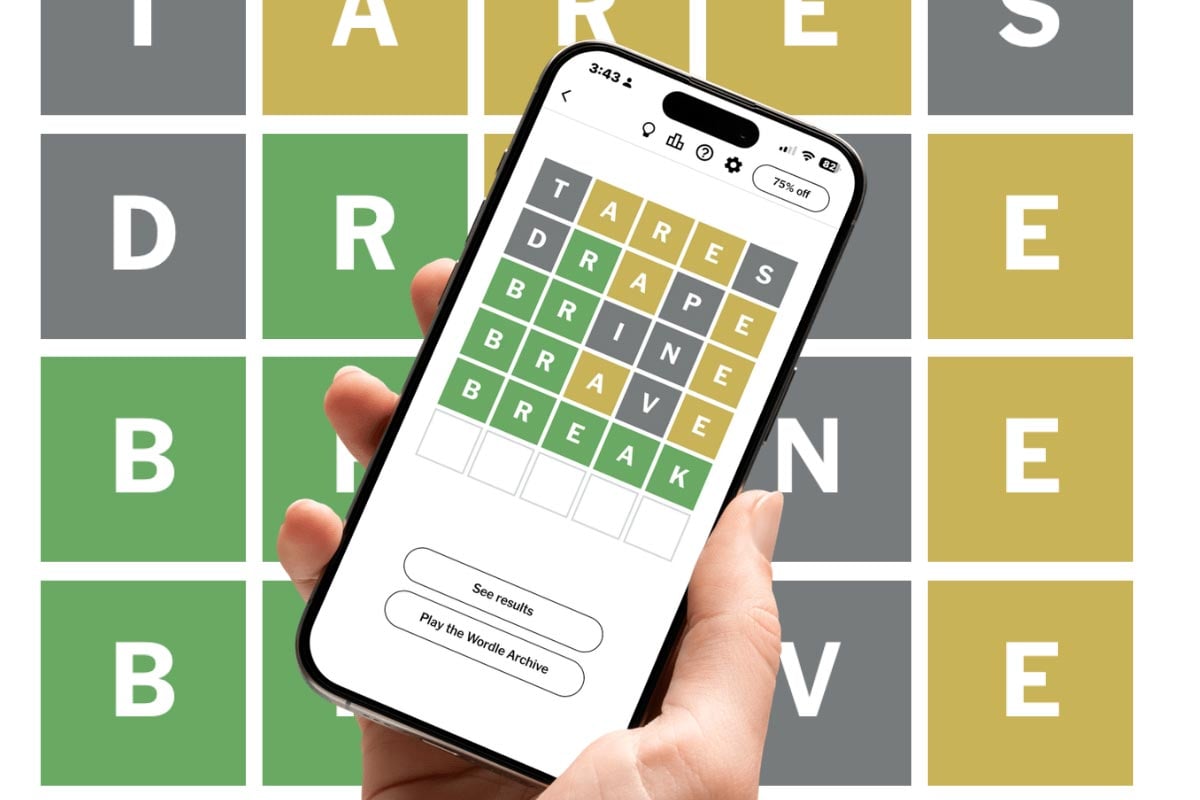
At the beginning of a Wordle puzzle, players see five empty spaces and receive no clues about the secret word. They enter a five-letter guess, such as “BRAVE,” and the game responds with color-coded feedback:
- Grey means the letter is not in the word.
- Yellow means the letter appears in the word but is in the wrong position.
- Green means the letter is in the correct position.
Using these clues, players continue making guesses until they either identify the word and turn all five squares green or run out of attempts.
Using Information Theory to Solve Wordle
The Binghamton research team, led by Assistant Professor Congyu “Peter” Wu, turned to Shannon entropy, a mathematical measure of uncertainty, to determine which guesses provide the most useful information.
Instead of immediately trying to guess the most likely answer, the method focuses on selecting words that eliminate as many possibilities as possible. Each guess is chosen based on how much information it can reveal about the remaining candidate words.
“Let’s say you’re at a certain guess. The previous guesses will eliminate a whole bunch of options, and based on the remaining options, guessing some words will send you into a trajectory where information gain is speedier,” said Wu, a faculty member at the Thomas J. Watson College of Engineering and Applied Science’s School of Systems Science and Industrial Engineering.
Donald Stephens, a doctoral student at Binghamton University, said the strategy challenges a common assumption about the game.
“A subtle but important insight from the paper is that a guess doesn’t have to be the most likely answer; it simply has to be informative,” Stephens said. “By applying Shannon entropy, the objective shifts to maximizing the expected reduction in uncertainty rather than the probability of being right. In practice, this approach can lead to solving the puzzle in fewer guesses.”
Why the Strategy Works
Although the approach may appear somewhat random, the researchers found that it increases the chances of eventually reaching the correct answer.
To use the strategy while playing, a person would run a separate script or program. After entering Wordle’s color-coded feedback into the program, it would recommend the next guess that is expected to reveal the most information.
The researchers compared their method with a more traditional strategy based on frequently used letters (e.g., “A”, “E”, “R”). In computer simulations, the information theory approach successfully solved 99% of Wordle puzzles. The traditional method achieved a success rate of 90%.
From Classroom Assignment to Published Research
The project began not as a formal research study but as a classroom assignment. Wu challenged students to demonstrate how information theory could be used to solve a real-world problem.
According to co-author Talal Aladaileh, the project’s journey from coursework to a published scientific paper highlights the strength of Binghamton’s School of Systems Science and Industrial Engineering.
“The courses here don’t just teach concepts; they push you to apply them in ways that have real, lasting impact,” Aladaileh said.
Wu noted that the project demonstrates how information theory can be used not just to measure uncertainty, but also to improve performance in practical tasks.
“What is especially creative and valuable about the team’s intellectual contribution,” Wu said, “is that it transformed a static measurement (Shannon entropy) in a scientific domain into a dynamic solution that helps accomplish a popular task better, which showcases the team’s deep understanding of class material and their talent as engineers.”
The team’s findings were published in the Northeast Journal of Complex Systems in a paper titled “Solving Wordle Using Information Theory.”
Reference: “Solving Wordle Using Information Theory” by Talal Aladaileh, Donald Stephens, Mallak Alqaisi and Congyu Wu, 6 April 2026, Northeast Journal of Complex Systems (NEJCS).
DOI: 10.63562/2577-8439.1146
Never miss a breakthrough: Join the SciTechDaily newsletter.
Follow us on Google and Google News.
3 Comments
Where is your insubscribe button please
You can click “unsubscribe” which is at the bottom of the emails.
I can’t believe I just wasted more time reading this article that “reveals” a “discovered” “scientific” strategy that I’ve been using for years. And I do have a 99% solve rate. They are basically saying you can solve Wordles by, well, playing Wordle. omg They are calling it “scientific” because scientists “found” it and “mathematical” but it’s neither. It’s simply employing a logical strategy while playing Wordle. I use the same three words each time which use all 5 vowels and all the most commonly used letters. I almost never lose. SOUND. GREAT. CLIMB. No math. No science. Just words and logic. Duh.
It’s another article that makes ME want to unsubscribe, as well.
99% is poor. I had a streak of over 1250. I would likely have failed a dozen times if my success rate was only 99%.