
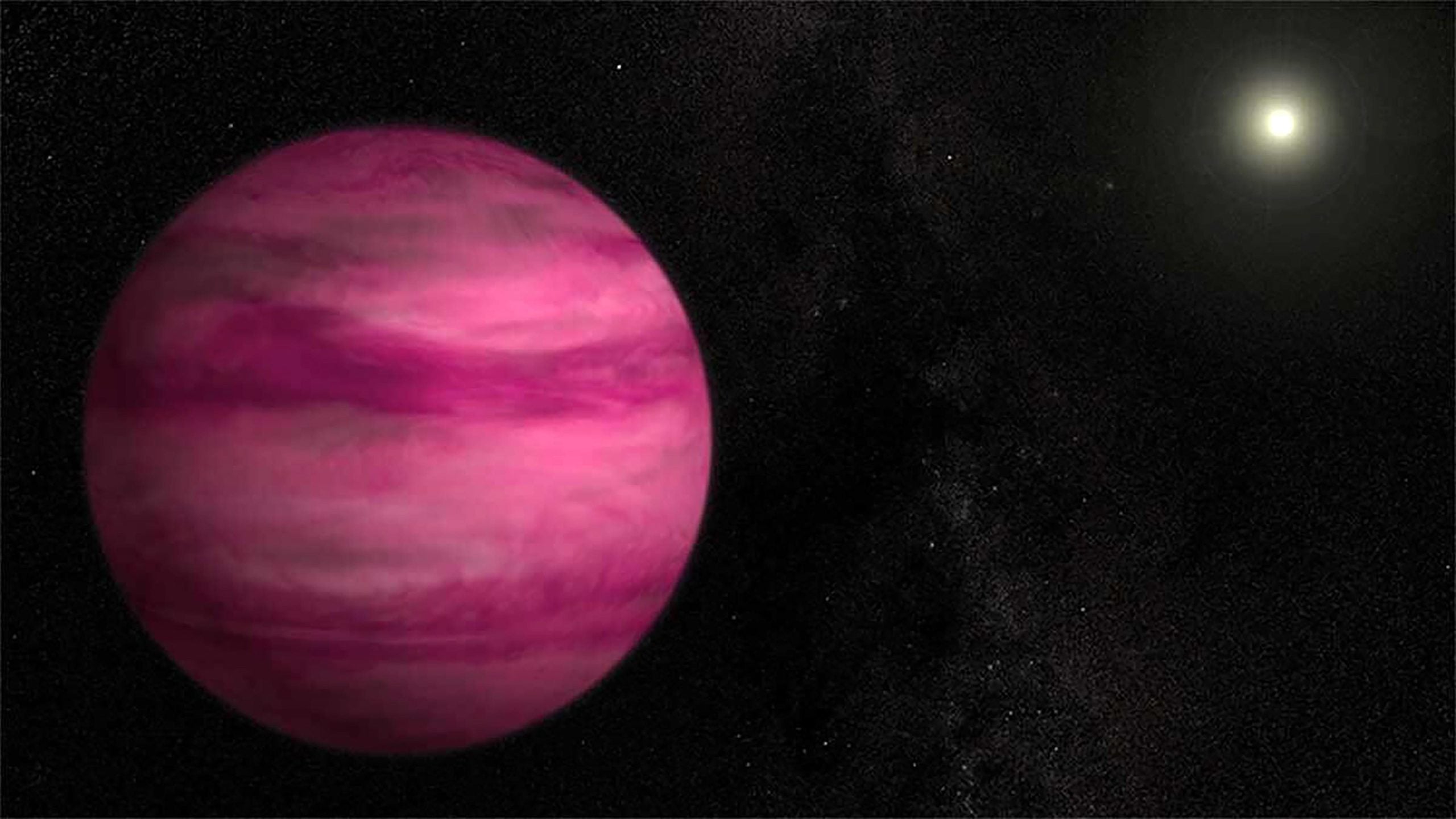
James Webb uncovered exotic salt clouds surrounding the famous “Pink Planet,” solving a long-standing mystery about one of the coldest known alien worlds.
Astronomers led by Northwestern University have uncovered an extraordinary feature surrounding the universe’s famous “Pink Planet”: skies filled with salt clouds.
For more than a decade, this ancient world, known for its rosy appearance, puzzled scientists. As one of the coldest planetary-mass companions ever directly imaged, it is so faint that ground-based telescopes have struggled to analyze the light reflected from its atmosphere. New observations from the James Webb Space Telescope (JWST), however, have finally provided a much clearer view, revealing an atmosphere packed with unusual chemistry and previously unseen salty clouds.
The findings provide some of the first direct evidence that salt clouds exist in the atmosphere of a cold planetary object, confirming an idea scientists first proposed more than 15 years ago. The discovery also demonstrates how JWST is making it possible to study extremely cold, dim worlds that have remained beyond the reach of Earth-based observatories.
The study was published on June 18 in the Astronomical Journal.
“The Pink Planet is the coldest companion ever discovered using ground-based instruments,” said Northwestern’s Aneesh Baburaj, who led the study. “Many teams all around the world performed follow-up observations to study its light, but it was too faint for ground-based instruments. That made it a perfect target for JWST. When we finally obtained its spectrum, it immediately looked interesting. But once we started digging deeper into the data, we realized it was not like anything we have analyzed before.”
Baburaj is an exoplanet researcher and postdoctoral associate at Northwestern’s Center for Interdisciplinary Exploration and Research in Astrophysics (CIERA). He collaborated with scientists at the Space Telescope Science Institute (STScI), including Marshall Perrin, who designed the observing program for GJ504b. Perrin also serves on the JWST Telescope Scientist Team, which helped develop the telescope and oversees its ongoing scientific operations.
The Mystery of the Pink Planet
First discovered in 2013, the Pink Planet, formally known as GJ504b, circles a sun-like star located 57 light-years from Earth. Despite its nickname, astronomers are still uncertain whether it should be classified as a true planet. With a mass roughly 25 times greater than Jupiter, GJ504b lies near the boundary between giant planets and brown dwarfs. Because of that uncertainty, researchers describe it as a “planetary-mass companion,” meaning a planet-sized object orbiting a star.
Its faintness has made the object especially difficult to study. While most directly imaged exoplanets have temperatures between about 1,000 and 2,000 degrees Fahrenheit, GJ504b is only about 550 degrees Fahrenheit (290 degrees Celsius), comparable to the temperature inside a bread-baking oven.
According to Baburaj, the object’s relatively cool temperature reflects its age. Giant planets begin their lives extremely hot but gradually cool over billions of years. The team’s analysis suggests GJ504b is between 2.5 billion and 4 billion years old.
To examine the object, the researchers used JWST to capture its faint light while applying advanced data processing techniques to remove the overwhelming glare from its much brighter parent star. That allowed them to isolate the companion’s spectrum, which separates light into different wavelengths. Because specific elements and molecules leave unique fingerprints in a spectrum, scientists can determine the composition of an atmosphere by studying those patterns.
“In the past, other astronomers observed the companion for an entire night with some of the biggest telescopes in the world to obtain a spectrum,” Baburaj said. “And they could not see the object. With JWST, our entire observation took around two hours, and we were successful.”
James Webb Reveals Salt Clouds
The spectrum revealed an atmosphere containing water vapor, methane, carbon dioxide, ammonia, and several other molecules. When the researchers compared those observations with atmospheric models, they encountered an unexpected problem. The models only matched the data by including unrealistic atmospheric conditions.
The mystery disappeared after the team introduced clouds into their simulations. Among several cloud types they tested, salt clouds produced by far the best agreement with the observations. Those clouds likely block the view of deeper atmospheric layers, changing the light that eventually reaches JWST.
“We ran simulations with clouds, and the results aligned with what we know about cold planets,” Baburaj said. “We tried three different types of clouds, and salt clouds fit best. When we accounted for salt clouds, it subdued the signature of molecules hidden deeper in the companion’s atmosphere. Then, the results became physically possible.”
The observations also indicate that GJ 504 b contains an unusually large amount of heavy elements, known to astronomers as metals. Even so, its origin remains uncertain. Based on the available evidence, it may have formed like a giant planet or more like a small star.
A New Window Into Cold Alien Worlds
Baburaj believes the methods demonstrated in this study will help scientists investigate many other faint, cold worlds. Jupiter, for example, is covered by clouds of ammonia ice. Although current instruments cannot yet study those cloud layers in comparable detail, the successful detection of salt clouds around GJ504b suggests that astronomers are steadily expanding what they can observe.
“This is the first time we’ve found that salt clouds are critical to explaining the spectrum of an object,” Baburaj said. “It’s a good reminder to account for clouds in our models.”
Reference: “JWST-TST High Contrast: First Direct Spectroscopy of GJ 504 b Reveals Clouds and Possible Metal Enrichment” by Aneesh Baburaj, Jean-Baptiste Ruffio, Marshall Perrin, Jerry W. Xuan, William O. Balmer, Yayaati Chachan, Quinn M. Konopacky, Travis S. Barman, Mathilde Mâlin, Kielan K. W. Hoch, Emily Rickman, Kimberly Ward-Duong, Laurent Pueyo, Julien H. Girard, Isabel Rebollido, Alexis Bidot, Christine Chen, Kadin Worthen, Cicero Lu, Jens Kammerer, Roeland P. van der Marel, Nikole K. Lewis, Jeff Valenti, Sara Seager, Chris Stark, Rémi Soummer, Jay Anderson, Charles-Philippe Lajoie, Mark Clampin and C. Matt Mountain, 18 June 2026, The Astronomical Journal.
DOI: 10.3847/1538-3881/ae6919
The study was supported by NASA (award number 80NSSC20K0586).
Never miss a breakthrough: Join the SciTechDaily newsletter.
Follow us on Google and Google News.