
Close Menu
    Facebook X (Twitter) Instagram
    SciTechDaily
    • Biology
    • Chemistry
    • Earth
    • Health
    • Physics
    • Science
    • Space
    • Technology
    Facebook X (Twitter) Pinterest YouTube RSS
    SciTechDaily
    Home»Space»Exploring Alien Worlds With NASA’s Webb Space Telescope: TRAPPIST-1 System
    Space

    Exploring Alien Worlds With NASA’s Webb Space Telescope: TRAPPIST-1 System

    By NASAMarch 6, 20227 Comments3 Mins Read
    Facebook Twitter Pinterest Telegram LinkedIn WhatsApp Email Reddit
    Share
    Facebook Twitter LinkedIn Pinterest Telegram Email Reddit
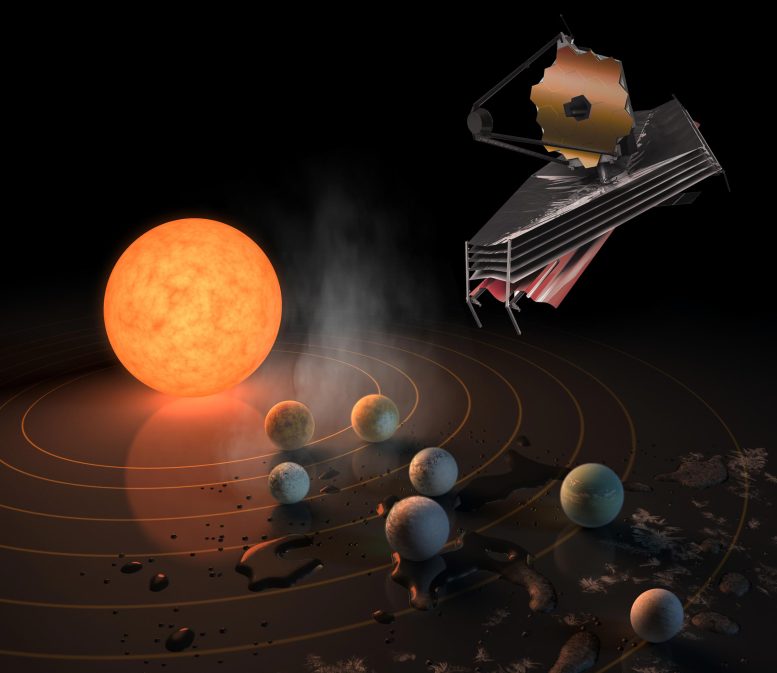
    TRAPPIST-1 Webb Space Telescope
    In its first operating cycle, the James Webb Space Telescope will target the TRAPPIST-1 system, a remarkable group of seven rocky exoplanets 41 light-years from Earth.

    During its first operating cycle, the James Webb Space Telescope will set its sights on the TRAPPIST-1 system, an incredible collection of seven rocky exoplanets 41 light-years away from Earth.

    Astrobiologists like Dr. Giada Arney from the NASA Goddard Space Flight Center are excited about this system because TRAPPIST-1 is a perfect laboratory for studying habitability! It consists of seven rocky planets, distributed across the system’s habitable zone, or the area around a star where it is not too hot and not too cold for liquid water to exist on the surface of surrounding planets. Webb will characterize the atmospheres of these planets and help scientists learn more about planetary formation and habitability.

    See Part 1 in this video series.

    Video Transcript:

    Well, TRAPPIST-1 is a really exciting system for James Webb to observe. It’s going to observe TRAPPIST-1 early in its operating cycle.

    And the reason why astronomers are so excited by TRAPPIST-1 is that it’s a system of seven, you know, not just one or two, but seven rocky planets orbiting a really low mass star.

    This is really, really interesting because these planets sort of are a natural laboratory to study processes that might impact planetary habitability. And the reason for that is because some of the planets in that system are too close to the star to be habitable. They’re probably too hot.

    Some of the planets in that system are just the right distance from their star to possibly be habitable. And then at least one of the planets in the system is probably too cold to be habitable. If I were to guess, I would probably guess that it’s cold and frozen over.

    So by studying all the planets in the system and comparing and contrasting their characteristics, we might learn more about how planetary habitability varies as you move out or inward from your distance from your parent star, and also about the different processes that can enable or maybe destroy habitability at different distances from your star.

    That’s really, really exciting.

    And all of these planets are orbiting the same star.

    So we know they’re all formed together; they’re all from the same material; they all experience the same processes from the star over their lifetime.

    So, it’s a really, really nice system to use for this kind of comparison.

    And of course, we also want to search for biosignatures in the atmospheres of the potentially habitable TRAPPIST-1 planets. And if we find things that’ll be really, really interesting because these low mass stars like TRAPPIST-1 are, they’re very different from our massive Sun-like stars.

    These low mass stars tend to be… they’re really, really active. They produce a lot of high energy stellar flares. They produce a lot of high-energy radiation.

    So, whatever evolutionary history these planets have had over time, it’s probably pretty different from the planets of our solar system just because its star behaves so differently.

    And so, it’ll also be really, really interesting to compare the planets in the system to the rocky planets in our solar system and see, you know, in what ways are these planets different, but also in what ways are they the same?

    Never miss a breakthrough: Join the SciTechDaily newsletter.
    Follow us on Google and Google News.

    Astronomy Exoplanet James Webb Space Telescope NASA Planets Popular TRAPPIST-1
    Share. Facebook Twitter Pinterest LinkedIn Email Reddit

    Related Articles

    TRAPPIST-1b: Bare Rock or Hazy Alien World? Webb’s Surprising Discovery

    Webb’s Galactic Surprise: Reveals Rocky Planet Secrets in Cosmic Extremes

    Exoplanet Discovery Alert: Webb Space Telescope Finds Water in Ultra-Hot Alien World

    Webb Space Telescope To Provide Details of Two Intriguing “Super-Earths” in the Milky Way

    NASA’s Webb Space Telescope Primed To Reveal Secrets of Galaxy’s Most Mysterious Planets

    Cold Planets Exist Throughout the Milky Way – Even in the Galactic Bulge

    Discovery Alert: A “Cool” Neptune-Like Planet – With Plenty of Atmosphere?

    The 7 Rocky Earth-Size TRAPPIST-1 Planets Have Remarkably Similar Densities

    Hubble Discovers a Strange Exoplanet That Resembles the Long-Sought “Planet Nine”

    7 Comments

    1. David W Edwards on March 7, 2022 10:26 pm

      That’s really, really interesting!

      Reply
    2. Justin Brown on March 8, 2022 4:59 am

      “Early on”? What does that mean? Tomorrow or 2036?

      Reply
    3. A. Crowley on March 9, 2022 4:54 am

      “really, really” Is that the next over-used catch phrase that will come into vogue when the hipsters get tired of saying ‘like’ in every sentence?

      Reply
    4. D1plo on March 9, 2022 2:01 pm

      Really, really exciting! Really, really!

      Reply
    5. Mark Bruce on March 10, 2022 12:20 pm

      Sweet, can’t wait, subscribing now

      Reply
    6. james r carter on July 15, 2022 11:28 am

      I am looking forward to James Webb telescope viewing the trappist system. It may discovered life

      Reply
    7. RelentlezCruiz on January 20, 2025 9:18 am

      Looks like a snake head with one large eye. Another satanic reference from the lizard people.

      Reply
    Leave A Reply Cancel Reply

    • Facebook
    • Twitter
    • Pinterest
    • YouTube

    Don't Miss a Discovery

    Subscribe for the Latest in Science & Tech!

    Trending News

    Scientists Say This Natural Hormone Reverses Obesity by Targeting the Brain

    35-Million-Year-Old Mystery: Strange Arachnid Discovered Preserved in Amber

    Is AI Really Just a Tool? It Could Be Altering How You See Reality

    JWST Reveals a “Forbidden” Planet With a Baffling Composition

    The Protein “Sabotaging” Aging Muscle Recovery Could Be Key to Surviving Aging

    This Diet–Gut Interaction Could Transform Fat Into a Calorie-Burning Machine

    Scientists Discover Hidden Virus Linked to Colorectal Cancer

    Scientists Discover 132-Million-Year-Old Dinosaur Tracks on South Africa’s Coast

    Follow SciTechDaily
    • Facebook
    • Twitter
    • YouTube
    • Pinterest
    • Newsletter
    • RSS
    SciTech News
    • Biology News
    • Chemistry News
    • Earth News
    • Health News
    • Physics News
    • Science News
    • Space News
    • Technology News
    Recent Posts
    • 500 Million Years Ago, Life Changed Forever: Scientists Reveal the DNA Changes That Helped Animals Move Onto Land
    • Surprise RNA Discovery Challenges Long-Held Beliefs About How Genes Work
    • Your IQ at 23 Could Predict Your Wealth at 27, Study Finds
    • 320 Light-Years Away, a Planet Confirms a Fundamental Cosmic Assumption
    • Astronomers Solve Decades-Long Mystery About Saturn’s Spin – “Something Strange Was Happening”
    Copyright © 1998 - 2026 SciTechDaily. All Rights Reserved.
    • Science News
    • About
    • Contact
    • Editorial Board
    • Privacy Policy
    • Terms of Use

    Type above and press Enter to search. Press Esc to cancel.