
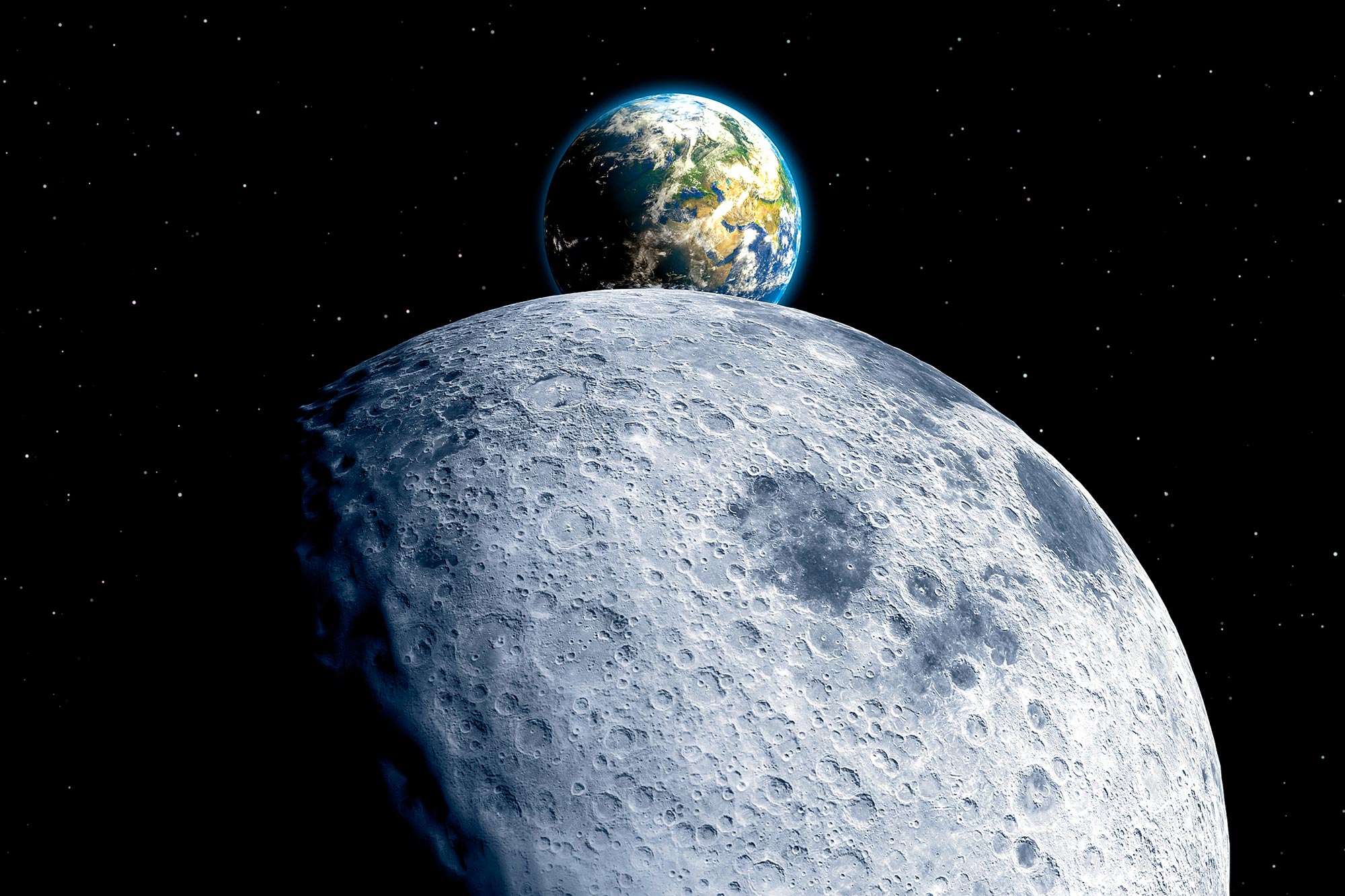
Researchers propose turning a future NASA moon base into a quarantine station that would screen space samples before they ever reach Earth.
A policy paper argues that NASA’s planned moon base should include a biocontainment facility to help protect Earth from potentially hazardous biological contaminants brought back from space.
“Humanity is entering a new era of space exploration, but our planetary protection strategies have not kept pace with the risks associated with returning extraterrestrial samples to Earth,” said paper coauthor Frederick I. Moxley, Director of Strategic Threat Analysis and Research Laboratories, an Idaho-based consultancy.
“The proposed facility would essentially act as a firewall between Earth and any potentially hazardous live organisms that could accompany returning future space missions,” said Moxley, whose coauthor is Anthony Ricciardi, a James McGill Professor of Biology and the Director of the Bieler School of Environment at McGill University.
Samples would stop on the moon
In their paper, published in Ambio, Moxley and Ricciardi argue that material gathered from the moon, Mars or farther destinations should not be sent straight to Earth. Instead, they say extraterrestrial samples should first go to a secure quarantine and research facility on the moon.
Moxley and Ricciardi recommend that all incoming space samples be handled only by advanced robotic systems inside the lunar facility. That approach would reduce the chances of human exposure or an accidental release.
Invasive species offer a warning
Although no extraterrestrial life has been confirmed, Moxley and Ricciardi warn that any unfamiliar form of life entering Earth’s biosphere could have unpredictable ecological effects. They point to Earth’s long history of invasive species as a cautionary example.
“Decades of research on invasive species have demonstrated how an organism introduced to the wrong place at the wrong time can spread uncontrollably with potentially devastating and irreversible long-term impacts on ecosystems,” said Ricciardi, an expert on biological invasions. “This research justifies a strong precautionary approach against introductions of extraterrestrial origin.”
Space missions raise containment stakes
The paper comes as government space agencies and private aerospace companies move more quickly into missions beyond Earth orbit. Moxley and Ricciardi argue that this busier and more competitive space environment makes strict biosafety standards increasingly important.
The study raises concerns about worst-case scenarios, including a spacecraft carrying contaminated material crashing or malfunctioning, or astronauts being exposed to extraterrestrial environments. Moxley and Ricciardi contend that no facility currently on Earth can absolutely guarantee containment, elimination or control of an unknown alien microorganism if an accident occurs.
The moon becomes a barrier
Moxley and Ricciardi conclude that the search for life beyond Earth could become one of humanity’s most important scientific milestones, but that its risks need to be managed before they become emergencies.
“The moon,” they argue, “may become humanity’s first line of biological defense.”
Reference: “Protecting earth from extraterrestrial contamination: The case for a lunar biocontainment facility” by Frederick I. Moxley, and Anthony Ricciardi, 28 May 2026, Ambio.
DOI: 10.1007/s13280-026-02428-5
Never miss a breakthrough: Join the SciTechDaily newsletter.
Follow us on Google and Google News.
2 Comments
You get an ‘alien’ biology of any sort – and all the world could go up in a puff. Everything we got in this world is DNA based life –
If something were to start breaking up DNA chains – munching DNA – or RNA – whether alien biology or some mad lab somewhere, that could be the long fabled doomsday for real.
That’s what’s wrong with the whole aliens, UFO believers – crowd. We’re a closed, interdependent system. One big fish tank.
Or, you know, maybe that’s why we don’t see them – at some point ‘life finds a way’ to destroy itself
“Could” does a whole lot of work here. Yeah, the Moon base *could* be useful – if they ever build it. Which they won’t.
I believe this entire article is just another angle to market SpaceX’s mad endeavours and nothing more.