
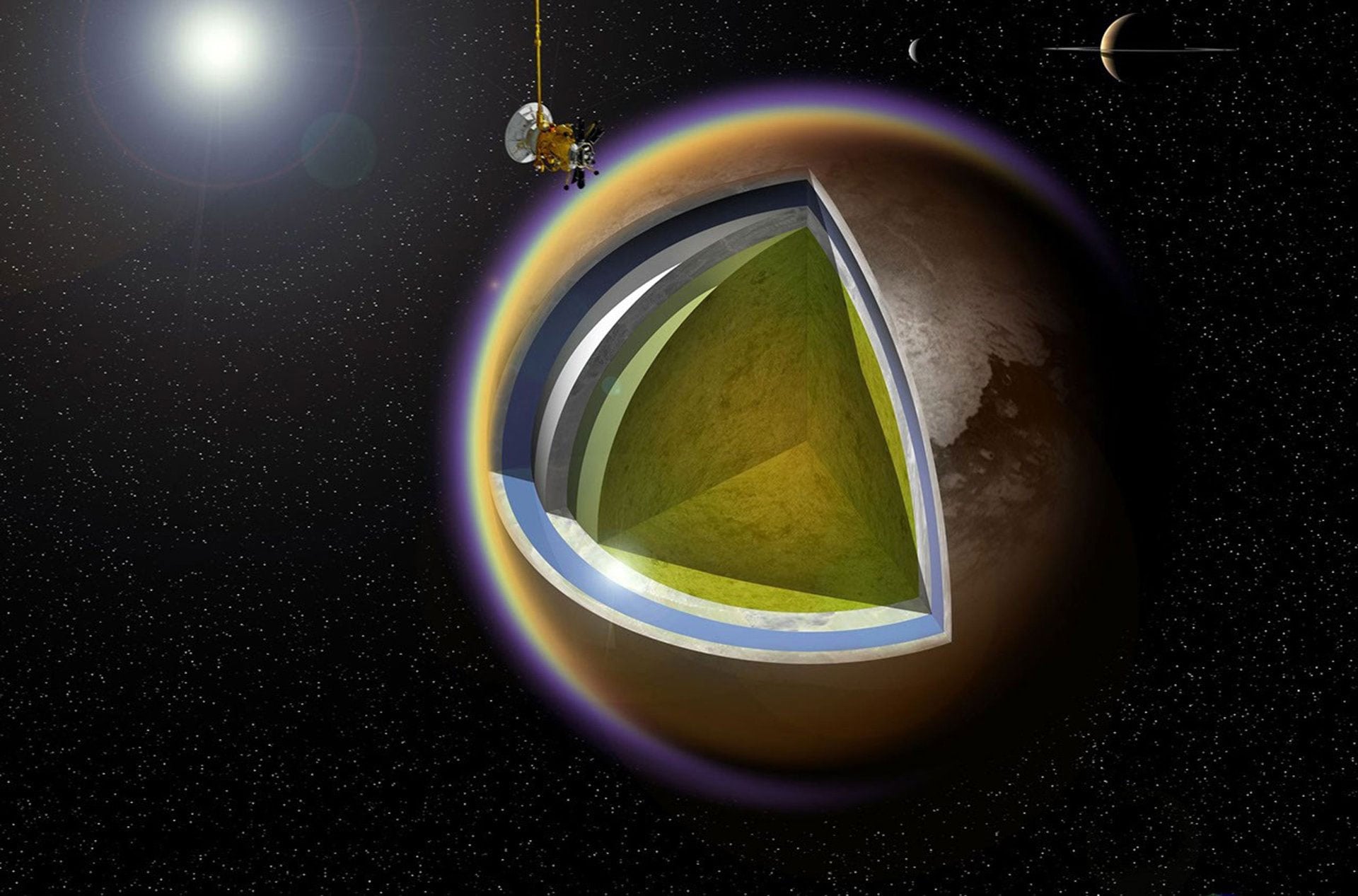
Titan’s resources could one day make Saturn’s largest moon a major outpost for deep space exploration.
Titan is one of the few places in the Solar System where the landscape can feel strangely familiar and completely alien at the same time. Saturn’s largest moon has weather, clouds, rain, lakes, and seas, but its cycle is driven by methane rather than water.
It is also wrapped in a dense, nitrogen-rich atmosphere, making it the only moon, and the only known world beyond Earth, with such a substantial atmospheric blanket.
That unusual mix has made Titan a major target for scientists interested in chemistry, habitability, and the early ingredients of life. Its surface contains complex organic molecules, and its environment is considered prebiotic, meaning it may preserve or produce chemistry relevant to the origins of life. NASA’s Dragonfly mission (set to launch no earlier than July 2028) is designed to explore that world in detail.
Titan may also matter for a very different reason: future human activity beyond Earth. In Entering Space: Creating a Spacefaring Civilization, Robert Zubrin described Saturn’s moons as the “Persian Gulf” of the Solar System, with Titan standing out because of its rich resource environment.
A recent NASA-supported study takes that idea seriously by examining what Titan could offer future generations of humans. The research team compiled an inventory of the moon’s available resources and considered how they might support long-term exploration or settlement. When compared with other possible destinations (i.e., the Moon and Mars), Titan appears to offer several potential advantages, although any human presence there remains a distant and highly challenging prospect.
The study was led by Conor A. Nixon, an astronomer and planetary scientist with the Solar System Exploration Division (SSED) at NASA Goddard Space Flight Center. He worked with Ye Lu, a Professor of Aerospace Engineering at the Worcester Polytechnic Institute, and Jennifer E. Ruliffson, a Professor of Materials Science and Engineering at the University of Florida. Their preprint has appeared online and is under review for publication in Acta Astronautica.
Titan widens the resource map
ISRU is a major aspect in all plans for long-duration missions to the Moon, Mars, and other locations far beyond Earth. To date, the vast majority of studies have focused on leveraging lunar and Martian resources to sustain crewed missions and eventual human settlement. With the exception of a recently proposed Titan ISRU Sample Return (TISR) mission, Titan has received considerably less attention, despite the possibilities this moon offers.
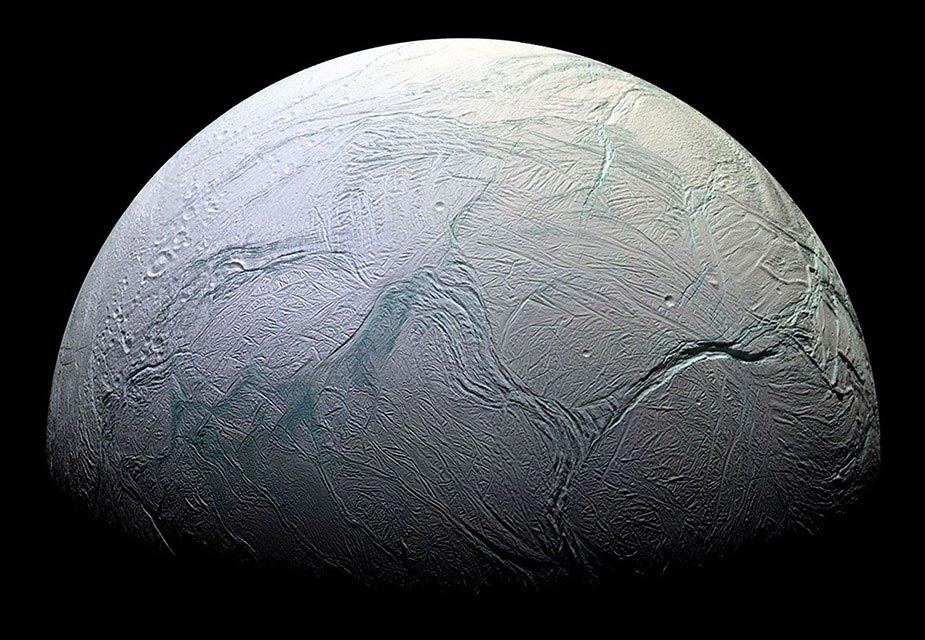
This includes opportunities for ISRU that would enable the construction of long-term habitats on the surface. In addition, they could also lead to Titan becoming a base for resupply missions traveling to and from the outer Solar System. Similarly, Titan could facilitate the exploration of Saturn’s other satellites, particularly the “Ocean Worlds” of Enceladus and Mimas, both of which are also rich in resources. Finally, its resources and products fashioned from them could be exported to other locations in the Solar System.
This includes fuel, feedstock, and basic necessities like food, water, nitrogen fertilizers, oxygen gas, and more. As Nixon told Universe Today via email:
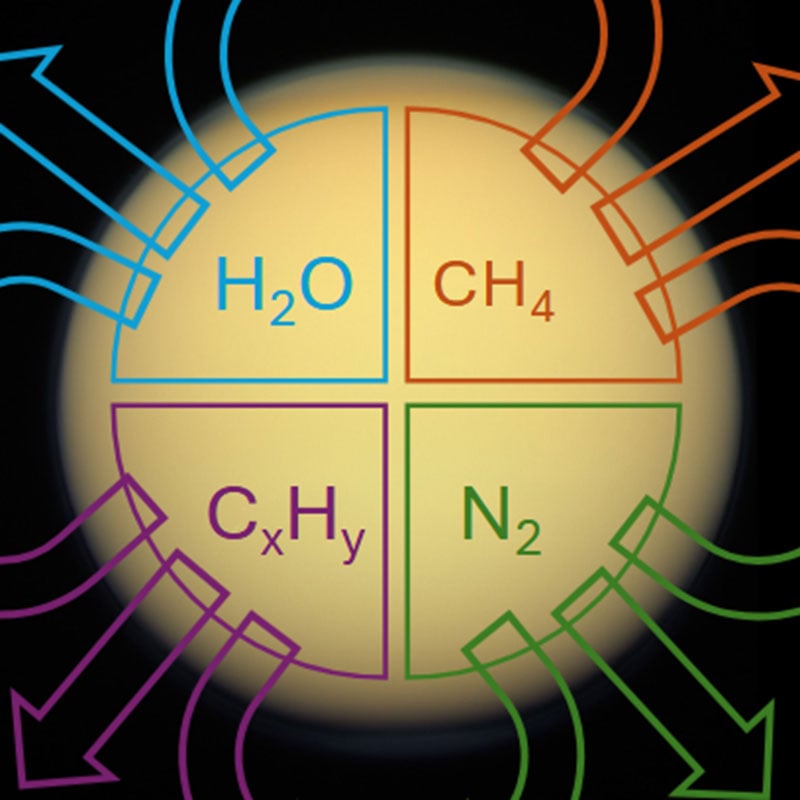
Titan is gushing with hydrocarbons – what we call oil and natural gas on Earth. In the atmosphere, it has about 5% methane (what we call LNG and use in home heating and cooking). On the surface, we can find heavier hydrocarbons, such as propane used in BBQ tanks, butane used in lighters, and heavier liquids like kerosene and gasoline. Besides burning these hydrocarbons, we can also make a lot of products from them: plastics, synthetic rubber, and feedstocks for everything from solvents to pharmaceuticals, and even foods.
Hydrocarbons could power exploration
The previous study, led by Geoffrey Landis and the Compass Lab team from NASA’s John Glenn Research Center, looked at ISRU at Titan for one purpose: liquefying methane and producing liquid oxygen (LOX) and liquid hydrogen (LH2) from water to create propellant for a sample-return mission. Nixon and his colleagues cast a much wider net, looking further ahead by examining the many possible uses of all of Titan’s resources.

They also considered how a rich resource base could be used for a wider range of mission profiles. These include missions that need to return to Earth, as well as missions that plan to explore beyond Saturn. To this end, refueling stations on the surface could be accessed by landers from a larger spacecraft that would take on fuel and supplies. Alternatively, refueling depots could be built in orbit – similar to what SpaceX is investigating for the Starship – so that spacecraft would rendezvous on their way to other destinations.
And as Nixon noted, there’s the possibility of harvesting resources to build long-term settlements on Titan’s surface:
“Basically, you could envision either ‘refueling’ at Titan (in the manner of the Oleson/Landis study), or using the resources to sustain a more permanent settlement. [And] regarding refueling, it doesn’t just have to be for a return trip to Earth: it could be refueling a ship just arrived from the inner Solar System to go further out, say to Uranus or Neptune, or to explore the Saturnian moons. Or it could just be refueling a regular shuttle that traverses around the Saturn system between colonies on different moons.
Also, we can widen the definition from just ‘fuel’ to resources for a wide variety of purposes. So let’s imagine a permanent station on Titan that refines hydrocarbons and stores them as a variety of feedstocks and raw materials: everything from printer ink to fertilizer. Then, when a visiting ship comes to ‘refuel,’ it is restocking not just fuel but raw ingredients for food, perhaps for 3D printers used to make spare parts, textiles, utensils, and more.
Water adds another advantage
There’s also the large volume of water on Titan, which accounts for 50% of its mass (the rest being rocky material in its core) and exists in both solid and liquid states. The liquid portion exists largely beneath the surface, where ammonia and salinity (two natural antifreeze compounds) maintain its liquid state. Water also exists in abundance as surface ice, which could be harvested and used to provide everything from drinking water to hydrogen fuel, oxygen gas, and (as noted) to manufacture LOX/LH2 propellant.
After considering Titan’s resource base and the opportunities for resupply, settlement, and exploration, Nixon and his colleagues compared Titan with the Moon, Mars, and several NEAs. They determined that while Titan is much more distant and would require nuclear propulsion to enable transits, its potential is unrivaled.
“There is simply no other world (that we know of) like Titan,” said Nixon. “Titan is unique in multiple respects: it’s the only moon with an atmosphere, and it’s the only planet/moon other than Earth to have hydrocarbons available in the atmosphere and on the surface.”
Saturn could become a hub
While the idea of crewed missions to Titan, or the settlement of this and other Cronian moons, is a far-off prospect, the potential is obvious. By establishing infrastructure and outposts in and around Saturn’s moons, humanity would have access to a huge resource base.
Beyond Titan, Saturn’s atmosphere contains massive reserves of the rare isotope helium-3 (³He), considered the ideal fuel for fusion reactors and fusion propulsion. With so much water, hydrocarbons, and precious gases available, Saturn could very well become the “Persian Gulf” of the Solar System.
But as Nixon indicated, the benefits go far beyond refueling and include the means to build a manufacturing base capable of meeting all the needs of a human population. With the abundant plastics, feedstock for 3-D printers, fuel, and food that could be produced in-situ, a human settlement on Titan could endure for generations. It may be a far-off possibility, but it’s good to know that it’s there and could be fulfilled someday as part of humanity becoming an interplanetary civilization.
Reference: “Titan’s Resources and their Utilization” by Conor A. Nixon, Ye Lu, and Jennifer Ruliffson, 4 June 2026, Acta Astronautica.
DOI: 10.48550/arXiv.2606.06608
Adapted from an article originally published in UniverseToday.
Never miss a breakthrough: Join the SciTechDaily newsletter.
Follow us on Google and Google News.
9 Comments
Habitability for Titan yes…probably more than mars. But resource extraction? Really? That’s a contradiction in itself and incompatible with our history or basic thermodynamics. All life accerates entropy in the universe and is the thermodynamic reason for its existence…we abet the second law to create an astronomically more likely, although not necessarily easily accessible, state of disorder. Paradoxically, it takes an intent driven highly ordered state like life to access modes of creating disorder inaccessible to the nonliving. The problem is local disorder is far easier to create than transporting that disorder far away, polluting and destroying that ordered mechanism of life in the process. You cannot dance with the devil without getting burned. It took early life billions of years to REALIZE via many failed Hadean collapses that LOCAL entropy production…although its far easier…means inevitable demise in the long run. What became of that life was mostly plants which export their excess disorder deep into space via infrared radiation from photosynthesis.
All animal life are a much more recent highly regulated experiment on this planet that parasitizes the local order of plants and generally only discharge their excess disorder locally. Humans have jumped the shark with technology and are destined to destroy themselves both physically and psychologically if they think knowledge will save them…indeed just the opposite. The whole point of brains is to create a little more order so that we can generate even more disorder…and unfortunately for us we create and are compelled to maximize that disorder locally…in the worst cases in each other through exploitation and war. Star Trek and Star Wars are fictions in the most ironic sense. Any civilization with that kind of technology and even 1% as exploitative and violent as we are today would destroy themselves in days. We may get to Titan, but a humanity that does so wouldn’t be ever able to achieve that without a major shift in understanding why we are here and its ever increasing danger to our existence the smarter and more capable we get. Resource extraction is just another name for destruction and far far less than that scale its incompatible with life.
Lol calm down it’s just a space gas station idea dude
What titan needs is a heavy explosion to fire methane that will result in cyclic rains that will reduce methane eventually and make water more sustainable for life. Titan is like early Earth when cyclic rains changed the chemistry of Earth and made it more habitable for microorganisms to complex ones later. We can definitely expedite that process by introducing more complex life to Titan
Dang …. Anti colonialism now goes inter planetary … how predictable. Sorry I haven’t taken on the self destruction paradigm yet …. Drill baby drill Titan style!! Haha
What titan needs is a heavy explosion to fire methane that will result in cyclic rains that will reduce methane eventually and make water more sustainable for life. Titan is like early Earth when cyclic rains changed the chemistry of Earth and made it more habitable for microorganisms to complex ones later. We can definitely expedite that process by introducing more complex life to Titan
14% gravity, no water, no oxygen. It’s almost like floating in space. A 200 lb person would weigh 28 lbs. there. You could probably leap 100 feet before atrophy set in.
For the next two hundred years, maybe. It’s not happening within our lifetimes. We can’t even get back to the moon. Spare me.
You’ve been reading too much science fiction.
All the things the article suggests doing require energy. Just keeping humans alive will also require energy. The article doesn’t suggest a source for that energy. Surely solar will be insufficient. Is there latent energy in the environment that can be harvested? There are all those hydrocarbons, but harvesting that requires free oxygen. I see mention of hydrogen and oxygen, but only in the form of water. That can only be freed with the application of more energy.
The only obvious *local* energy source I can see today is geothermal. (Tytothermal?) Could that be viable?
Another, longer term, possibility is fusion. But I’m not holding my breath for a useful fusion reactor that can be transported from Earth to Titan.
Fission reactors could be helpful, but aren’t a local solution, and aren’t scalable if the uranium/plutonium must be brought from Earth.
never gonna happen, it takes several thousand people to operate a mining venture, more fantasy bs