
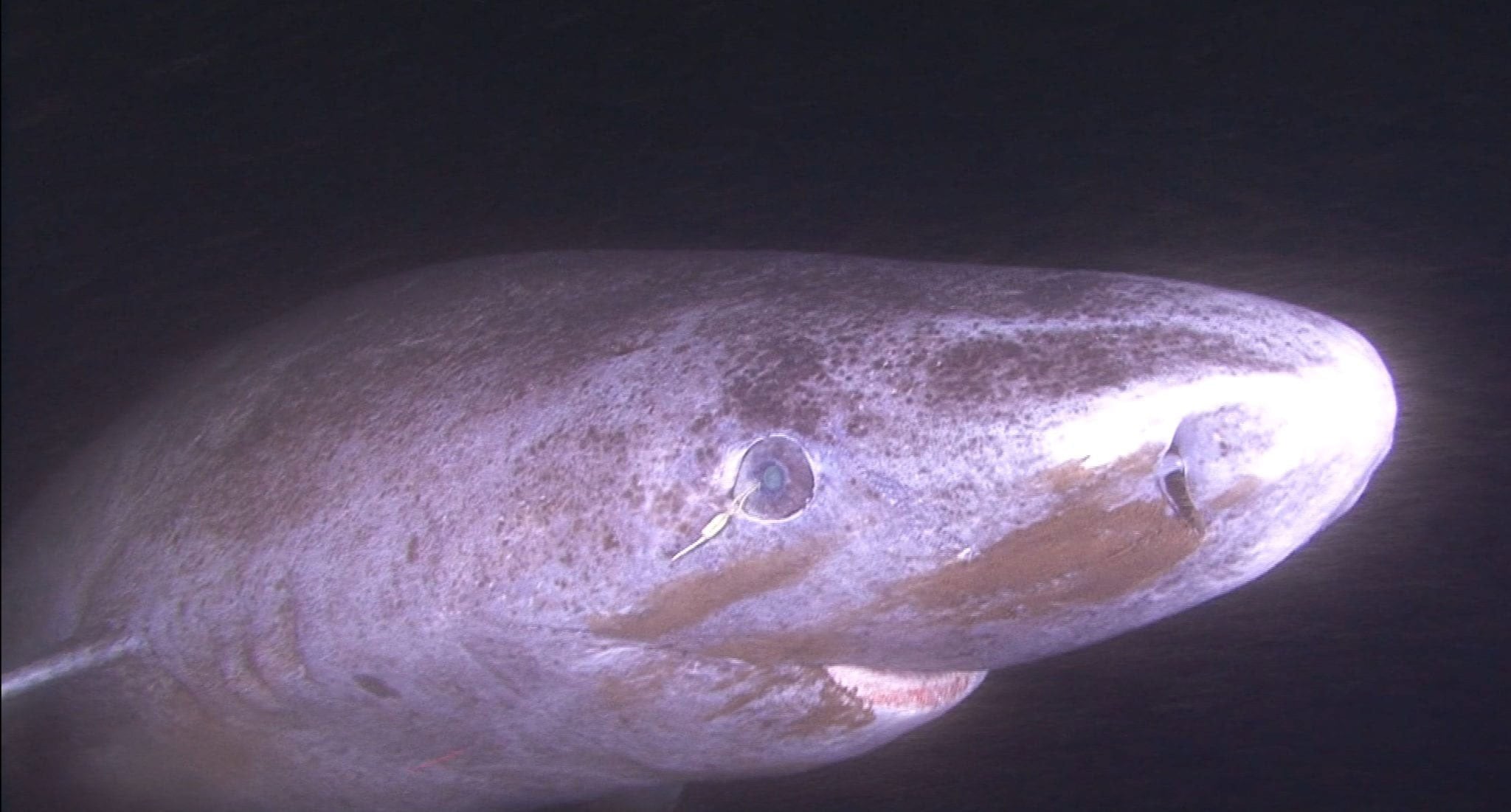
A UC Irvine study identifies a DNA mechanism that helps these sharks maintain their vision over centuries.
On a computer screen in her UC Irvine office, Dorota Skowronska-Krawczyk watches a Greenland shark drift through the dark Arctic water. Its body moves slowly through the murk, but what catches her attention is not the shark’s size or age. It is the eye.
“You see it move its eye,” says the UC Irvine associate professor of physiology and biophysics, pointing to an image of a Greenland shark slowly drifting through the murky Arctic Ocean. “The shark is tracking the light – it’s fascinating.”
Greenland sharks are the longest-living vertebrates known to science. They can survive for centuries, with some individuals living up to 400 years. Their thick gray bodies, small heads, and rounded snouts are already unusual, but their eyes have long raised a separate question. Many appear cloudy and lifeless, and parasites are often found attached to them. Combined with the dim, obstructed world these sharks inhabit, that led scientists to suspect they may be functionally blind.
Skowronska-Krawczyk’s new work suggests that assumption may be wrong. The research, conducted with University of Basel researchers Walter Salzburger and Lily G. Fogg, who studied the evolutionary side of the project, indicates that Greenland sharks may preserve useful vision across centuries.
Published in Nature Communications, the findings point to a DNA repair mechanism that may help protect the shark retina from age-related decline. The study found no signs of retinal degeneration and showed that the sharks are adapted to extremely low-light environments.
A moving eye raised questions
Skowronska-Krawczyk studies the molecular processes involved in aging and eye disease, so the Greenland shark presented an unusual biological puzzle. If an animal can live for centuries, its tissues must somehow resist damage that accumulates with age. The eye, which is especially vulnerable to degeneration in humans, offered a direct way to investigate that resilience.
Her curiosity began with a 2016 research paper by John Fleng Steffensen in Science. The paper noted that many Greenland sharks carry parasites on their eyes, a detail that could help explain why their vision had been dismissed.

“One of my takeaway conclusions from the Science paper was that many Greenland sharks have parasites attached to their eyes—which could impair their vision,” she says. “Evolutionarily speaking, you don’t keep the organ that you don’t need. After watching many videos, I realized this animal is moving its eyeball toward the light.”
That observation turned the question around. Instead of asking why the shark’s eyes looked damaged, Skowronska-Krawczyk wanted to know whether the eyes were still working.
Rare eyes reached the lab
The sharks examined in the study were caught between 2020 and 2024 on scientific long lines off the coast of the University of Copenhagen’s Arctic Station on Disko Island, Greenland. Steffensen, a professor of marine biology at the University of Copenhagen, worked with Peter G. Bushnell of Indiana University South Bend and Richard W. Brill of the Virginia Institute of Marine Science to dissect and preserve the eyes in a fixative solution.
The preserved tissue eventually reached UC Irvine, where Emily Tom, a UC Irvine Ph.D. student and physician scientist in training in Skowronska-Krawczyk’s lab, faced a very different specimen from the tiny mouse eyes she normally handled.
“I opened the package, and there was a giant, 200-year-old eyeball sitting on dry ice just staring back at me,” the 28-year-old says with a laugh. “We’re used to working with mouse eyeballs, which are the size of a papaya seed, so we had to figure out how to scale up to a baseball-sized eyeball. Luckily, Dorota is very hands-on, both in her mentoring style and in the lab—which you don’t see a lot of with professors.”
Tom then let the eyeball defrost. “The lab smelled like a fish market,” she says.
Handling the tissue required careful timing. If it thawed too much, the sample could degrade once it reached room temperature. Tom carried out histological and vision-specific analyses, looking closely at tissue structure and markers of visual function. She found no signs of cell death and showed that rhodopsin (a protein essential for vision in dim light) remained active in the shark retina and was tuned to blue light.
“Not a lot of people are working on sharks, especially shark vision,” Tom says. “We can learn so much about vision and longevity from long-lived species like the Greenland shark, so having the funds to do research like this is very important.”
Shark vision may guide medicine
For Skowronska-Krawczyk, the value of the work reaches beyond shark biology. If Greenland sharks can keep retinal tissue healthy for centuries, the mechanisms behind that protection could help scientists think differently about age-related vision loss in people.
The findings may eventually inform research on eye diseases such as macular degeneration and glaucoma. They also raise broader questions about how vision evolves, how long-lived tissues avoid damage, and how lessons from extreme animals might guide human medicine.
She notes that with federal research funding under threat, future support for her studies is a concern, but she believes that “we will prevail.”
“What I love about my work is that we are the first in the world to see results—at the forefront, finding new mechanisms, rules and discoveries,” Skowronska-Krawczyk says, looking over at the paused shark on the screen. “Then, being able to share this joy with students—that’s the best part of it.”
Reference: “The visual system of the longest-living vertebrate, the Greenland shark” by Lily G. Fogg, Emily Tom, Maxime Policarpo, William Cho, Fangyuan Gao, Doreen Hii, Aaron E. Fawcett, Nicolas Boileau, Amalie Bech-Poulsen, Kirstine F. Steffensen, Cherlyn J. Ng, Peter G. Bushnell, John Fleng Steffensen, Richard Brill, Walter Salzburger and Dorota Skowronska-Krawczyk, 5 January 2026, Nature Communications.
DOI: 10.1038/s41467-025-67429-6
Never miss a breakthrough: Join the SciTechDaily newsletter.
Follow us on Google and Google News.
1 Comment
Oh yeah? Scientists are only seeking to destroy everything God created. Why can’t anyone stop destroying everything that makes up planet earth? 🌍😠🌲