
Close Menu
    Facebook X (Twitter) Instagram
    SciTechDaily
    • Biology
    • Chemistry
    • Earth
    • Health
    • Physics
    • Science
    • Space
    • Technology
    Facebook X (Twitter) Pinterest YouTube RSS
    SciTechDaily
    Home»Biology»Unexpected Discovery of a 410-Million-Year-Old Fossil Forces Rethink of Shark Evolution
    Biology

    Unexpected Discovery of a 410-Million-Year-Old Fossil Forces Rethink of Shark Evolution

    By Imperial College LondonSeptember 9, 2020No Comments4 Mins Read
    Facebook Twitter Pinterest Telegram LinkedIn WhatsApp Email Reddit
    Share
    Facebook Twitter LinkedIn Pinterest Telegram Email Reddit
    Fossil Scan Shark Evolution
    A 410-million-year-old fish fossil with a bony skull suggests that the lighter skeletons of sharks may have evolved from bony ancestors, reversing previous assumptions.

    Sharks’ non-bony skeletons were thought to be the template before bony internal skeletons evolved, but a new fossil discovery suggests otherwise.

    The discovery of a 410-million-year-old fish fossil with a bony skull suggests the lighter skeletons of sharks may have evolved from bony ancestors, rather than the other way around.

    Sharks have skeletons made of cartilage, which is around half the density of bone. Cartilaginous skeletons are known to evolve before bony ones, but it was thought that sharks split from other animals on the evolutionary tree before this happened; keeping their cartilaginous skeletons while other fish, and eventually us, went on to evolve bone.

    Now, an international team led by Imperial College London, the Natural History Museum, and researchers in Mongolia have discovered a fish fossil with a bony skull that is an ancient cousin of both sharks and animals with bony skeletons. This could suggest the ancestors of sharks first evolved bone and then lost it again, rather than keeping their initial cartilaginous state for more than 400 million years.

    The team published their findings on September 7, 2020, in Nature Ecology & Evolution.
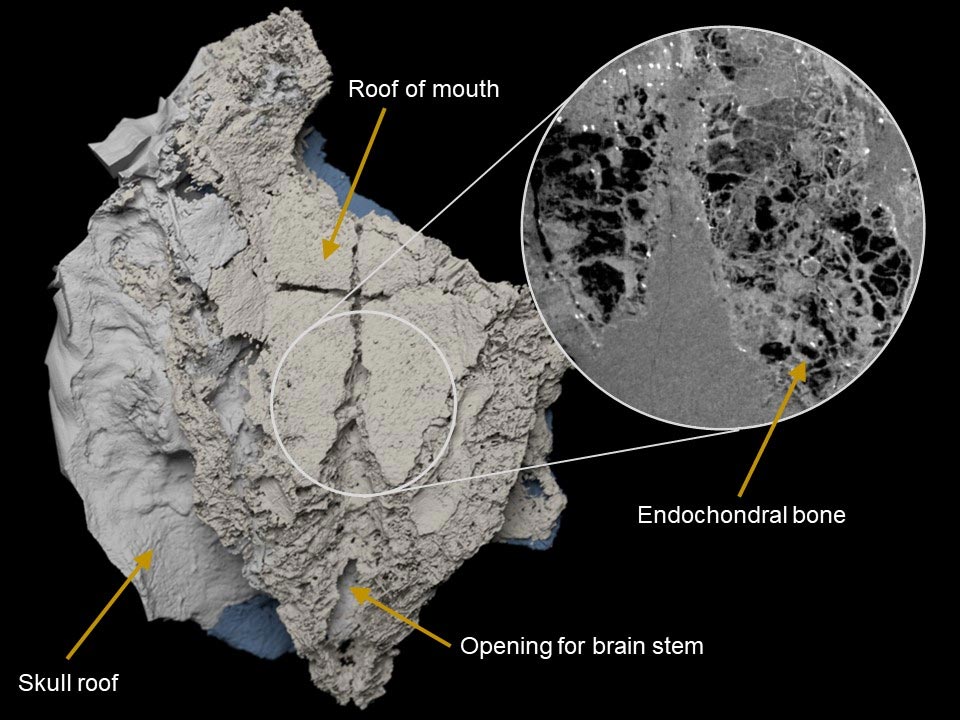
    Braincase Minjinia turgenensis
    Virtual three-dimensional model of the braincase of Minjinia turgenensis generated from CT scan. Inset shows raw scan data showing the spongy endochondral bone inside. Credit: Imperial College London/Natural History Museum

    Unexpected discovery

    Lead researcher Dr. Martin Brazeau, from the Department of Life Sciences at Imperial, said: “It was a very unexpected discovery. Conventional wisdom says that a bony inner skeleton was a unique innovation of the lineage that split from the ancestor of sharks more than 400 million years ago, but here is clear evidence of bony inner skeleton in a cousin of both sharks and, ultimately, us.”

    Most of the early fossils of fish have been uncovered in Europe, Australia, and the USA, but in recent years new finds have been made in China and South America. The team decided to dig in Mongolia, where there are rocks of the right age that have not been searched before.

    They uncovered the partial skull, including the brain case, of a 410-million-year-old fish. It is a new species, which they named Minjinia turgenensis, and belongs to a broad group of fish called ‘placoderms’, out of which sharks and all other ‘jawed vertebrates’ – animals with backbones and mobile jaws – evolved.


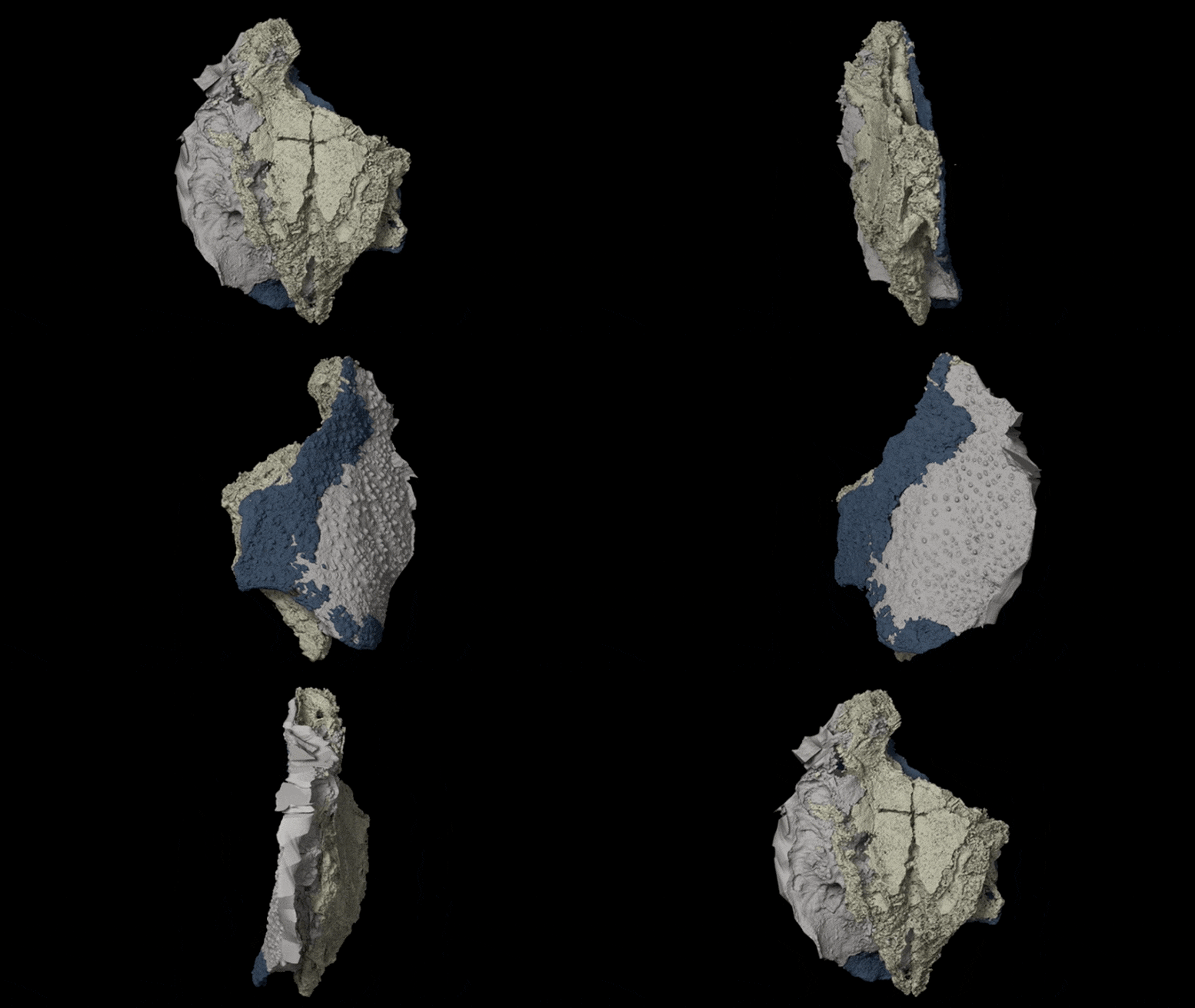
    Virtual three-dimensional model of the braincase of Minjinia turgenensis generated from CT scan. Credit: Imperial College London/Natural History Museum

    When we are developing as foetuses, humans and bony vertebrates have skeletons made of cartilage, like sharks, but a key stage in our development is when this is replaced by ‘endochondral’ bone – the hard bone that makes up our skeleton after birth.

    Previously, no placoderm had been found with endochondral bone, but the skull fragments of M. turgenensis were “wall-to-wall endochondral”. While the team are cautious not to over-interpret from a single sample, they do have plenty of other material collected from Mongolia to sort through and perhaps find similar early bony fish.

    World domination

    If further evidence supports an early evolution of endochondral bone, it could point to a more interesting history for the evolution of sharks.

    Dr Brazeau said: “If sharks had bony skeletons and lost it, it could be an evolutionary adaptation. Sharks don’t have swim bladders, which evolved later in bony fish, but a lighter skeleton would have helped them be more mobile in the water and swim at different depths.

    “This may be what helped sharks to be one of the first global fish species, spreading out into oceans around the world 400 million years ago.”

    Reference: “Endochondral bone in an Early Devonian ‘placoderm’ from Mongolia” by Martin D. Brazeau, Sam Giles, Richard P. Dearden, Anna Jerve, Ya. Ariunchimeg, E. Zorig, Robert Sansom, Thomas Guillerme and Marco Castiello, 7 September 2020, Nature Ecology & Evolution.
    DOI: 10.1038/s41559-020-01290-2

    Never miss a breakthrough: Join the SciTechDaily newsletter.
    Follow us on Google and Google News.

    Evolution Fish Imperial College London Marine Biology Paleontology Popular Sharks
    Share. Facebook Twitter Pinterest LinkedIn Email Reddit

    Related Articles

    Massive Predator: School Lesson Gone Wrong Leads to New, Bigger Megalodon Size Estimate

    Fossilized Fish Larvae Discovery Challenges Long-Accepted Theory of Vertebrate Origin

    Evolution in Action Revealed by Stunning New Starfish-Like Fossil

    Prehistoric Shark Hid Its Largest, Sharpest Teeth

    Solved: Mystery That’s Been Puzzling Scientists Since 1852 – Bizarre Giraffe-Necked Reptile Hunted Underwater

    Sexual Parasitism: Deep-Sea Anglerfish Evolved a New Type of Immune System to Physically Fuse With Their Mates

    Evolutionary Origin of the Human Hand Revealed by Ancient Fish Fossil

    Ancient Sea-Worm Mystery Solved by Student After 50 Years in “Wastebasket”

    Relationships of Male Dolphins from Shark Bay Determined by Slow Swimming

    Leave A Reply Cancel Reply

    • Facebook
    • Twitter
    • Pinterest
    • YouTube

    Don't Miss a Discovery

    Subscribe for the Latest in Science & Tech!

    Trending News

    AI Could Detect Early Signs of Alzheimer’s in Under a Minute – Far Before Traditional Tests

    What if Dark Matter Has Two Forms? Bold New Hypothesis Could Explain a Cosmic Mystery

    This Metal Melts in Your Hand – and Scientists Just Discovered Something Strange

    Beef vs. Chicken: Surprising Results From New Prediabetes Study

    Alzheimer’s Breakthrough: Scientists Discover Key Protein May Prevent Toxic Protein Clumps in the Brain

    Quantum Reality Gets Stranger: Physicists Put a Lump of Metal in Two Places at Once

    Scientists May Have Found the Key to Jupiter and Saturn’s Moon Mystery

    Scientists Uncover Brain Changes That Link Pain to Depression

    Follow SciTechDaily
    • Facebook
    • Twitter
    • YouTube
    • Pinterest
    • Newsletter
    • RSS
    SciTech News
    • Biology News
    • Chemistry News
    • Earth News
    • Health News
    • Physics News
    • Science News
    • Space News
    • Technology News
    Recent Posts
    • Ancient “Rock” Microbes May Reveal How Complex Life Began
    • Hidden “Trade Winds” Inside Cells Could Explain Cancer Spread
    • Humans Owe Their Eyes to a Tiny One-Eyed “Cyclops”
    • Researchers Capture Quantum Interference in One of Nature’s Rarest Atoms
    • Ancient DNA Reveals Irish Goats Have a 3,000-Year-Old Lineage Still Alive Today
    Copyright © 1998 - 2026 SciTechDaily. All Rights Reserved.
    • Science News
    • About
    • Contact
    • Editorial Board
    • Privacy Policy
    • Terms of Use

    Type above and press Enter to search. Press Esc to cancel.