
Close Menu
    Facebook X (Twitter) Instagram
    SciTechDaily
    • Biology
    • Chemistry
    • Earth
    • Health
    • Physics
    • Science
    • Space
    • Technology
    Facebook X (Twitter) Pinterest YouTube RSS
    SciTechDaily
    Home»Biology»Prehistoric Shark Hid Its Largest, Sharpest Teeth
    Biology

    Prehistoric Shark Hid Its Largest, Sharpest Teeth

    By SciTechDailyNovember 20, 2020No Comments3 Mins Read
    Facebook Twitter Pinterest Telegram LinkedIn WhatsApp Email Reddit
    Share
    Facebook Twitter LinkedIn Pinterest Telegram Email Reddit
    Prehistoric Shark
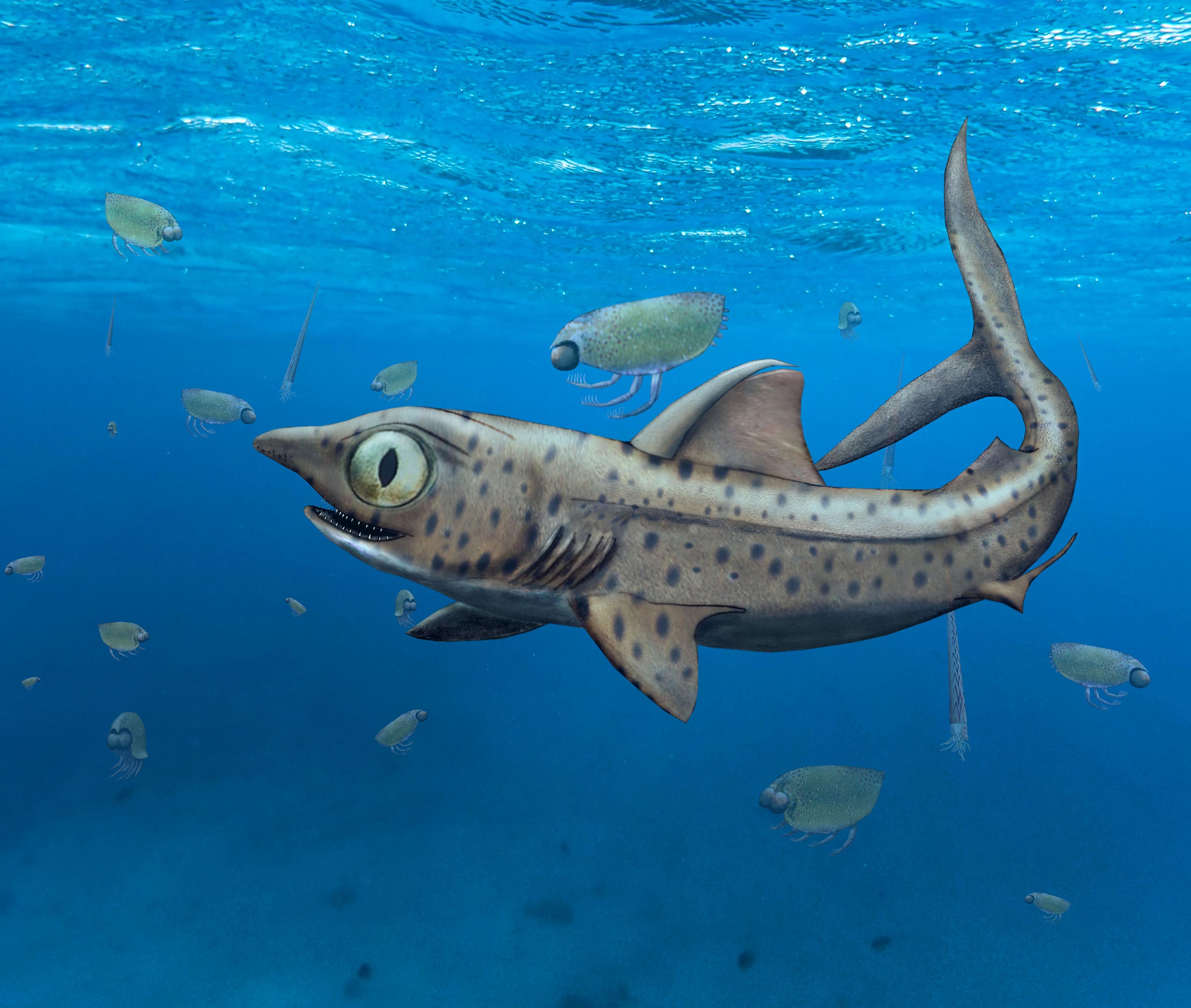
    With mouths closed, the older, smaller teeth of the ancestors of today’s sharks stood upright on the jaw, while the younger and larger teeth pointed towards the tongue and were thus invisible when the mouth was closed. Credit: Christian Klug, UZH

    Some, if not all, early sharks that lived 300 to 400 million years ago not only dropped their lower jaws downward but rotated them outwards when opening their mouths. This enabled them to make the best of their largest, sharpest, and inward-facing teeth when catching prey, paleontologists at the Universities of Zurich and Chicago have now shown using CT scanning and 3D printing.

    Many modern sharks have row upon row of formidable sharp teeth that constantly regrow and can easily be seen if their mouths are just slightly opened. But this was not always the case. The teeth in the ancestors of today’s cartilaginous fish (chondrichthyan), which include sharks, rays, and chimeras, were replaced more slowly. With mouths closed, the older, smaller, and worn-out teeth of sharks stood upright on the jaw, while the younger and larger teeth pointed towards the tongue and were thus invisible when the mouth was closed.

    Jaw reconstruction thanks to computed tomography

    Paleontologists at the University of Zurich, the University of Chicago, and the Naturalis Biodiversity Center in Leiden (Netherlands) have now examined the structure and function of this peculiar jaw construction based on a 370-million-year-old chondrichthyan from Morocco. Using computed tomography scans, the researchers were able not only to reconstruct the jaw, but also print it out as a 3D model. This enabled them to simulate and test the jaw’s mechanics.

    What they discovered in the process was that unlike in humans, the two sides of the lower jaw were not fused in the middle. This enabled the animals to not only drop the jaw halves downward but at the same automatically rotate both outwards. “Through this rotation, the younger, larger, and sharper teeth, which usually pointed toward the inside of the mouth, were brought into an upright position. This made it easier for animals to impale their prey,” explains first author Linda Frey.  “Through an inward rotation, the teeth then pushed the prey deeper into the buccal space when the jaws closed.”

    Jaw joint widespread in the Paleozoic era

    This mechanism not only made sure the larger, inward-facing teeth were used, but also enabled the animals to engage in what is known as suction-feeding. “In combination with the outward movement, the opening of the jaws causes sea water to rush into the oral cavity, while closing them results in a mechanical pull that entraps and immobilizes the prey.”

    Since cartilaginous skeletons are barely mineralized and generally not that well preserved as fossils, this jaw construction has evaded researchers for a long time. “The excellently preserved fossil we’ve examined is a unique specimen,” says UZH paleontologist and last author Christian Klug. He and his team believe that the described type of jaw joint played an important role in the Paleozoic era. With increasingly frequent tooth replacement, however, it became obsolete over time and was replaced by the often peculiar and more complex jaws of modern-day sharks and rays.

    Reference: “A symmoriiform from the Late Devonian of Morocco demonstrates a derived jaw function in ancient chondrichthyans” by Linda Frey, Michael I. Coates, Kristen Tietjen, Martin Rücklin and Christian Klug, 17 November 2020, Communications Biology.
    DOI: 10.1038/s42003-020-01394-2

    Never miss a breakthrough: Join the SciTechDaily newsletter.
    Follow us on Google and Google News.

    Evolution Marine Biology Paleontology Popular Sharks
    Share. Facebook Twitter Pinterest LinkedIn Email Reddit

    Related Articles

    Mysterious Megalodon: No One Actually Knows What the Gigantic Shark Really Looked Like

    Answers to a Fundamental Puzzle: Why Are Some Fish Warm-Blooded When Most Are Not?

    Massive Predator: School Lesson Gone Wrong Leads to New, Bigger Megalodon Size Estimate

    Fossilized Fish Larvae Discovery Challenges Long-Accepted Theory of Vertebrate Origin

    Evolution in Action Revealed by Stunning New Starfish-Like Fossil

    Unexpected Discovery of a 410-Million-Year-Old Fossil Forces Rethink of Shark Evolution

    Solved: Mystery That’s Been Puzzling Scientists Since 1852 – Bizarre Giraffe-Necked Reptile Hunted Underwater

    Ancient Sea-Worm Mystery Solved by Student After 50 Years in “Wastebasket”

    Relationships of Male Dolphins from Shark Bay Determined by Slow Swimming

    Leave A Reply Cancel Reply

    • Facebook
    • Twitter
    • Pinterest
    • YouTube

    Don't Miss a Discovery

    Subscribe for the Latest in Science & Tech!

    Trending News

    New Pill Lowers Stubborn Blood Pressure and Protects the Kidneys

    Humans May Have Hidden Regenerative Powers, New Study Suggests

    Scientists Just Solved the Mystery of Why Crabs Walk Sideways

    Doctors Are Surprised by What This Vaccine Is Doing to the Heart

    This Popular Supplement May Boost Your Brain, Not Just Your Muscles

    Scientists Say This Simple Supplement May Actually Reverse Heart Disease

    Warming Oceans Could Trigger a Dangerous Methane Surge

    This Simple Movement Could Be Secretly Cleaning Your Brain

    Follow SciTechDaily
    • Facebook
    • Twitter
    • YouTube
    • Pinterest
    • Newsletter
    • RSS
    SciTech News
    • Biology News
    • Chemistry News
    • Earth News
    • Health News
    • Physics News
    • Science News
    • Space News
    • Technology News
    Recent Posts
    • New MRI Breakthrough Captures Stunningly Clear Images of the Eye and Brain
    • Scientists Warn Sitting Too Much Can Harm Your Body in Surprising Ways
    • Your Blood Pressure Reading Could Be Wrong Because of One Simple Mistake
    • Scientists Discover Cheap Material That Kills Deadly Superbugs
    • This Magnetic Field Trick Creates Entirely New Forms of Matter
    Copyright © 1998 - 2026 SciTechDaily. All Rights Reserved.
    • Science News
    • About
    • Contact
    • Editorial Board
    • Privacy Policy
    • Terms of Use

    Type above and press Enter to search. Press Esc to cancel.