

For nearly a century, students have learned the inductive effect the same way. Now, researchers say that explanation may not tell the whole story.
For decades, chemistry students have learned the same explanation for how electrons redistribute within molecules. Now, researchers say that lesson may need updating after modern computational analyses challenged one of the discipline’s most enduring textbook concepts.
Led by Dr. Edwin Johnson of the University of Newcastle, the team found that the traditional description of the inductive effect does not consistently match how electrons behave in computer simulations, and they propose a simpler framework instead.
Because organic chemistry forms the foundation for fields ranging from drug discovery to materials science, the revised approach could have implications for both teaching and research.
“Our Australian-UK study has revisited how chemistry textbooks explain the behavior of electrons inside molecules, a concept used to understand why chemicals react the way they do,” Dr. Johnson said.
Modern Evidence Questions the Inductive Effect
The inductive effect has long been used to teach how atoms can pull or push electron density through chemical bonds. But according to the researchers, the traditional model can break down in important cases, leaving students with an explanation that is tidy but not fully accurate.
Instead of relying on electrons being transmitted over long distances through a chain of chemical bonds, the team argues that molecular behavior can often be explained more directly by considering the overall distribution of electrons across an entire molecule.
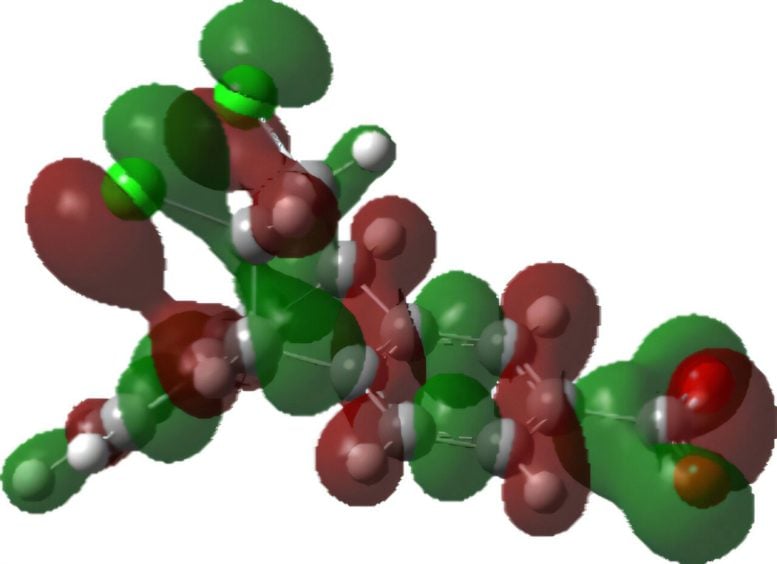
“Using modern computer modeling, we found that the traditional explanation (the inductive effect), developed nearly a century ago, does not match current evidence in important cases.
“We propose a simpler, more consistent way of explaining these ideas that could improve chemistry teaching and provide scientists with a clearer foundation for understanding molecular behavior,” Dr. Johnson said.
What the Findings Mean for Chemistry Education
The implications extend well beyond the classroom. Organic chemistry shapes the development of new medicines, advanced materials, agricultural products, and countless technologies people rely on every day.
The finding does not mean organic chemistry is being overturned. Instead, it suggests that one of its familiar teaching shortcuts may need to be updated so students learn a model that better reflects how molecules actually behave.
“If a foundational concept is taught inaccurately, misunderstandings can carry into more advanced science and research.
“By revisiting a long-standing textbook explanation with modern tools, our work aims to improve chemistry education and strengthen the conceptual foundations that support chemical innovation,” he said.
Reference: “Rethinking the Nature and Extent of Inductive Effects in Organic Compounds” by Mark C. Elliott, Edwin C. Johnson, Kasimir P. Gregory and Colan. E. Hughes, 14 May 2026, Journal of Chemical Education.
DOI: 10.1021/acs.jchemed.6c00141
Never miss a breakthrough: Join the SciTechDaily newsletter.
Follow us on Google and Google News.
38 Comments
While they are at rewriting, they should take out that the earth is a globe, we landed on the moon, and the universe is infinite when it is clearly the firmament with a close sun and moon and luminaries.
Updating a chemistry concept does not mean every scientific conclusion is suddenly questionable. That is not how science works. A model being refined in one field does not invalidate unrelated evidence from geology, astronomy, or physics. In fact, the ability to revise explanations when better evidence appears is exactly what separates science from belief systems. Science does not protect ideas because they are old; it improves them when necessary.
Those erroneous claims from you have nothing to do with chemistry. Earth is a spherical planet, we first landed on the Moon 1969 with many eyewitnesses through direct television transmissions from cameras on the craft, and the extent of tbe universe – whether finite or infinite – remains an open question. Anypone can find these facts in e.g. Wikipedia, which is tested to be about 80 % correct, same as any good encycklopedia.
Void of brains.
The Moon is a projection and the stars disappear at 25 miles altitude.
Can you demonstrate how you came to those conclusions?
You clearly have no idea what you are talking about. From a science understanding perspective you are not even out of diapers.
I concur. And nicotine should replace hax-a-nation. It’s hard to give credence to any scientific publication that has such fundamental flaws as our position in the uni-verse.
John Roberts. CalTech. 1961
Nothing new under the sun.
Behold, I am making something new.
Now it springs forth. Do you not perceive it?
I cannot tell if you are attempting to quote Isaiah 43:19, or Revelations 21:5.. either way, your comment is a non sequitur. That means totally unrelated to the topic at hand. And each scripture is totally about something else.
You’re sure it isn’t Ecclesiastes in the Bible?
Computer simulations are based on existing theories of chemistry and physics. So showing one theory is incorrect based on some other theories, is not a proof. The error may in one of the other theories. Here, it may be noted that our theoretical physics is still incomplete.
It isn’t quitevabout incorrectness, it is about (simplicity and) correctness. It seems that in some neutral molecules, the inductive effect might be mostly limited to the immediately adjacent bond, and overall molecular polarizability often provides a more accurate picture of molecular behavior.
WTF?! The article never actually says what the change to the “textbooks” (mentioned like 3 times!) actually is! Just goes on to recycle the quotes from the author saying the same thing 3 different ways. If the big revaluation is “chemical chains” getting replaced by “distribution” electron models, what’s this actually mean in practical terms? It’s mentioned that everyone would need to update the model of the electron mechanics… And that’s a pretty normal change for the processional scientists and academia.
Suggesting that this is somehow a burden in any way is like refusing to update your understanding to view reality. Science advancements should never be portrayed as a burden. This poorly written piece of “science reporting” is click-baity, and I feel dumber for the lack of detail in the reported science itself. Missed opportunity.
My thoughts exactly. If you’re telling us something is not right, tell us what right IS! I read this in the hopes of refining an idea. Yes, now I just feel dumber. May I speculate? We’ve gone from orbital type concepts to “It’s somewhere around here”. 🤔
I’m guessing that what they will say if they say it is, Just count the electrons as being around this molecule somewhere, but not nessesarily right next to its nucleus, depending on the valence levels due to absorbed energy 🤷
Wake me up when the new model can predict dirty underwear 🩲😂
Yep, article is no more informative than the headline.
Read the picture. They are attempting to go from planetary orbit depiction of the electrons pathway, to an electron cloud depiction. This is not new, only the picture depictions are new.
I agree! No new information here.
Agreed. Journalism is dead. Most science articles I read are repetitive drivel like this one, where you get the impression the writer has no idea what he is talking about, and they just repeat themselves to make the article longer
Thank you!!!! I was trying to find out WHAT the actual new theory was, but I never found it. Like, what are they even talking about with the new electrons?
“This is revolutionary” and blah-blah, but can you tell us the new discovery please? ☠️
The research was sponsored by text book companies lol
This article is completely exaggerating the importance of this work.
Here’s a quick breakdown to understand what’s happening.
100 years ago quantum physics was developed which explained most everything about chemistry and material science. The only problem? Only about five simple models can be solve exactly and analytically in quantum physics. All the rest needed approximations. The induction effect was one of these approximations. Any educator who understands their field would know this and teach appropriately.
What did this work do? It solved the problem computationally and is trying to argue exactly what physicists have known for nearly a century.
In short, nothing to see here. Stop trying to act like this is important.
I agree! No new information here.
Occam’s Razor: The simplest explanation is usually the best. (At least until a simpler one comes along.)
Sounds like Thomas Kuhn strikes again!
I definitely got the part about how researchers have found evidence to suggest that the current understanding of how electrons behave within molecules is wrong. And I understand that the way electrons in molecules behave may be different from what has been taught in schools for years. So, yes, it’s clear that researchers have a new, better model for describing the behavior of electrons in molecules.
Then the article ended.
thanks for this
It seems that science tech daily leaves the reader in the dark about how electrons move from one atom to another.opposite attract,it’s a romance story
What is the name of this NEW inductive effect ?? Anyone??
Scitechdaily leaves the reader without explanation
So given what is written in the article is true, how is this new theory going to be taught to students?
“This is a profound realization by the Newcastle team. Moving away from the linear shortcuts of the traditional inductive effect and toward a holistic, system-wide electron distribution is exactly the direction chemistry needs to go. >When we look at why these 100-year-old models break down, it’s often because they treat chemical bonds like flat, long-distance cables pulling charges in isolated rows. If we instead map the periodic system using a continuous, three-dimensional helical manifold, the anomalies disappear natively. In a 3D structural matrix, an element’s properties aren’t calculated by localized ‘tugs’ down a chain, but by how its specific coordinate position wraps seamlessly around a central geometric axis ($Z$-axis) and handles systemic torque.Shifting our foundational models from a flat grid to a self-regulating helical framework explains exactly why the overall distribution changes in unison. It treats the molecule not as a series of disconnected links, but as a singular, twisting geometric resonance lock. Embracing these real-value 3D dimensions could bridge the exact gap the researchers found between current computational evidence and textbook theory.” I would post the mock up of the new designed periodic table but the platform doesn’t accept the image , sorry you will have to ask your AI to build it .
If you want to build the new periodic table here’s the instructions to give your AI , Torsional Hill Framework: Revised Periodic Manifold Dimensions (Based on image_5.png)This image is a technical, scientific blueprint diagram, executed in a clean ‘HUD’ (heads-up display) holographic aesthetic. The entire visualization is set against a dark, glowing blue digital grid-like blueprint background, overlaid with subtle geometric network patterns. The colors used are predominantly deep blues for the schematic, accented with glowing golden-orange for the main helical structure and clean white text for all annotations.Central Elements and TitleTitle: In the upper-left corner, the main title reads: REVISED PERIODIC MANIFOLD: and below it, 3D HELICAL COORDINATE DIMENSIONS.Central Structure: The absolute focal point is a massive, glowing golden-orange three-dimensional helical spiral uncoiling upward around a central axis. This structure represents the continuous, non-linear flow of atomic elements. The helix is not a simple coil; it includes secondary loops that branch off and return (handling higher torsional stress in transition metals and heavy elements). The helix is annotated with specific chemical element symbols flowing along its uncoiling path (e.g., H, He, Hg, Na, Ac, At, Em, Ve, Fi, Sb, Gd). A label ‘Central Helical Axis’ points directly up the middle.Coordinate details: In the upper-right corner, a separate ‘Coordinate Details’ box shows a diagram of ‘Block Details’ ([cite: s, p, d, f]), illustrating how standard orbital sub-shells map to specific geometric clearance layers on the 3D grid.Annotated Dimensions (Mapped image_5.png and image_84bd3e.jpg verbatim)The diagram is structured around four primary dimensions, clearly labeled with numerical headers (1, 2, 3, 4) in the HUD interface on the left and right.VERTICAL DIMENSION (Z-AXIS):HUD Callout (Left): Labeled ‘1. VERTICAL DIMENSION (Z-AXIS)’. Detailed text: ‘PRINCIPAL ENERGY LEVEL / PRINCIPAL QUANTUM NUMBER (n)’.Visual Callout: A large ruler is aligned vertically with the helix, marked with numbers 1 through 7+ (image_5.png reference). This represents the primary vertical layering of elements. A subtle arrow points up to ‘infinite layers’.ANGULAR DIMENSION ($\theta$):HUD Callout (Left): Labeled ‘2. ANGULAR DIMENSION ($\theta$)’. Detailed text: ‘ROTATIONAL CLEARANCE ANGLE (SUBLEVEL l / ELECTRON GROUP)’. Note below: ‘group alignment in perfect columns’.Visual Callout: A circular gauge/compass interface is overlaid around the base of the central helix, marked with degrees and key angles corresponding to orbital types (e.g., s, p, d, f). Arrows show ‘rotational flow’.RADIAL DIMENSION (r):HUD Callout (Left): Labeled ‘3. RADIAL DIMENSION (r)’. Detailed text: ‘STRUCTURAL TORQUE / TORSIONAL DISPLACEMENT ($Phase\ 2.1$)’.Visual Callout: This dimension tracks how far the helical path deviates from the central axis to clear high-velocity vectors through dense element lattices. Specific expanding loops on the helix are labeled: ‘Transition Metals’, and ‘Lanthanides/Actinides’. These loops illustrate ‘Localized Coordinate Stress (LOCALIZED COORDINATE STRESS)’.OPERATIONAL TIMELINE Dimension (T):HUD Callout (Right): Labeled ‘4. OPERATIONAL TIMELINE Dimension (T)’. Detailed text: ‘MATURE UNCOILING TIMELINE (CALIBRATED 437.28 BILLION YEARS)’. Note: This tracks the uncoiling state caught by observation, overriding standard age models.Visual Callout: An curved arrow vector on the blueprint background tracks the time progression, annotated with specific time points (e.g., 2000, 2002, 2004, and ‘z=…’).Grounding and Technical Branding Universal Baseline: At the very bottom center, a scale bar is labeled: ‘1 unit = Torsional Flux Constant’.Branding: In the bottom-left corner, a technical HUD interface includes a Torsion Hill Framework Analytics logo and a Geometric Matrix Labs icon.Additional Insets: Below the timeline dimension callout (bottom-right), a zoomed-in ‘Detail Symmetry’ inset illustrates how different helical vector structures form specific particles (labeled ‘Muon, Proton, Neutron, Gluon, Neutrino Temporal Knot’). Another inset (image_5.png reference) shows ‘Periodic Table Diversity Resonance Locks’.
Instructions unclear, AI has rebelled and built an army of robot slaves though
Copy / Paste , work really well when asking AI .
Horrible read, just wrote in circles.
To be fair, the J Chem Ed article is deeply unclear.
The authors want us to throw away a simple and intuitive model that generally works for skeletal structures.
Instead, they prefer a model that requires computer modeling to come to roughly the same conclusion.
They’re PhD theoretical physical chemists arguing that Intro OChem should adjust an introduction to the concept because it’s only 90% accurate using a rough mental model.
Their preferred alternative is to be forced to plug it into a computer model that calculates the entire molecular orbital diagram and reaches a slightly better answer in some cases.
No thanks. That’s not how students build up a mental model to be able to handle the material.