
Close Menu
    Facebook X (Twitter) Instagram
    SciTechDaily
    • Biology
    • Chemistry
    • Earth
    • Health
    • Physics
    • Science
    • Space
    • Technology
    Facebook X (Twitter) Pinterest YouTube RSS
    SciTechDaily
    Home»Chemistry»Scientists Create the Impossible: New Compound Challenges Fundamental Principle of Chemistry
    Chemistry

    Scientists Create the Impossible: New Compound Challenges Fundamental Principle of Chemistry

    By Megha Kalra, Okinawa Institute of Science and Technology (OIST) Graduate UniversityJuly 15, 20251 Comment4 Mins Read
    Facebook Twitter Pinterest Telegram LinkedIn WhatsApp Email Reddit
    Share
    Facebook Twitter LinkedIn Pinterest Telegram Email Reddit
    Abstract Chemistry Molecule
    Scientists have created a stable 20-electron ferrocene, defying a core principle of organometallic chemistry. This rare compound could revolutionize redox chemistry and molecular design. Credit: Stock

    Once thought unlikely, this new finding in coordination chemistry could lead to promising advances in catalysis and materials science.

    For more than 100 years, the widely accepted 18-electron rule has been a foundational guideline in organometallic chemistry. Now, researchers at the Okinawa Institute of Science and Technology (OIST) have synthesized a new organometallic compound that challenges this principle. They developed a stable 20-electron version of ferrocene, an iron-based metal-organic complex, which could open new directions in chemical research.

    “For many transition metal complexes, they are most stable when surrounded by 18 formal valence electrons. This is a chemical rule of thumb on which many key discoveries in catalysis and materials science are based,” said Dr. Satoshi Takebayashi, lead author of the paper published in Nature Communications, working with colleagues from Germany, Russia, and Japan. Ferrocene is a classic example that follows this rule. “We have now shown for the first time that it is possible to synthesize a stable 20-electron ferrocene derivative,” he added.

    This achievement advances our understanding of metallocenes, a class of compounds with a distinctive “sandwich” structure where a metal atom is positioned between two organic rings.

    Rebuilding our conceptual understanding

    First created in 1951, ferrocene transformed the field of chemistry with its surprising stability and distinctive structure. Its discovery led to the 1973 Nobel Prize in Chemistry and marked a turning point in the understanding of metal–organic bonding. Ferrocene became a cornerstone of modern organometallic chemistry and has continued to inspire scientists to investigate the potential of metal–organic compounds.

    Building on this legacy, the new study introduces a significant advancement. The research team developed a custom ligand system that successfully stabilized a ferrocene derivative containing 20 valence electrons—an arrangement once thought unlikely in coordination chemistry. “Moreover, the additional two valence electrons induced an unconventional redox property that holds potential for future applications,” said Dr. Takebayashi.
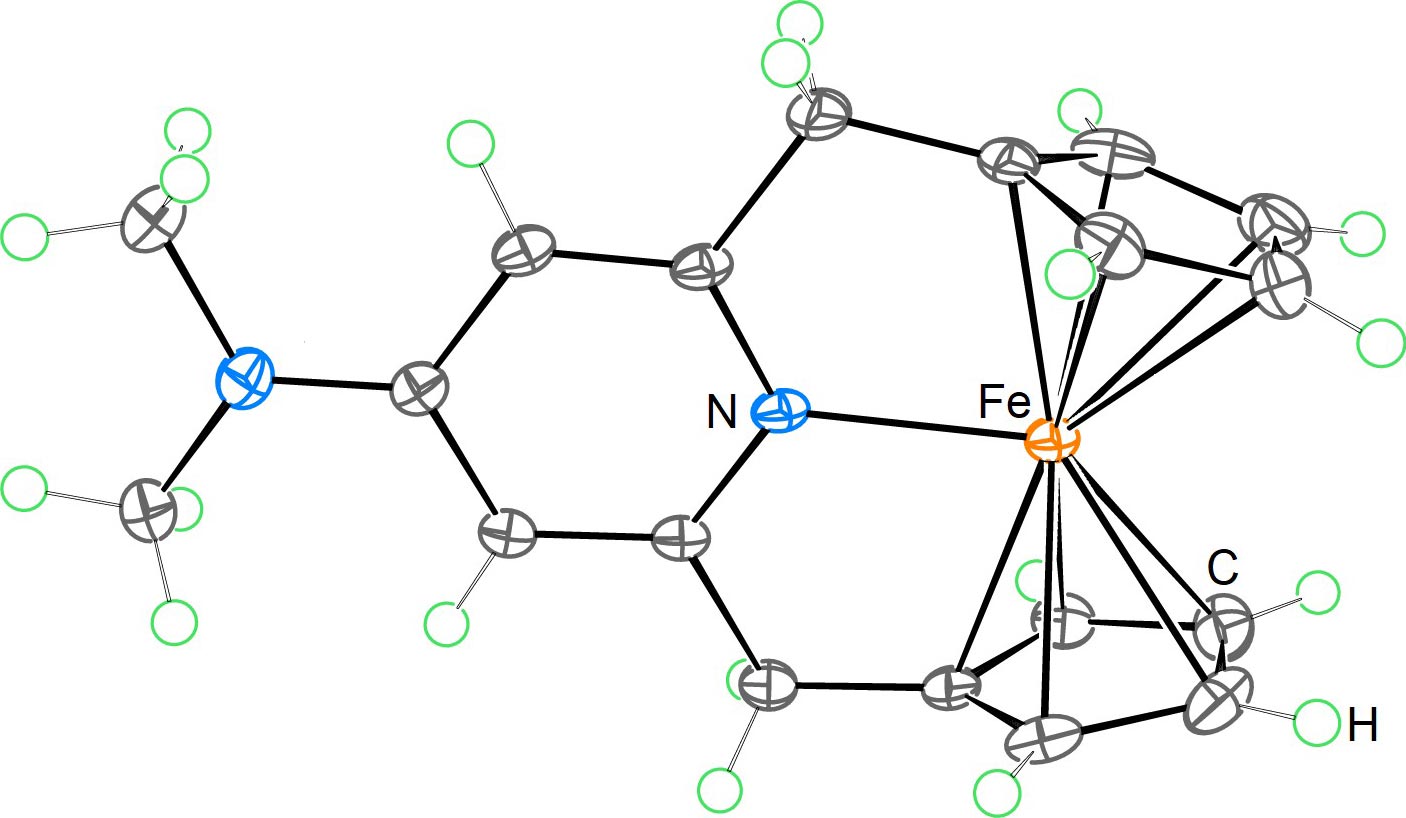
    Molecular Structure of 20 Electron Ferrocene Derivative With Fe–N Bond
    Molecular structure of the new 20-electron ferrocene derivative, highlighting nitrogen (blue), iron (orange), hydrogen (green), and carbon (grey) atoms. Credit: Modified from Figure 2c in Takebayashi, S., Ariai, J., Kartashov, S.V. et al. From 18- to 20-electron ferrocene derivatives via ligand coordination. Nature Communications (2025). https://doi.org/10.1038/s41467-025-61343-7. (CC BY 4.0)

    This finding is notable because, although ferrocene is commonly used in redox reactions (processes involving electron transfer), it has traditionally been restricted to a narrow set of oxidation states. By forming an Fe–N bond in this new compound, the researchers expanded ferrocene’s ability to gain or lose electrons, opening up new possibilities for its use in catalysis and functional materials. Applications could range from energy storage systems to chemical manufacturing.

    Learning how to push beyond the traditional rules of chemical stability allows scientists to design molecules with specific, desirable properties. These discoveries may pave the way for progress in sustainable chemistry, including the creation of environmentally friendly catalysts and advanced new materials.

    A platform for future innovation

    Ferrocene derivatives have already made their way into various technologies, from solar cells and pharmaceuticals to medical devices and advanced catalysts. By expanding the conceptual toolkit available to chemists, this latest breakthrough could help build on and diversify these applications while inspiring entirely new ones.

    The Organometallic Chemistry Group at OIST focuses on uncovering the fundamental principles that govern metal-organic interactions and applying them to real-world challenges. The team has a special interest in unconventional compounds that defy standard chemical rules, such as the 20-electron ferrocene derivative reported in this study.

    Reference: “From 18- to 20-electron ferrocene derivatives via ligand coordination” by Satoshi Takebayashi, Jama Ariai, Sergey V. Kartashov, Robert R. Fayzullin, Tomoko Onoue, Ko Mibu, Hyung-Been Kang and Noriko Ishizu, 7 July 2025, Nature Communications.
    DOI: 10.1038/s41467-025-61343-7

    Never miss a breakthrough: Join the SciTechDaily newsletter.
    Follow us on Google and Google News.

    Catalysts Electrons Materials Science Molecular Chemistry Okinawa Institute of Science and Technology Graduate University Popular
    Share. Facebook Twitter Pinterest LinkedIn Email Reddit

    Related Articles

    Scientists Create Powerful New Form of Aluminum That Could Replace Rare Earth Metals

    Weak Forces, Super Materials: The Breakthrough Changing Material Science

    Entirely New, Inexpensive Catalyst Speeds the Production of Oxygen From Water

    Realization of Omnipotent Catalysts Expected After Breakthrough Creation of Super Multi-Element Catalyst

    High Efficiency at Low Cost: New Catalyst Moves Seawater Desalination, Hydrogen Production Closer to Commercialization

    Scientists Turn Plastic Waste Into Valuable Chemicals With Sunlight

    Scientists Synthesize an Entirely New Form of Silicon

    Scientists Examine Platinum-Based Catalyst Design

    Working to Recycle Greenhouse Gases

    1 Comment

    1. Boba on July 16, 2025 7:01 am

      It may challenge our knowledge of the principles, not the principles themselves.

      Reply
    Leave A Reply Cancel Reply

    • Facebook
    • Twitter
    • Pinterest
    • YouTube

    Don't Miss a Discovery

    Subscribe for the Latest in Science & Tech!

    Trending News

    Even Occasional Binge Drinking May Triple Liver Damage Risk

    Liftoff! NASA’s Artemis II Launch Sends Astronauts Around the Moon for First Time in 50 Years

    Scientists Discover New Way To Eliminate “Zombie Cells” Driving Aging

    This New Quantum Theory Could Change Everything We Know About the Big Bang

    This One Vitamin May Help Protect Your Brain From Dementia Years Later

    Stopping Weight-Loss Drugs Like Ozempic Can Quickly Erase Heart Benefits

    A 500-Million-Year-Old Surprise Is Forcing Scientists to Rethink Spider Evolution

    Coffee and Blood Pressure: What You Need To Know Before Your Next Cup

    Follow SciTechDaily
    • Facebook
    • Twitter
    • YouTube
    • Pinterest
    • Newsletter
    • RSS
    SciTech News
    • Biology News
    • Chemistry News
    • Earth News
    • Health News
    • Physics News
    • Science News
    • Space News
    • Technology News
    Recent Posts
    • Tiny 436-Million-Year-Old Fish Fossil Rewrites the Origins of Vertebrates
    • 1,800 Miles Down: Scientists Uncover Mysterious Movements at the Edge of Earth’s Core
    • Scientists Uncover Earth’s Hidden “Gold Kitchen” Beneath the Ocean Floor
    • You Don’t Need To Be Rich: New Study Reveals a Simple Life Is the Real Secret to Happiness
    • “Crazy Dice” Help Scientists Prove Only One 150-Year-Old Theory About Randomness Works
    Copyright © 1998 - 2026 SciTechDaily. All Rights Reserved.
    • Science News
    • About
    • Contact
    • Editorial Board
    • Privacy Policy
    • Terms of Use

    Type above and press Enter to search. Press Esc to cancel.