
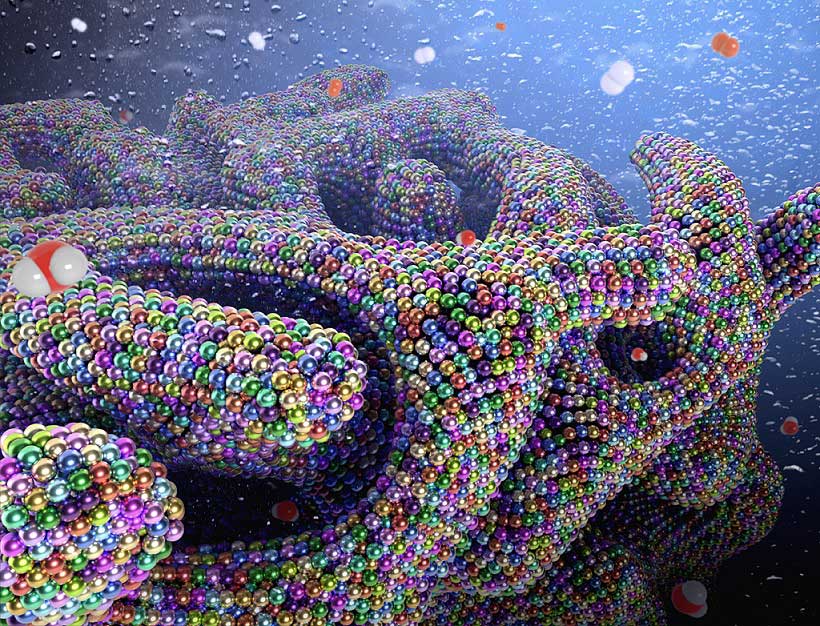
Simple creation of a super multi-element catalyst homogeneously containing 14 elements.
A research group in Japan has successfully developed a “nanoporous super multi-element catalyst”[1] that contains 14 elements[2] which are mixed uniformly at the atomic level and used as a catalyst. A high-entropy alloy composed of 10 or more elements may act as a catalyst to exhibit” omnipotency and versatility” being able to freely modify its morphology and become active according to the reaction field. However, so far, it has not been easy to produce entropy alloys composed of more than 10 elements. The reason is the existence of combinations of some elements that are hard to be mixed, like water and oil.
A joint research group led by Research Associate Cai ZeXing and Professor Takeshi Fujita at School of Environmental Science and Engineering, Kochi University of Technology, and Professor Masahiro Miyauchi at School of Materials Science and Engineering, Tokyo Institute of Technology has developed a “nanoporous super multi-element catalyst” by a method called de-alloying[3] via the selective corrosion and elusion of a specified element from the alloy. The fabrication method is simple: an aluminum alloy containing 14 elements is prepared, and the nanoporous super multi-element catalyst is manufactured by preferential dissolution of aluminum using an alkaline solution. It has been found that, by using this method, while creating a nanoporous structure with a large specific surface area (surface area per unit mass of material) with a pore size of about 5 nanometers, elements other than aluminum that do not dissolve in the alkaline solution are accumulated to be aggregated in the form of a solid solution alloy[4] in which the 14 elements are uniformly distributed at the atomic level.

Further, the nanoporous super multi-element catalyst was found to show excellent properties as an electrode material for water electrolysis due to the multi-element superposition effect (cocktail effect)[5]. As this catalyst contains many different elements, it is expected to be developed into an omnipotent and versatile catalyst in the future.
This research is conducted under the JST’s Strategic Basic Research Programs CREST (Team type), Research Area: “Innovative catalysts and creation technologies for the utilization of diverse natural carbon resources.”
Explanation of Terms
1. Nanoporous super multi-element catalyst
A catalyst wherein at least 10 elements are uniformly distributed in a sponge structure (porous structure comprising nanosized pores) in which the nanosized pores are randomly connected.
2. 14 elements
Aluminum (Al), Silver (Ag), Gold (Au), Cobalt (Co), Copper (Cu), Iron (Fe), Iridium (Ir), Molybdenum (Mo), Nickel (Ni), Palladium (Pd), Platinum (Pt), Rhodium (Rh), Ruthenium (Ru), Titanium (Ti).
3. De-alloying
A method of selectively eroding and eluting specific elements from an alloy. It is also called selective corrosion.
4. Solid solution alloy
An alloy in which two or more elements are mutually melted in each other to form a uniform solid phase.
5. Multi-element superposition effect (cocktail effect)
Manifestation of a characteristic feature resulting from nonlinear interaction between various constituent atoms. It is expected to reveal particular and outstanding catalytic properties so far inexistent in conventional alloy catalysts.
Reference: “Nanoporous ultra-high-entropy alloys containing fourteen elements for water splitting electrocatalysis” by Ze-Xing Cai, Hiromi Goou, Yoshikazu Ito, Tomoharu Tokunaga, Masahiro Miyauchi, Hideki Abe and Takeshi Fujita, 20 August 2021, Chemical Science.
DOI: 10.1039/D1SC01981C
Never miss a breakthrough: Join the SciTechDaily newsletter.
Follow us on Google and Google News.
1 Comment
Absolutely cool. Aluminum, basically solid electricity, is the one thing to rule them all, the one thing to bind them. And in the end winds up like the Wicked Witch of the West.