
Close Menu
    Facebook X (Twitter) Instagram
    SciTechDaily
    • Biology
    • Chemistry
    • Earth
    • Health
    • Physics
    • Science
    • Space
    • Technology
    Facebook X (Twitter) Pinterest YouTube RSS
    SciTechDaily
    Home»Chemistry»Weak Forces, Super Materials: The Breakthrough Changing Material Science
    Chemistry

    Weak Forces, Super Materials: The Breakthrough Changing Material Science

    By Institute for Integrated Cell-Material Sciences, Kyoto UniversityMarch 18, 2025No Comments2 Mins Read
    Facebook Twitter Pinterest Telegram LinkedIn WhatsApp Email Reddit
    Share
    Facebook Twitter LinkedIn Pinterest Telegram Email Reddit
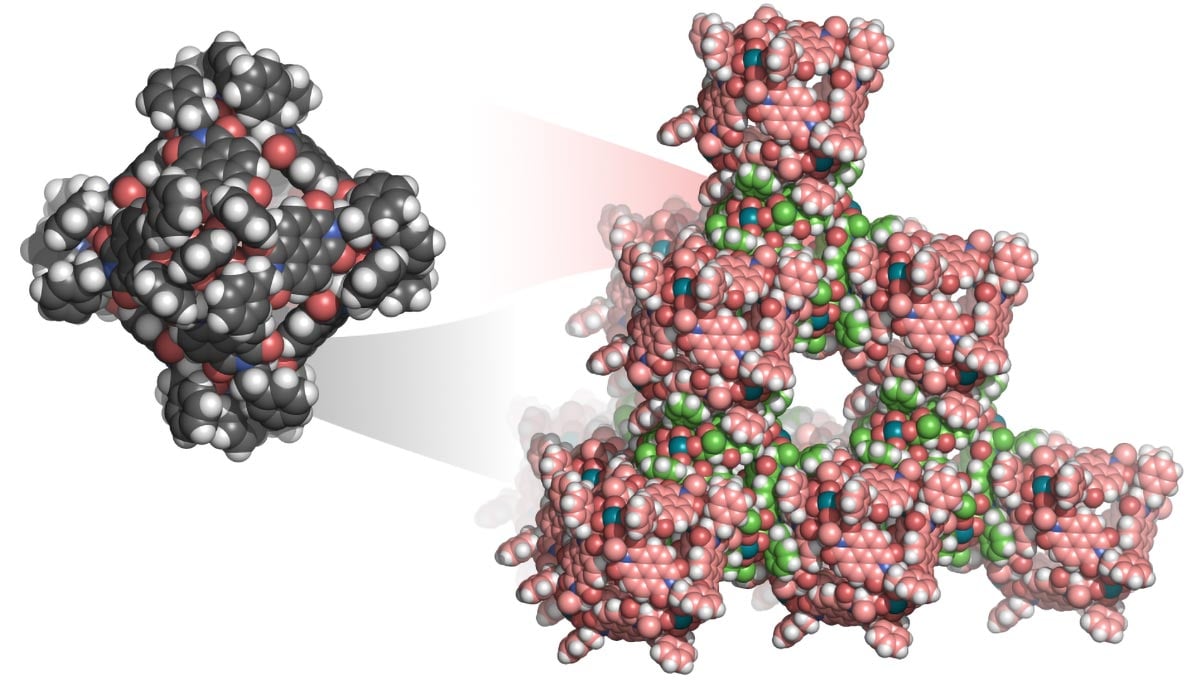
    Crystal Structure of Van der Waals Open Framework-1 (WaaF-1)
    Crystal structure of van der Waals open framework-1 (WaaF-1). Credit: Kyoto University iCeMS

    A team from Kyoto University has developed novel three-dimensional van der Waals frameworks that showcase exceptional stability and porosity.

    These materials, suitable for applications like gas storage and carbon capture, overturn previous beliefs about the limitations of van der Waals forces and offer a scalable, recyclable solution in material engineering.

    Groundbreaking Advancements in Materials Science

    Researchers at Kyoto University have made a major breakthrough in materials science by developing the first-ever three-dimensional van der Waals open frameworks (WaaFs). This discovery challenges the long-standing belief that van der Waals forces are too weak to support stable open-framework materials, proving instead that they can create highly porous and durable structures.

    Challenging Old Assumptions

    Published today (March 18) in Nature Chemistry, the study introduces a method that uses octahedral metal-organic polyhedra (MOPs) as building blocks to form WaaFs. These frameworks are remarkably stable, highly porous, and can be reversibly assembled, making them ideal for applications in gas storage, separation, and catalysis. Despite previous doubts about the strength of van der Waals interactions, WaaFs demonstrate robust three-dimensional structures that remain intact at temperatures up to 593 K and boast surface areas exceeding 2,000 m2/g, making them efficient for industrial use.

    High Stability and Industrial Potential

    A key advantage of WaaFs is their ability to be disassembled and reassembled in solution, enabling scalable production and recyclability. Their adjustable porosity and strong chemical stability make them highly promising for applications such as gas storage, carbon capture, water harvesting, and catalytic processes.

    Expert Insights on the Future of WaaFs

    Professor Shuhei Furukawa of Kyoto University’s Institute for Integrated Cell-Material Sciences (iCeMS) emphasized the broader impact of this breakthrough, stating, “Our research challenges the long-standing assumption that van der Waals forces are too weak to construct stable frameworks. Through careful supramolecular design, we have demonstrated that these interactions can be harnessed to create robust and highly porous materials with practical applications.”

    Mr. Shun Tokuda, lead researcher of the study, added, “This discovery redefines the design principles of porous materials, showcasing a new approach to material engineering that enables both scalability and recyclability. WaaFs offer an innovative solution for gas separation, storage, and beyond.”

    Reference: “Three-dimensional van der Waals open frameworks” by Shun Tokuda, and Shuhei Furukawa, 18 March 2025, Nature Chemistry.
    DOI: 10.1038/s41557-025-01777-0

    Never miss a breakthrough: Join the SciTechDaily newsletter.
    Follow us on Google and Google News.

    Carbon Capture Catalysts Kyoto University Materials Science Molecular Chemistry
    Share. Facebook Twitter Pinterest LinkedIn Email Reddit

    Related Articles

    Scientists Create Powerful New Form of Aluminum That Could Replace Rare Earth Metals

    Scientists Create the Impossible: New Compound Challenges Fundamental Principle of Chemistry

    Shape-Shifting Membrane Transforms Carbon Capture Technology

    Catalyst Zeolite Nanopores Discovery May Lead to New Materials for Clean Energy and Carbon Capture

    New Discovery Makes Valuable Chemicals Using Excess Carbon Dioxide in the Atmosphere

    Chemists Create Flexible Polymer Gels From Caffeine

    New Catalyst Promotes Carbon Dioxide Conversion into Fuels

    UJI Patents New Graphene-Based Catalysts

    Scientists Examine Platinum-Based Catalyst Design

    Leave A Reply Cancel Reply

    • Facebook
    • Twitter
    • Pinterest
    • YouTube

    Don't Miss a Discovery

    Subscribe for the Latest in Science & Tech!

    Trending News

    Scientists Discover How Coffee Impacts Memory, Mood, and Gut Health

    Why Did the Neanderthals Disappear? Scientists Reveal Humans Had a Hidden Advantage

    Physicists Propose Strange Experiment Where Time Goes Quantum

    Magnesium Magic: New Drug Melts Fat Even on a High-Fat, High-Sugar Diet

    Weight-Loss Drugs Like Ozempic May Come With an Unexpected Cost

    Mezcal “Worm” in a Bottle Mystery: DNA Testing Reveals a Surprise

    New Research Reveals That Your Morning Coffee Activates an Ancient Longevity Switch

    This Is What Makes You Irresistible to Mosquitoes

    Follow SciTechDaily
    • Facebook
    • Twitter
    • YouTube
    • Pinterest
    • Newsletter
    • RSS
    SciTech News
    • Biology News
    • Chemistry News
    • Earth News
    • Health News
    • Physics News
    • Science News
    • Space News
    • Technology News
    Recent Posts
    • Harvard Scientists Reveal Secret Structure Behind How You Smell
    • Scientists Just Discovered the Hidden Trick That Keeps Your Cells Alive
    • This Simple Movement Could Be Secretly Cleaning Your Brain
    • Male Birth Control Breakthrough: Scientists Find Way To Turn Sperm Production Off and Back On
    • A Common Vitamin Could Hold the Key to Treating Fatty Liver Disease
    Copyright © 1998 - 2026 SciTechDaily. All Rights Reserved.
    • Science News
    • About
    • Contact
    • Editorial Board
    • Privacy Policy
    • Terms of Use

    Type above and press Enter to search. Press Esc to cancel.