
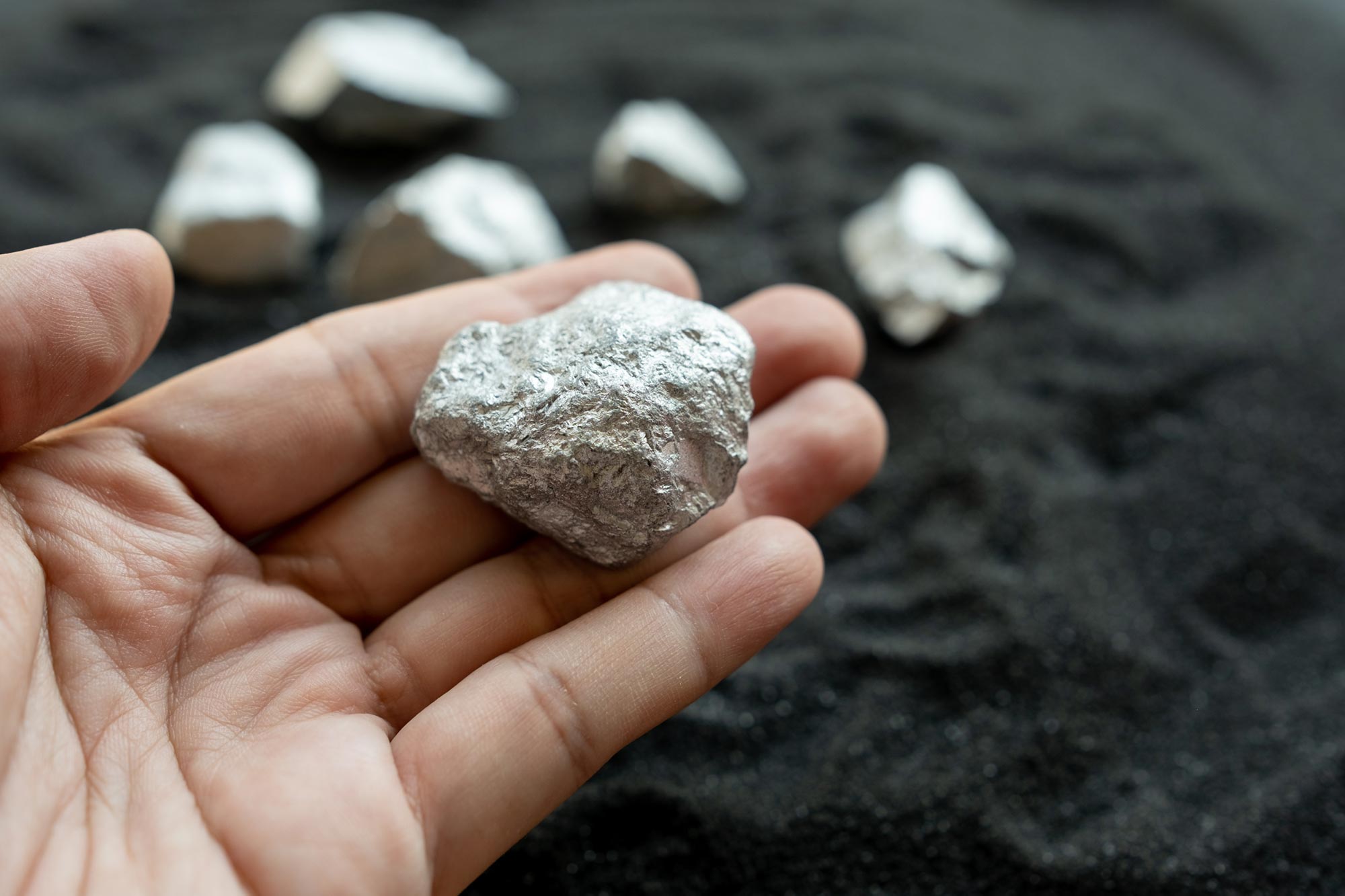
Researchers have uncovered an unusual new form of aluminium that challenges long-held assumptions about how this common metal behaves.
Researchers at King’s College London have identified an unusual new form of aluminum, one of the most abundant metals in Earth’s crust. The discovery points to a much less expensive and more sustainable substitute for rare earth metals that are widely used in modern technology and industry.
Dr. Clare Bakewell, a senior lecturer in the Department of Chemistry, led the study. Her team created highly reactive aluminum-based molecules capable of breaking some of the strongest chemical bonds. Their findings, published in Nature Communications, also describe molecular structures that have never been observed before, opening the door to new types of chemical reactivity.
A central achievement of the research is the first reported example of a cyclotrialumane. This compound consists of three aluminum atoms linked together in a triangular arrangement. The three-atom structure shows an unusual level of reactivity while remaining intact when dissolved in different solutions.
That stability allows it to participate in a variety of chemical processes. Among them are the splitting of dihydrogen and the controlled insertion and chain growth of ethene, a 2-carbon hydrocarbon that serves as a key building block in chemical manufacturing.
Reducing Dependence on Precious Metals
Metals play an essential role in producing both bulk and specialty chemicals. However, many industrial reactions, especially those involving catalysis, depend on precious metals such as platinum. Mining and refining these materials is costly and can cause significant environmental harm.
Scientists have long been searching for alternative metals to use in chemical transformations. Dr. Clare Bakewell said: “Transition metals are the workhorses of chemical synthesis and catalysis – but many of the most useful are becoming increasingly difficult to access and extract – often being located in regions of political instability, increasing the demand and price.
“Chemists have been looking towards more common elements from the periodic table, and we chose aluminum, as it’s super abundant, making it ~20,000 times less expensive than precious metals such as platinum and palladium.”
Beyond Mimicking Transition Metals
Beyond designing aluminum compounds for synthetic applications, the team has uncovered entirely new reaction pathways.
Dr. Bakewell said, “What’s special about this work, is that we’re pushing the boundaries of chemical knowledge. Most excitingly, we can use this aluminum trimer to build completely new compounds with levels of reactivity that have never been observed before – these include the 5- and 7-membered aluminum and carbon rings formed through reaction with ethene. These capabilities go beyond the transition metals we were originally trying to mimic, to the forefront of chemical research.”
Bakewell believes this chemistry could enable scientists to invent new reaction types and assemble larger molecular structures with distinctive properties. Such advances may ultimately support the development of new materials and industrial products.
She said, “We’re very much in the exploratory phase, and we’re just at the start of beginning to unlock the capability of these earth-abundant materials.
“But from what we’ve seen already, this chemistry could support a transition to cleaner, greener and cheaper chemical production, whilst making new discoveries along the way.”
Reference: “A neutral cyclic aluminium (I) trimer” by Imogen Squire, Matthew de Vere-Tucker, Michelangelo Tritto, Lygia Silva de Moraes, Tobias Krämer and Clare Bakewell, 30 January 2026, Nature Communications.
DOI: 10.1038/s41467-026-68432-1
Never miss a breakthrough: Join the SciTechDaily newsletter.
Follow us on Google and Google News.
31 Comments
thanks
One word missing. . NO
Didn’t they discover this ‘clear aluminum’ super strong, better in the star trek episode about 20 years or so ago.
interesting how all of the sudden, one of the most reactive metals, becomes so unreactive.
breaking di hydrogen. oh no!! those dihydrogen monoxide molecules, the monoxide will kill us all for sure..
Have another cup of troll ignorance juice. Clearly you don’t understand the significance of the use of atomic hydrogen rather than molecular hydrogen in clean energy technologies. The article did not mention water, your ignorance did. Clear aluminum is a ceramic completely unrelated to the material discussed in this article. Comment on technology you understand, like moss growth on the underside of the bridge.
The title of the article suggested a new form of aluminum could replace rare earth metals. The author did not understand his own title. There is no mention of rare earth metals. The article refers to a new unique aluminium ring structure in organic compounds that could replace platinum or other catalysts. Where do the comments about plastic aluminium come from. This is about reaction intermediates not materials science. O
No one mentions rare-earth metals (which are not rare), the work and the paper refer to rare on earth platinum group metals.
No little Waterboy. We need products in order to live our lives. We’re not gonna live in teepees. Back on board with reality.
How many years until they “discover” the different types of cancer this will cause?
Remember when scientists “discovered” plastic?
I’ll take a tipi any day
Transparent aluminum. “Hello computer .”
I’ll never forget that scene. Great comment!
The Chinese have already stolen your research and working on it
FWIW, conspiracy theory is boring.
They mean aluminium plastic… cause there’s not new aluminum material as such just same aluminum with added plastic (definitely what picture show 😉) it’s true it’s more workable and better for cooking and stuff and there is very high amount of plastic on earth and plastic is cheap…
It could save the world. Or destroy it.
Wonder if they used my research experiment in aluminum carbon bonds.
I remember the alumni in that Star Trek episode as being transparent.
great job guys 😃
Can we now make Transparent Aluminium?
Transparent aluminum. “Hello computer .”
I Believe Dr Bakewell may be on a path of wisdom and molecular structure similar to what someone like Enoch would understand
Because the research was initiated in the UK, we’re expecting the final products to be named as compounds of ALUMINIUM.
You’re welcome.
I think this technology may have big impacts on our spacecrafts,airships and anything that may need a light weight shell. I think these scientists may go far with this way of thinking. I know some metals are made to be more flexible and stronger with different elements added or extracted from them. Good work my hat is off to all who participates in improving mankind’s life in a matter of Discovery.
The title of the article suggested a new form of aluminum could replace rare earth metal. The author did not understand his own title. There is no mention of rare earth metals. The article refers to a new unique aluminium ring structure in organic compounds that could replace platinum or other catalysts. Where do the comments about plastic aluminium come from. This is about reaction intermediates not materials science.
Do you understand the article? It says rare earth, not rare-earth.
Change for the new world , it needs it.
Good work and all the best!
It is an interesting organic complex, but the chemistry takes off from petrol (toluene) so it is both environmentally and medically problematic.
Anyway, we need more tools in our toolbox, and replacing metals that are rare on Earth (like the platina group) seems useful.
The subed did not understand the article. The article is correct.
The subed did not understand the article. The article is correct. Also, US scifi is not science.
Surgeon general warning ⚠️
State of California has fund this substance may cause cancer
All things can be transparent to light of the right frequency. You eyes only see a small subset of frequencies.