
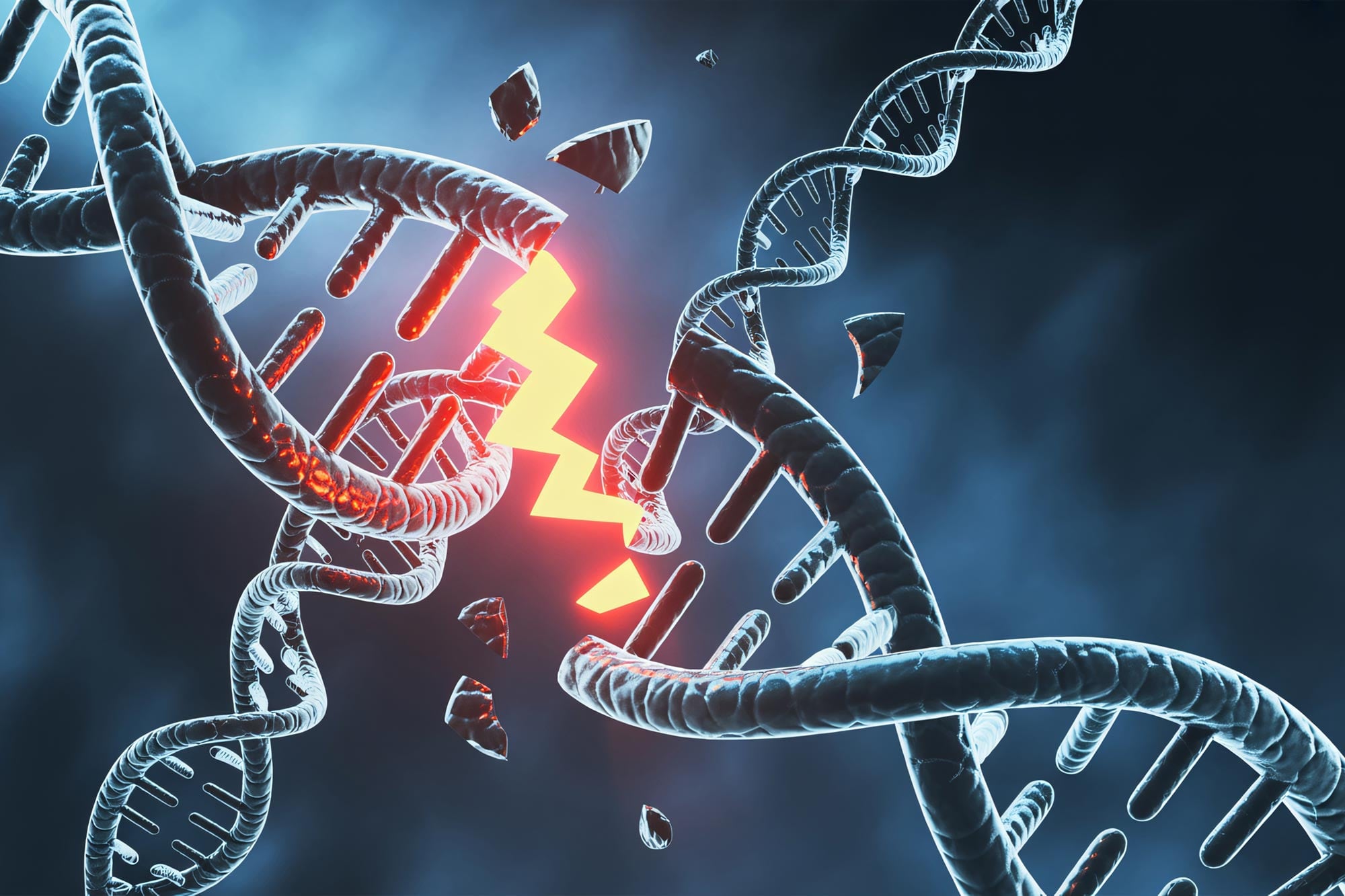
Scientists discovered that building a healthy brain involves an unexpected step: young neurons routinely break and rapidly repair their own DNA.
As the brain develops, newly formed nerve cells must travel through tightly packed tissue to reach the locations where they will become part of the brain’s neural networks. That demanding journey turns out to come with an unexpected cost.
A new study published in Nature by researchers at Kyoto University’s Institute for Integrated Cell-Material Sciences (WPI-iCeMS) and collaborating institutions found that this migration causes widespread DNA damage in young neurons. Surprisingly, the researchers discovered that this damage is not a sign that something has gone wrong. Instead, it appears to be a normal part of brain cortex development, with healthy cells repairing the damage before it can cause lasting harm.
The DNA damage takes the form of double-strand breaks, in which both strands of the DNA double helix are cut. These are among the most serious types of DNA damage because they can lead to mutations or even cell death if left unrepaired.
“The developing brain appears to have evolved to tolerate and repair the neuronal damage efficiently,” says Professor Mineko Kengaku of WPI-iCeMS, who led the study. “But understanding the limits of that tolerance—and what happens when repair is incomplete—brings us closer to understanding a range of neurological conditions.”
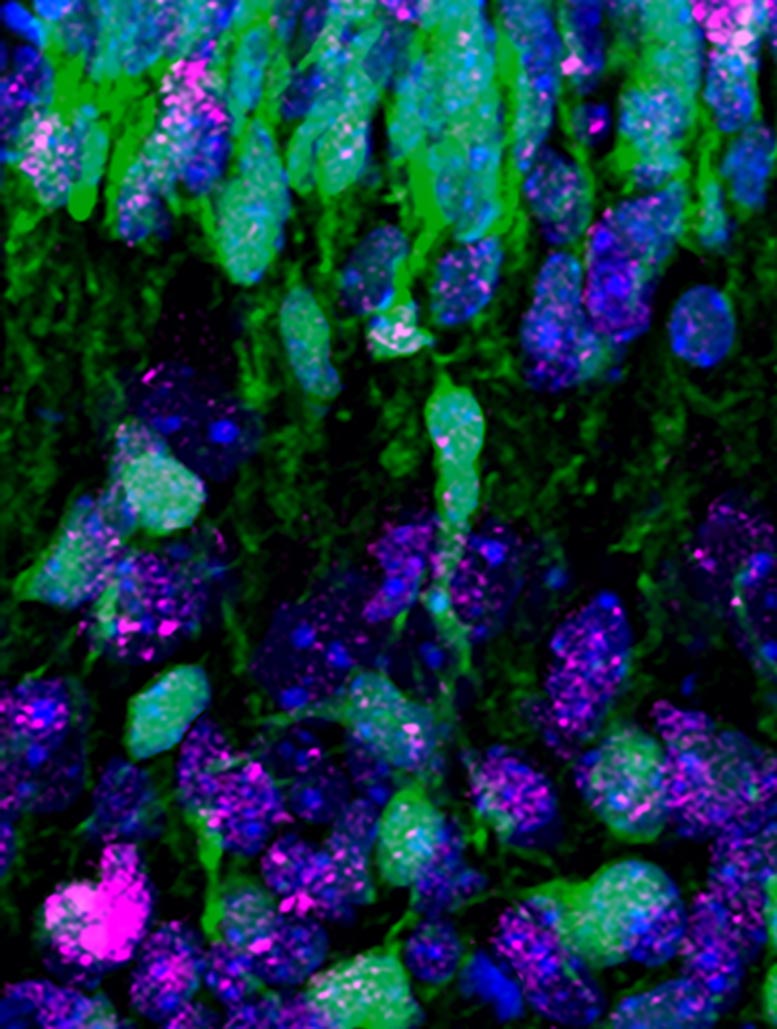
Tracking DNA Damage During Neuron Migration
To investigate how this damage occurs, the researchers recreated the physical journey of developing neurons using tiny laboratory microchannels that mimic the narrow passages found in the growing brain.
As neurons squeezed through these confined spaces, fluorescent markers showed DNA double-strand breaks appearing inside the cells. After the neurons completed the journey, those signals gradually disappeared. Most of the damage had been repaired within 24 hours, and the neurons continued functioning normally.
How the Brain Repairs Dangerous DNA Breaks
The team identified the source of the damage as Topoisomerase IIβ, an enzyme that normally makes temporary cuts in DNA to relieve twisting and mechanical strain created during everyday cellular activity.
The process is similar to cutting a twisted cable so it can unwind before reconnecting it. Under the physical stress of migrating through tight spaces, however, the enzyme can become trapped before completing the repair, leaving broken DNA ends behind.
Cells fix these breaks using a repair mechanism called non-homologous end joining, which reconnects the broken DNA strands.
The researchers also found that this process is very different from what happens in certain cancer cells moving through the same types of microchannels. In cancer cells, DNA damage is more random and often disrupts important genes, reducing cell function or causing cell death. In neurons, the breaks occur mainly in less critical parts of the genome, allowing the cells to continue developing normally.
What Happens When DNA Repair Fails?
To understand the importance of this repair system, the scientists created mice whose newly formed cerebellar neurons lacked Ligase 4, an essential DNA repair enzyme.
Although the animals developed normally, they gradually began showing mild balance problems during early adulthood. These symptoms resemble those seen in human genome instability syndromes that affect the cerebellum, suggesting that even small failures in DNA repair can have long-term consequences.
Clues to Brain Diversity and Neurological Disease
The findings also raise intriguing questions about whether these temporary DNA breaks help create subtle genetic differences between individual neurons and whether those differences could influence neurodevelopmental or neurodegenerative diseases.
“It shifts how we think about the neuronal genome,” says Professor Kengaku. “All neurons originate from the same DNA, but DNA damage and repair can introduce small genetic differences between individual neurons through a small mechanical journey. Some of that history may be written into the genome itself.”
Reference: “Confined migration induces non-lethal DNA damage in developing neurons” by Zhejing Zhang, Andres Canela, Junko Kurisu, Peilin Zou, Takumi Kawaue, Naotaka Nakazawa, Noriko Takeda, Mai Saeki, Masaki Utsunomiya, Merve Bilgic, Fumiyoshi Ishidate, Gianluca Grenci, Takahiro Furuta, Yusuke Kishi, Hiroyuki Sasanuma and Mineko Kengaku, 17 June 2026, Nature.
DOI: 10.1038/s41586-026-10648-8
The research was carried out through a collaboration between Kyoto University, the University of Tokyo, the University of Osaka, the National University of Singapore, and the Tokyo Metropolitan Institute of Medical Science.
Never miss a breakthrough: Join the SciTechDaily newsletter.
Follow us on Google and Google News.