
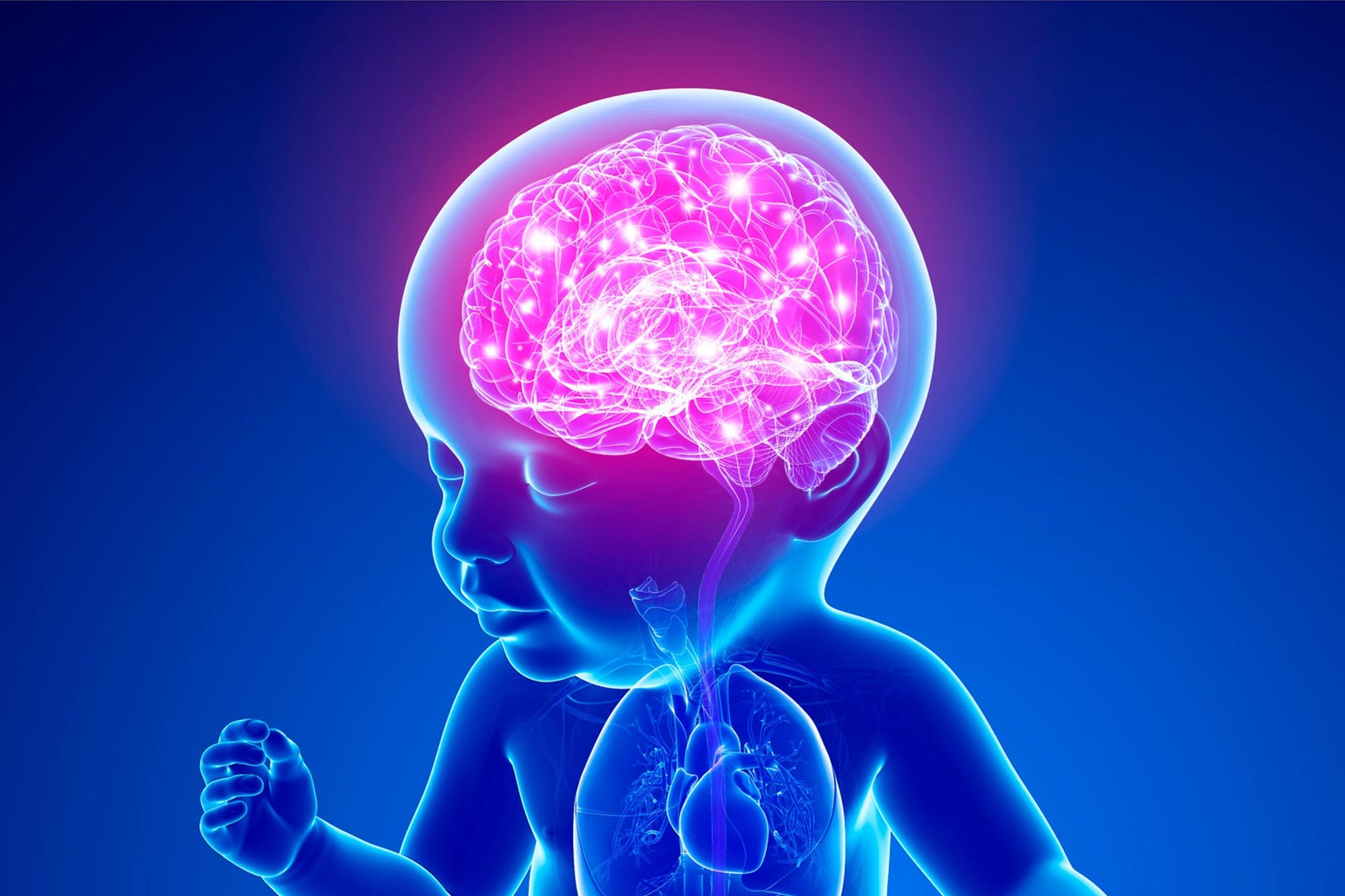
Modern brain data does not support the classic explanation for infant helplessness.
A new study suggests that babies’ brains are not as immature as previously believed; instead, they utilize their period of postnatal ‘helplessness’ to develop foundational models similar to those that drive generative Artificial Intelligence.
The study finds for the first time that the classic explanation for infant helplessness is not supported by modern brain data. The research was led by a Trinity College Dublin neuroscientist and published in the journal Trends in Cognitive Sciences.
Compared to many animals, humans are helpless for a long time after birth. Many animals, such as horses and chickens, can walk on the day they are born. This protracted period of helplessness puts human infants at risk and places a huge burden on the parents, but surprisingly has survived evolutionary pressure.
Insights from a Cross-Species Study
“Since the 1960s scientists have thought that the helplessness exhibited by human babies is due to the constraints of birth. The belief was that with big heads human babies have to be born early, resulting in immature brains and a helpless period that extends up to one year of age. We wanted to find out why human babies were helpless for such a long period,” explains Professor Rhodri Cusack, Professor of Cognitive Neuroscience, and lead author of the paper.
The research team comprised Prof. Cusack, who measures the development of the infant brain and mind using neuroimaging; Prof. Christine Charvet, Auburn University, USA, who compares brain development across species; and Dr. Marc’Aurelio Ranzato, a senior AI researcher at DeepMind.
“Our study compared brain development across animal species. It drew from a long-standing project, Translating Time, that equates corresponding ages across species to establish that human brains are more mature than many other species at birth,” says Prof. Charvet.
The researchers used brain imaging and found that many systems in the human infant’s brain are already functioning and processing the rich streams of information from the senses. This contradicts the long-held belief that many infant brain systems are too immature to function.
The team then compared learning in humans with the latest machine learning models, where deep neural networks benefit from a ‘helpless’ period of pre-training.
In the past, AI models were directly trained on tasks for which they were needed for example a self-driving car was trained to recognize what they see on a road. But now models are initially pre-trained to see patterns within vast quantities of data, without performing any task of importance. The resulting foundation model is subsequently used to learn specific tasks. It has been found this ultimately leads to quicker learning of new tasks and better performance.
Implications for Future AI Development
“We propose that human infants similarly use the ‘helpless’ period in infancy to pre-train, learning powerful foundation models, which go on to underpin cognition in later life with high performance and rapid generalization. This is very similar to the powerful machine learning models that have led to the big breakthroughs in generative AI in recent years, such as OpenAI’s ChatGPT or Google’s Gemini,” Prof. Cusack explained.
The researchers say that future research on how babies learn could well inspire the next generation of AI models.
“Although there have been big breakthroughs in AI, foundation models consume vast quantities of energy and require vastly more data than babies. Understanding how babies learn may inspire the next generation of AI models. The next steps in research would be to directly compare learning in brains and AI,” he concluded.
Reference: “Helpless infants are learning a foundation model” by Rhodri Cusack, Marc’Aurelio Ranzato and Christine J. Charvet, 4 June 2024, Trends in Cognitive Sciences.
DOI: 10.1016/j.tics.2024.05.001
This research was supported by the European Research Council.
Never miss a breakthrough: Join the SciTechDaily newsletter.
Follow us on Google and Google News.
1 Comment
Don’t tell Sam Altman, he’ll throw a temper tantrum.