
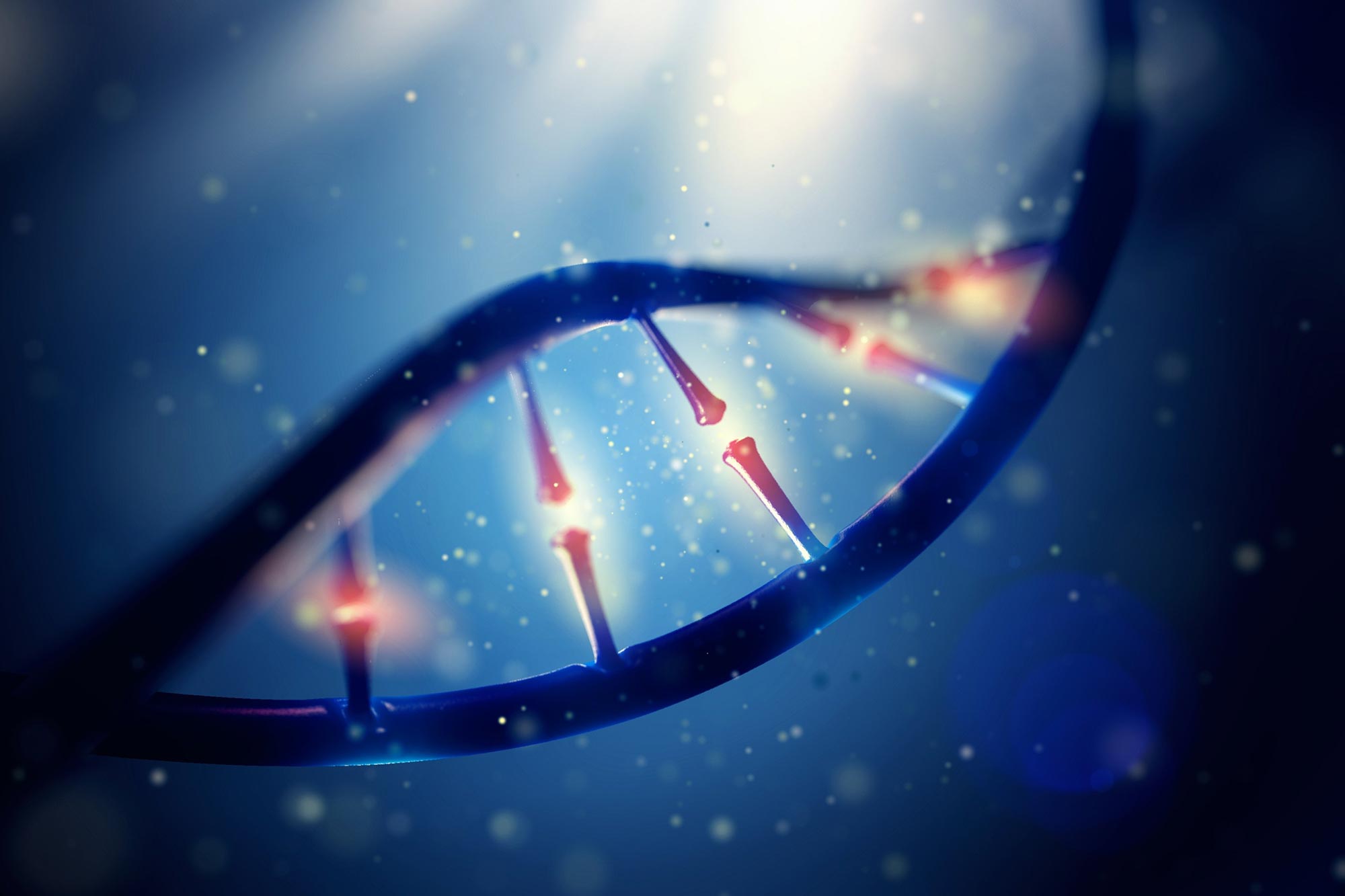
Transposons, specifically LINE-1 elements, previously regarded as genomic parasites, play a pivotal role in early human development by regulating gene expression and ensuring embryonic progression.
These findings challenge our understanding of transposons, highlighting their critical involvement in developmental stages and potential implications for regenerative medicine and disease treatment.
Unveiling Transposons’ Role in Human Development
Sinai Health researchers have discovered that a critical transition in early human development is regulated not by our own genes, but by DNA elements called transposons that can move around the genome.
This remarkable discovery challenges our previous understanding of these elusive DNA segments, illuminating their impact on human development and disease.
Rethinking Transposons: From Parasites to Protectors
“People tend to think of transposons as akin to viruses where they hijack our cells for the sole purpose of propagating themselves,” says study’s senior co-author Dr. Miguel Ramalho-Santos, Senior Investigator at the Lunenfeld-Tanenbaum Research Institute (LTRI), part of Sinai Health, and Professor at the Department of Molecular Genetics at the University of Toronto.
“But here we have discovered that these elements are not mere genomic parasites but are essential for early development,” said Dr. Ramalho-Santos, who holds the Canada 150 Research Chair in Developmental Epigenetics.
The Essential Role of LINE-1 in Embryogenesis
Their study, published today (October 15) in the journal Developmental Cell, indicates that transposable elements are critical to ensure that human embryonic cells progress normally through early development, rather than going back in time.
The researchers focussed on the transposable elements known as LINE-1, for Long-Interspersed Nuclear Element-1. Unlike our own genes, which compose less than 2% of our genome, the LINE-1 elements comprise a staggering 20% of the genetic material in our cells. Some of LINE-1 elements can amplify and move around the genome, inserting themselves in new locations. Because they spread of their own accord in a way that can disrupt normal gene functions, this has earned them the moniker of “selfish DNA.”
Challenging the “Selfish DNA” Notion
For years, scientists believed these elements were mostly harmful, occasionally wreaking havoc in the genome and contributing to a variety of diseases, from hemophilia to neurological disorders and cancer.
Dr. Juan Zhang, a senior co-author and postdoctoral fellow who spearheaded the research, initially found it intriguing that LINE-1 RNA messages are abundant in early embryo. RNA message molecules are transcribed from parts of the genome that are active, indicating that LINE-1 elements are switched on in these critical early stages.
The Vital Function of LINE-1 in Early Development
“If transposons are bad and dangerous, why do we see them active in the early embryo? This is an embryo that’s just beginning its formation. Any dangerous insertion into the genome at this point is going to be propagated throughout the rest of the development of the individual,” said Dr. Zhang.
When Dr. Zhang inhibited LINE-1 expression in cultured human embryonic stem cells (ESCs), a reversal occurred, taking them back to the more primitive 8-cell stage. At this point, each of the eight cells is identical and totipotent, capable of developing into both the embryo and placenta. However, beyond this stage, while ESCs can still form all fetal cells, they become less and less able to contribute to the placenta, through which the embryo receives nutrients from the mother.
LINE-1’s Unexpected Contribution to Embryonic Development
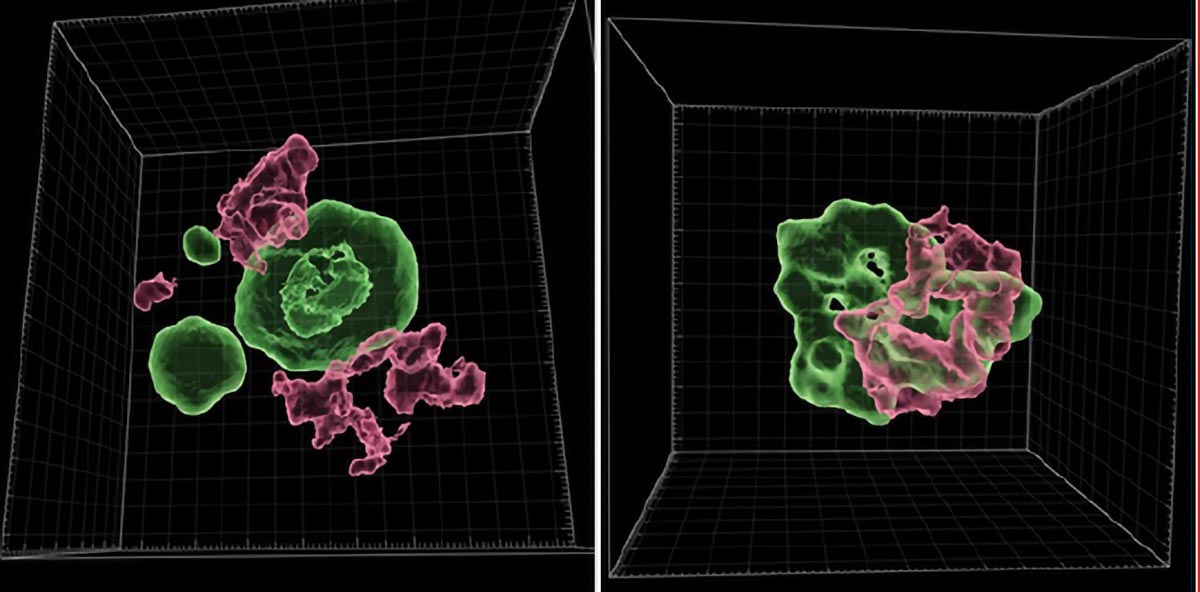
Further experiments showed that these LINE-1 message molecules act as a scaffold to organize the DNA in the 3D space of the cell’s nucleus. They help move chromosome 19—home to crucial genes for the 8-cell stage—to a gene-silencing region of the nucleus, ensuring the embryo can progress to subsequent stages without a glitch.
“We show that LINE-1 regulates gene expression at a crucial turning point where the embryo starts to specialize its cells for various functions. Our results indicate that this not an accidental occurrence but a vital evolutionary mechanism,” said Dr. Zhang.
LINE-1’s Role Beyond Genetic Jumping
Adding to the surprises, this new role of LINE-1 elements deviates from their typical behavior of jumping to new genomic locations and thereby causing potentially harmful mutations. Instead, in this critical context, LINE-1 elements exclusively foster developmental progression, a unique action that underscores their importance in early human growth.
This fundamental research has important implications for fertility treatments and the use of stem cells in regenerative medicine. Moreover, this work unveils novel roles for LINE1 that can now be explored in the disease contexts where it has been implicated, from neurological disorders to cancer.
Pioneering Research on Genomic Elements
Dr. Anne-Claude Gingras, Director of LTRI and Vice President of Research for Sinai Health has said, “This research underscores just how much more there is to learn, not only about human development but also about these enigmatic genome elements whose roles are only beginning to emerge. I congratulate my colleagues on breaking new ground with this fascinating insight into human biology, and I eagerly anticipate further discoveries as they continue their work.”
Reference: “LINE1 and PRC2 control nucleolar organization and repression of the 8C state in human ESCs” by Juan Zhang, Lamisa Ataei, Kirti Mittal, Liang Wu, Lauren Caldwell, Linh Huynh, Shahil Sarajideen, Kevin Tse, Marie-Michelle Simon, Md. Abdul Mazid, David P. Cook, Daniel Trcka, Tony Kwan, Michael M. Hoffman, Jeffrey L. Wrana, Miguel A. Esteban and Miguel Ramalho-Santos, 15 October 2024, Developmental Cell.
DOI: 10.1016/j.devcel.2024.09.024
This research was supported by funding from the Canadian Institutes for Health Research, the Great Gulf Homes Charitable Foundation, and the Medicine Design initiative at the University of Toronto.
Never miss a breakthrough: Join the SciTechDaily newsletter.
Follow us on Google and Google News.
2 Comments
Amazing. We don’t know what we don’t know. I am in complete awe thank you researchers scientists and schools for all your work
Much like discovering “junk” DNA being vital 2nd/3rd order metainformation or Epigenetics, once again we have discovered that evolution doesn’t retain things that are useless or a complete detriment to survival.
Perhaps a complete revaluation of every phenomena believed to function in that way is called for.