
A new study challenges the familiar idea that the brain evolved by stacking rational systems on top of primitive emotional ones.
A familiar dilemma sits behind countless choices: follow the careful reasoning in your head, or trust the feeling in your gut. Popular culture often turns that tension into a simple story about two brains at odds, with a rational human layer supposedly sitting on top of an older “lizard brain” built for instinct.
Brain evolution is far stranger than that. The evidence does not point to a neat stack of old parts and new parts, or to a clean divide between emotion and logic. Research published in Science Advances suggests that the deeper story is about wiring, space, and tradeoffs.
“There was a theory proposed in the ‘50s that the brain evolved in layers starting with basic bodily functions, to emotions in the reptilian brain, leading up to sophisticated reasoning in humans,” explains Nabil Imam, an assistant professor in the School of Computational Science and Engineering and a faculty member with Georgia Tech’s Institute for Neuroscience, Neurotechnology, and Society (INNS). “This is not how an evolutionary biologist would think about the problem.”
Imam’s team studied the architecture of biological brains and artificial brains to understand how different brain systems change together across species. The answer points to a kind of evolutionary balancing act. The brain has limited space and energy, so it cannot expand every system equally. Instead, evolution appears to shift resources between two broad wiring strategies that are already taking shape before birth.
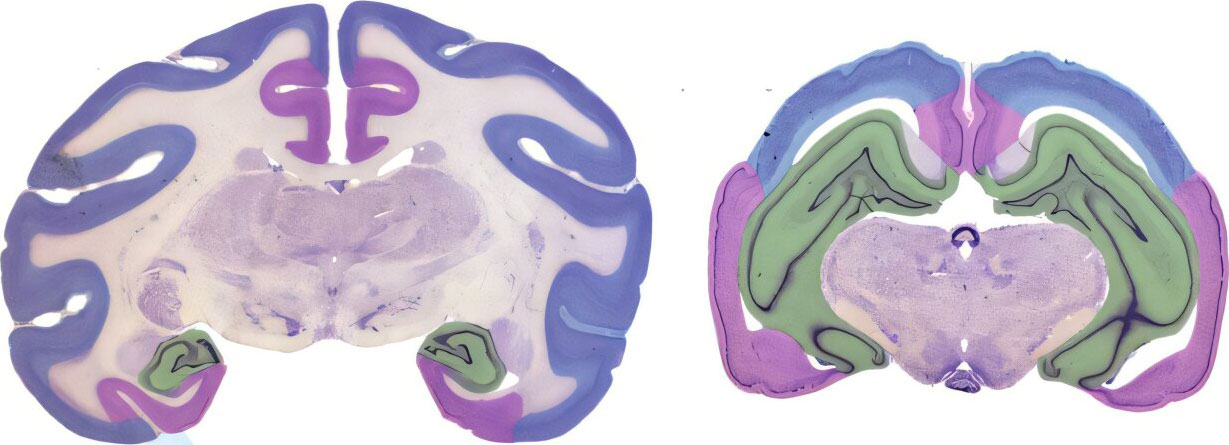
That idea helps explain a long-running puzzle in brain evolution and may also offer lessons for artificial intelligence systems that need to learn more efficiently.
Old brain layers fall apart
When people talk about a “logical” brain, they usually mean the neocortex, the outer layer of the brain involved in vision, perception, reasoning and other complex abilities. The so-called lizard brain is usually linked to the limbic system, but Imam notes that this label hides a complicated mix of functions.
“The limbic system, sometimes called the ‘reptilian brain,’ controls emotion broadly speaking — but it also has other components with distinct functions,” explains Imam. The system has separate regions for memory, smell, and navigation in addition to emotional regulation. “Why do people group all these different regions into one big system? There hasn’t been a good theory for what is common between these different circuits.”
Limbic circuits expand as one
To get past that problem, Imam’s team looked beyond what each brain region does on its own. Instead, the researchers asked how the limbic system and neocortex scale across many species. If the limbic system is truly a related network, its parts should change together rather than behave like separate organs.
That is what they found. Across species, when one part of the limbic system was larger, other limbic components tended to be larger too. At the same time, the neocortex tended to be smaller. The pattern was not random growth of individual parts.
“Rather,” says Imam, “it’s a coordinated expansion of these regions across species.”
That result reframed the limbic system. It appears less like a grab bag of emotional, memory, and smell circuits, and more like a network that expands or shrinks together over evolutionary time.
The next question was why.
Evolution reallocates brain space
Imam’s explanation begins with how brain circuits are arranged before experience shapes them.
The neocortex is organized much like a map. Nearby body parts, such as a thumb and index finger, are represented in nearby areas of the brain. Similar map-like layouts help organize vision and hearing. That kind of wiring is useful when information has a clear spatial structure, such as where a sound comes from or where an object falls in the visual field.
The limbic system works differently. Its wiring is not mainly organized by physical location. Instead, it acts more like a bar code, using distinctive patterns spread across networks to represent things like smells or complex memories.
To test whether these wiring styles were built in or learned from experience, Imam’s team turned to artificial intelligence. The researchers built AI models for different senses and gave them different starting architectures. Networks with localized spatial connections naturally performed well on vision, sound, and touch. Networks with distributed bar code-style connections were better suited to smell recognition and memory.
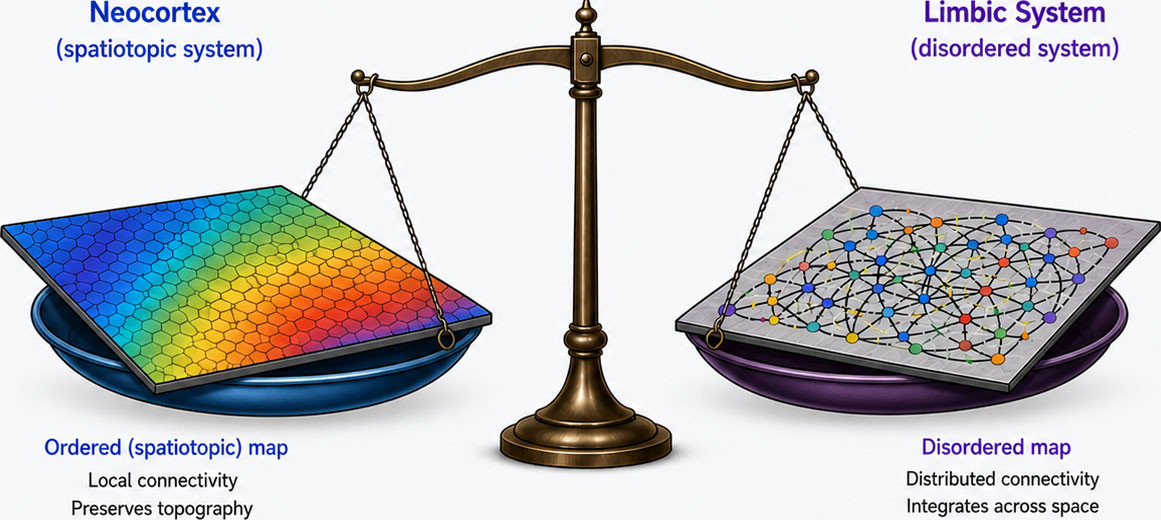
That step mattered because it linked brain layout to function. The researchers were not simply saying that the neocortex and limbic system look different. They showed that different wiring patterns are better matched to different kinds of information.
The final problem was how these wiring strategies shape whole brains across species. Since brain tissue is costly, evolution has to prioritize. A species that depends heavily on smell may benefit from expanding distributed limbic networks. A species that relies more on vision may benefit from a larger neocortex.
Imam’s team simulated this tradeoff in a multimodal network, where spatial and distributed systems competed for limited real estate. When the model environment rewarded smell, the distributed system expanded together, and the neocortex became smaller. When vision mattered more, the neocortex expanded and the distributed system contracted.
That pattern helped explain real species differences. The nine-banded armadillo, which relies strongly on scent, has an especially large limbic system. The highly visual squirrel monkey has a brain dominated by its neocortex. Across the 182 species examined, the picture was not one of evolution stacking reason on top of instinct. It was one of the spaces being reallocated between different wiring systems, depending on what helped an animal survive.
AI could borrow brain wiring
The same logic may matter for artificial intelligence. Today’s AI often learns by being fed enormous amounts of data. Biological brains do not begin that way. They start with built-in architecture that guides learning before experience fills in the details.
“Today’s artificial neural networks are trained by vast amounts of data — it’s about nurture,” says Imam. “But the brain is not a blank slate that gets trained by experience. It is a mix of nature and nurture, and the nature is that pre-wired architecture.”
“We could translate that architecture to AI systems to make it more brain-like, or make it learn or function as efficiently as the brain.”
Reference: “Dual computational systems in the development and evolution of mammalian brains” by Nabil Imam, Matthew Kielo, Brandon M. Trude and Barbara L. Finlay, 22 April 2026, Science Advances.
DOI: 10.1126/sciadv.aec6112
This work was supported by National Science Foundation grants 2223811 (to N.I.) and 2319060 (to N.I.).
Never miss a breakthrough: Join the SciTechDaily newsletter.
Follow us on Google and Google News.
3 Comments
The brain is a learning computer. There is no blueprint that can suggest that they all evolved according to a set of plans. If that was true, people who have never had any education should be just as capable and knowledgeable as people who are highly educated. How does this explain the differences in IQ.
What measuring system is involved in determining the IQ?
IQ is measured by performance on IQ tests.