
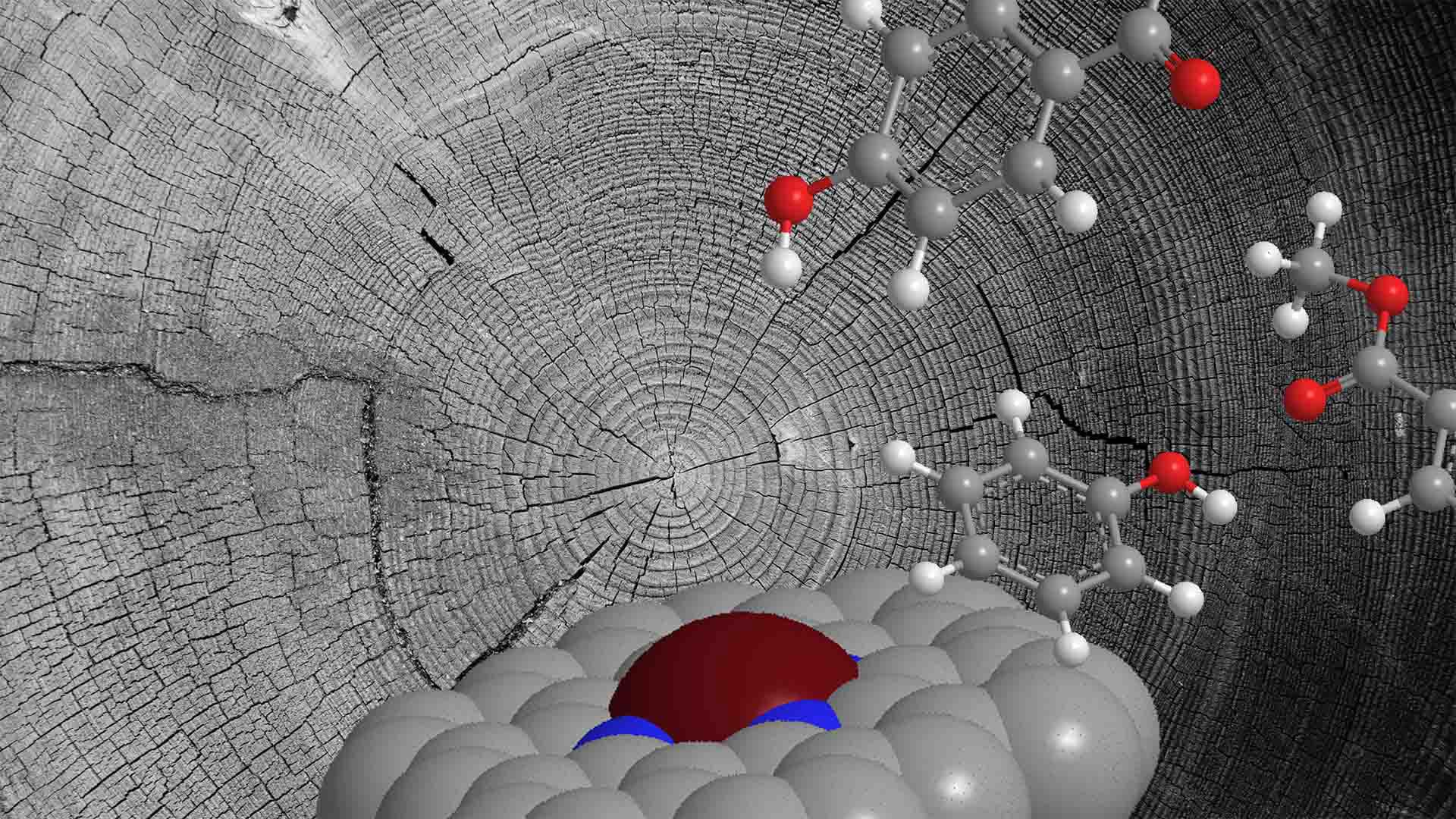
Atomic insight could make plant waste a more practical source of fuels, plastics and chemicals.
Every year, agriculture and forestry leave behind large amounts of plant material containing lignin, the substance that helps stems, wood, and other tissues remain rigid. Lignin can make up (up to 35%) of this discarded biomass and represents nature’s largest renewable supply of aromatic chemicals, which are carbon-based compounds built around stable ring structures.
That chemical stability is also the problem. Lignin consists of a tangled network of strong bonds that resists ordinary processing, making it difficult to turn this abundant material into useful products for sustainable manufacturing.
An international research group including Dr Christopher Parlett, Xinyue Zhou, and Yutao Jiang from the Department of Chemical Engineering developed a catalyst designed to overcome that barrier. Their work, reported in ACS Catalysis, not only demonstrated efficient lignin conversion but also identified the molecular machinery responsible for breaking its strongest bonds.
The material is a “single-atom catalyst,” meaning its active metal is dispersed as individual atoms rather than larger particles. In this case, isolated ruthenium atoms are anchored within carbon containing added nitrogen atoms. Separating the ruthenium in this way allows more of the metal to participate in reactions while minimizing the amount required.
It was more difficult to determine which precise arrangement of atoms performed the chemistry. Without knowing the active structure, researchers could improve a catalyst only through trial and error.
Atomic sites reveal the mechanism
The investigation identified a configuration called a “Ru–N₄ site” as the key reaction center. At these sites, one ruthenium atom is held in place by surrounding nitrogen atoms, creating a location where oxygen molecules can be activated.
That oxygen activation is essential because ordinary oxygen is not reactive enough to dismantle lignin efficiently. Once transformed into more reactive forms, it can attack the carbon–oxygen and carbon–carbon bonds that reinforce lignin’s molecular network.
The researchers combined laboratory measurements with computational modeling to follow this sequence step by step. The experiments showed what products formed, while the calculations helped explain how atoms and bonds changed during the reaction. Together, the evidence showed that the catalyst activates oxygen first, then uses the resulting reactive species to cut lignin into smaller molecules.
Mild conditions yield useful chemicals
Under optimized conditions, the catalyst converted nearly all of the model lignin compounds used in the tests. It also generated high yields of valuable products, including phenol, an aromatic chemical used in the production of many materials.
The reaction worked under relatively mild conditions and did not require harsh chemical treatments. Reducing the need for extreme processing could lower energy use and waste in future manufacturing systems.
Model compounds provide a controlled way to study reaction chemistry, but actual lignin is much more complicated. To determine whether the catalyst could handle that complexity, the researchers tested lignin obtained from several biomass sources.
The catalyst successfully converted those real samples into useful aromatic compounds. Such molecules could eventually serve as starting materials for fuels, plastics, and other products now commonly manufactured from petroleum.
Atomic insight guides future design
By identifying the active atomic structure and explaining each stage of the reaction, the work offers more than a single catalyst recipe. It provides a guide for designing future materials that use isolated metal atoms to process difficult forms of biomass more efficiently.
“Understanding exactly how these catalysts work at the atomic level allows us to design better materials for converting renewable resources into valuable chemicals,” said Dr Christopher Parlett, Lecturer in Chemical Engineering.
Finding practical uses for lignin could transform a resistant component of plant waste into a renewable chemical resource. That shift would support movement away from linear manufacturing based on petroleum, where resources are extracted, used, and discarded, and toward a more circular economy built around recovering and reusing biomass.
Reference: “Unveiling the Role of Ru–N4 on Ru–N–C Single-Atom Catalyst in C–O/C–C Bonds’ Oxidative Cleavage in Lignin” by Yingxiang Zhao, Yingjie Zhao, Xinyue Zhou, Haiwei Guo, Qiqi Yin, Yutao Jiang, Haiyan He, Na Liu, Gengbo Ren, Christopher M. A. Parlett and Changzhi Li, 4 February 2026, ACS Catalysis.
DOI: 10.1021/acscatal.5c08001
Never miss a breakthrough: Join the SciTechDaily newsletter.
Follow us on Google and Google News.