
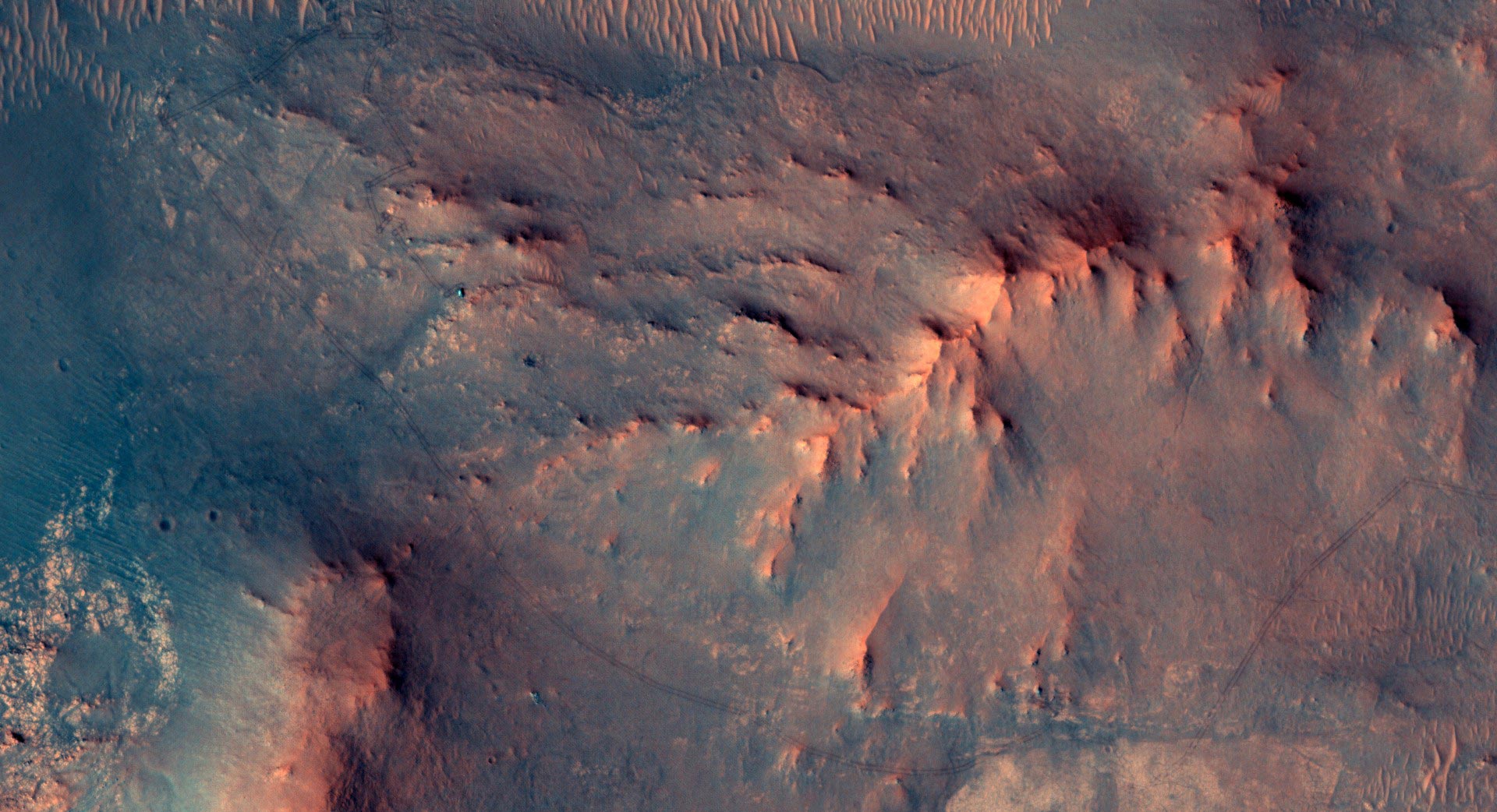
A new NASA orbital image captures Perseverance after completing a marathon across the surface of Mars.
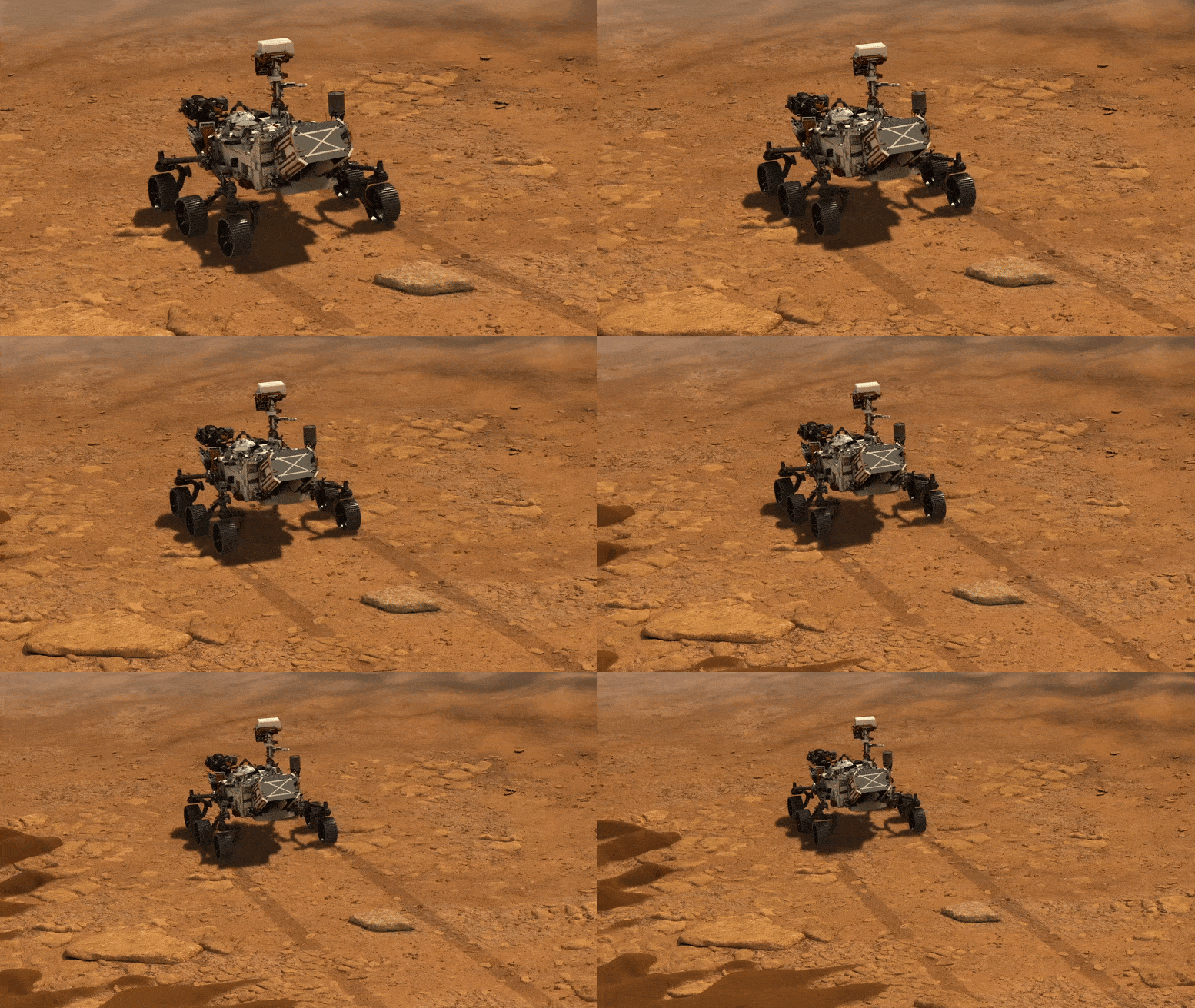
NASA’s Perseverance rover has completed the equivalent of a full marathon on Mars, reaching 26.2 miles (42.195 kilometers) after five years and four months of driving across the Red Planet.
The milestone came on the 1,890th Martian day, or sol, of the mission. Perseverance reached the distance considerably faster than NASA’s Opportunity rover, which required 11 years and two months to cover the same ground.
A Tiny Rover Seen From Mars Orbit
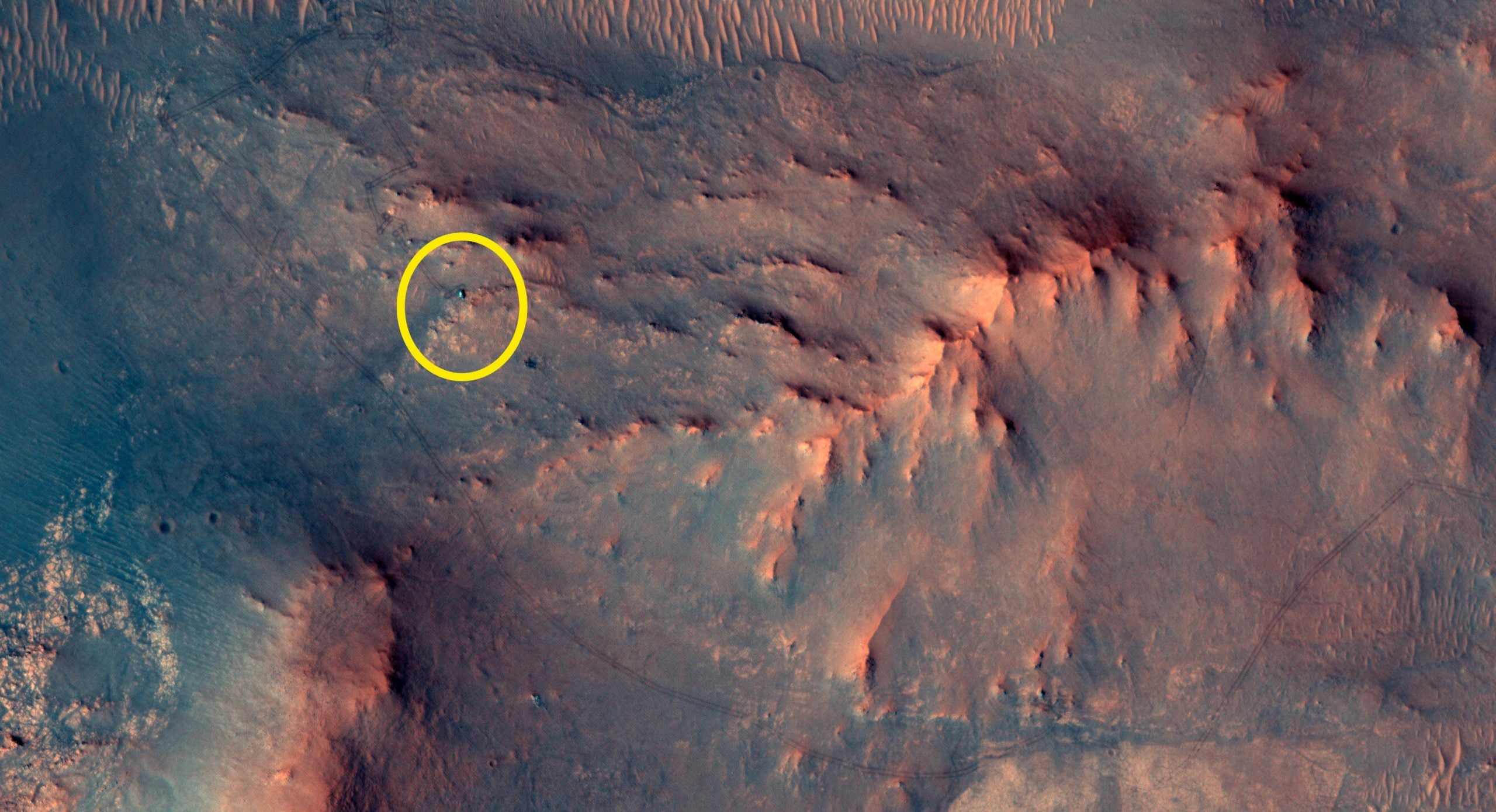
One day before Perseverance crossed the marathon mark, NASA captured the rover from high above the Martian surface. In the image, taken on June 13, 2026, the robotic explorer appears as a tiny green speck against the surrounding terrain.
The view came from NASA’s Mars Reconnaissance Orbiter (MRO), which photographed the area using its High-Resolution Imaging Science Experiment, better known as the HiRISE camera. Faint lines extending across the landscape reveal the tracks left by Perseverance during its journey.
At the time, the rover was traveling through a region west of Jezero Crater that mission scientists have named “Arbot.”
Perseverance’s Long Journey Across Mars
Perseverance was sent to Mars to investigate the planet’s ancient environments and search for evidence that microbial life may once have existed there. Since beginning its surface mission, the rover has crossed rocky plains, climbed slopes, examined geological formations, and collected samples intended to preserve clues about Mars’ distant past.
Traveling on Mars is far more complicated than driving on Earth. Mission teams must carefully plan routes around loose sand, steep terrain, sharp rocks, and other hazards. Because signals take time to travel between Earth and Mars, Perseverance also relies on onboard navigation systems to make some driving decisions independently.
Its marathon distance therefore represents more than a simple measurement. Each mile reflects years of route planning, scientific stops, engineering decisions, and cautious movement through an unfamiliar landscape.
The Spacecraft Watching From Above
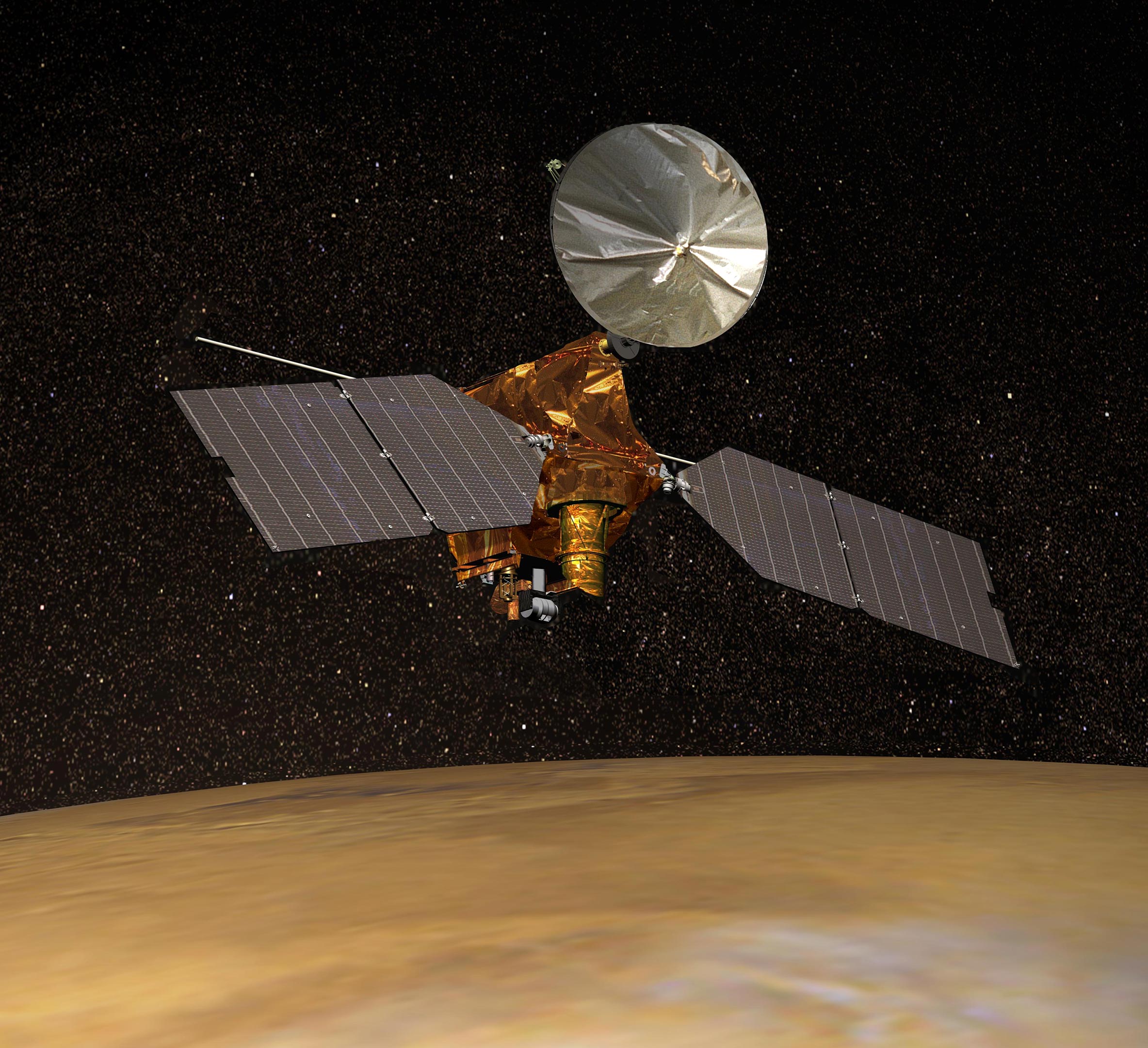
The Mars Reconnaissance Orbiter has studied the planet from orbit for years, mapping its surface and monitoring changes in the terrain. Its HiRISE camera can capture remarkably detailed views, allowing researchers to examine landforms and occasionally spot spacecraft operating below.
Images from orbit also help mission planners understand the terrain ahead of Perseverance and identify scientifically promising locations for future exploration.
Teams Behind the Mars Missions
NASA’s Jet Propulsion Laboratory in Southern California manages operations for Perseverance and the Mars Reconnaissance Orbiter on behalf of the agency’s Science Mission Directorate. JPL is managed for NASA by Caltech, and both missions are part of NASA’s Mars Exploration Program portfolio.
Lockheed Martin Space in Denver built the Mars Reconnaissance Orbiter and continues to support its operations. The University of Arizona, in Tucson, operates HiRISE, which was built by BAE Systems in Boulder, Colorado.
Never miss a breakthrough: Join the SciTechDaily newsletter.
Follow us on Google and Google News.
1 Comment
So now we’re taking pictures of the rover which is taking pictures on Mars. Can we see a picture of the orbiter which is taking pictures of the rover which is taking pictures? Please?