
A new analysis of seismic “families” reveals that some large earthquakes may be preceded by hidden patterns in clustering, localization, and strain release.
The warning signs before a major earthquake, if they exist at all, are often buried in thousands of smaller tremors that seem ordinary at first glance. The problem for geoscientists is not only finding those signals, but knowing whether they are meaningful before the main rupture arrives.
Researchers from the GFZ Helmholtz Center for Geosciences, including Dr. Sadegh Karimpouli and Prof. Dr. Patricia Martínez-Garzón, worked with international partners to build a data-driven method for spotting changes in seismic activity before some large earthquakes. Instead of telling a computer what warning pattern to search for, they used unsupervised machine learning, a type of artificial intelligence that looks for structure in data without being given preset labels.
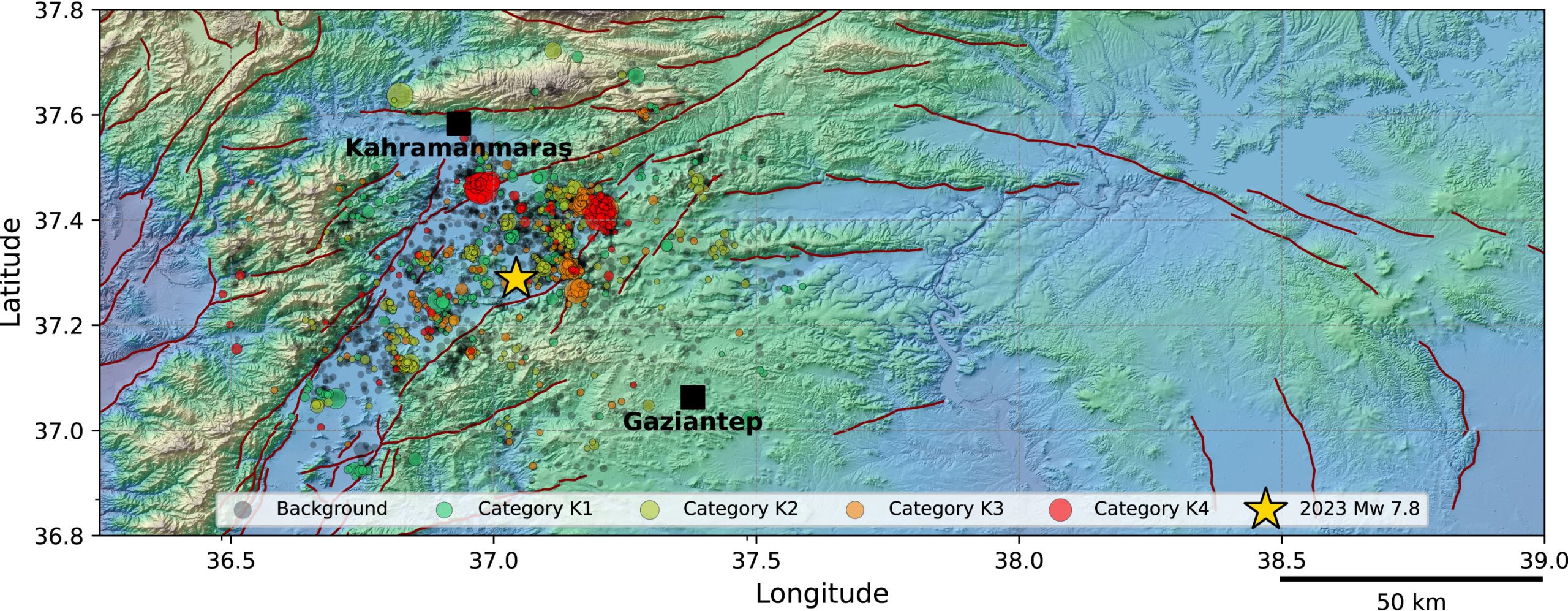
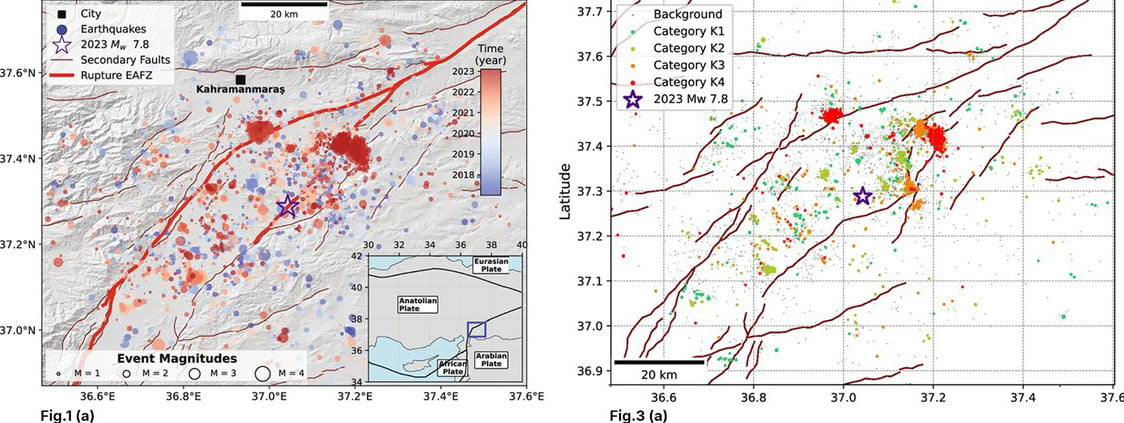
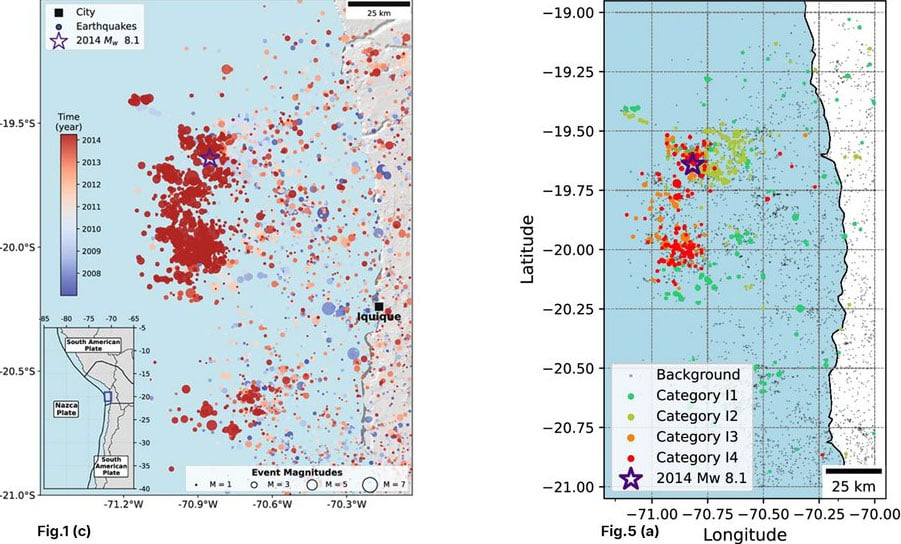
The method was tested on several major earthquake sequences whose histories are already well documented, including Kahramanmaraş (Türkiye, 2023), Iquique (Chile, 2014) and L’Aquila (Italy, 2009). In those cases, the analysis detected distinct foreshock patterns that appeared weeks to months before the mainshock.
When the same method was applied to earthquakes without known precursor signals, including Noto (Japan, 2024) and Amatrice (Italy, 2016), it did not find the same patterns. The researchers argue that this approach could help improve operational earthquake forecasting. The study was published in Nature Communications.
The challenge of earthquake prediction
Forecasting when, where and how strongly an earthquake will strike remains one of the hardest unresolved problems in geoscience. Some researchers even question whether exact prediction is possible. Instead, much of the field focuses on precursor phenomena, meaning changes that may occur before some large earthquakes. These can include foreshocks, which are smaller quakes before a larger one, or slow slip events, where a fault moves quietly without producing strong shaking.
The difficulty is that these signals are inconsistent. Their timing, size and location can vary depending on the fault, the plate boundary, the local geology and the stress already stored in the crust. A pattern that appears before one earthquake may be absent before another.
Pattern recognition using unsupervised machine learning
Machine learning has already helped geoscientists work through the complexity of earthquake interactions and search large earthquake catalogs for patterns that would be difficult to spot by hand.
In this study, Dr. Karimpouli and colleagues changed the usual strategy. Instead of beginning with a fixed idea of what a precursor should look like, they allowed the data itself to sort seismic activity into meaningful patterns.
“Instead of searching for specific precursors, we let the data reveal its own structure and make use of so-called unsupervised learning in which diagnostic criteria are not predefined,” says lead author Dr. Sadegh Karimpouli, scientist in Section 4.2 “Geomechanics and Scientific Drilling” at GFZ. Similar unsupervised methods have previously helped detect early changes before landslides and volcanic eruptions.
From individual earthquakes to interacting “families”
The next challenge was how to represent earthquakes in a way that captures their relationships. Rather than treating each earthquake as a separate point in a catalog, Dr. Karimpouli and colleagues grouped related events into “families” based on their closeness in space, time, and magnitude.
That shift matters because earthquakes can influence one another. A small rupture can change stress nearby, sometimes making another rupture more or less likely.
“Earthquakes are not isolated events; they influence each other, and the closer the rupture event gets, the stronger this influence becomes,” explains co-author Prof. Marco Bohnhoff, Head of GFZ Section 4.2 “Geomechanics and Scientific Drilling.” “By analyzing their collective behavior, we can better capture how stress builds up in the Earth’s crust before large events.”
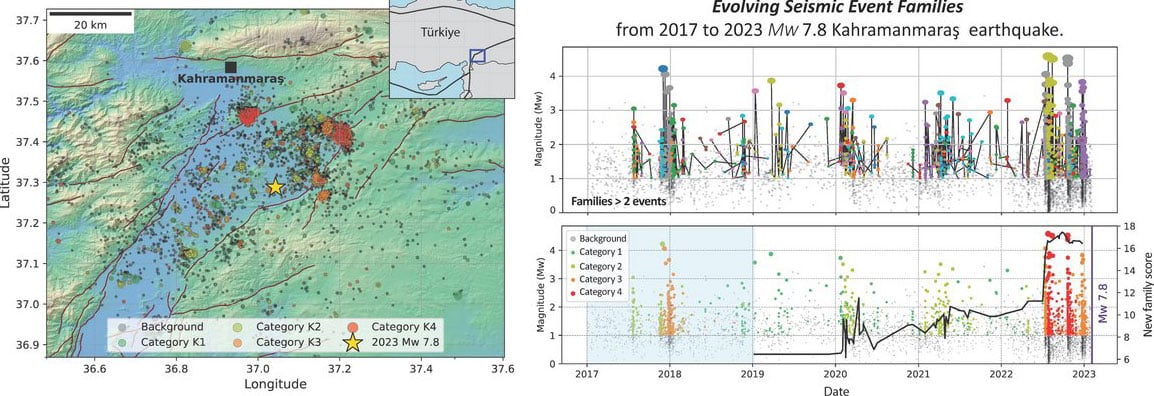
The researchers then described each earthquake family using many physical and statistical features. These included how tightly events clustered, how localized they were in space and time, and other indicators related to stress in the crust. The unsupervised algorithm then grouped those families into categories that reflected different stages of stress evolution.
Dr. Karimpouli and colleagues had already tested the approach in controlled laboratory earthquake experiments. The new question was whether it would still work in nature, where faults are far more complicated, and the available data are often imperfect.
Detecting the transition to a critical state
The researchers applied the method to several major earthquake sequences in different tectonic settings where precursor phenomena had already been reported. These included the 2023 Mw 7.8 Kahramanmaraş (Türkiye) earthquake along a major strike-slip plate boundary, the 2009 Mw 6.1 L’Aquila (Italy) earthquake on fragmented normal faults, and the 2014 Mw 8.1 Iquique (Chile) earthquake in a subduction zone. In every one of these examples, the analysis identified a distinct type of seismic activity before the mainshock.
Those critical patterns had three main traits: stronger clustering and interaction among earthquakes, greater localization in space and time, and increased release of seismic strain. Together, these features point to a fault system moving closer to instability.
“We observe a transition from relatively stable activities – known from previous activities in the region – to a more organized, critical state shortly before rupture,” says Dr. Karimpouli. In the cases studied, the changes appeared from weeks to months before the main earthquake.
Not all earthquakes show warning signals
The results also showed an important boundary of the method. Some earthquakes may not produce detectable seismic preparation before they fail. When Dr. Karimpouli and colleagues applied the method to the 2016 Amatrice earthquake in Italy, no clear critical category appeared relative to earlier activity. The 2024 Noto earthquake in Japan also lacked a clear preparatory signal, even though the region had long-lasting swarm activity.
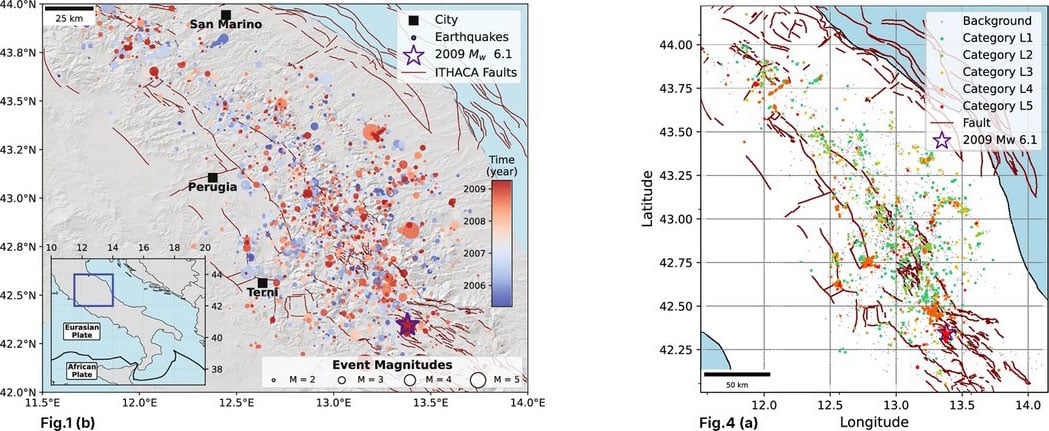
“This variability reflects the complexity of both monitoring conditions and earthquake processes,” says co-author Prof. Patricia Martínez-Garzón. “Some faults may fail without obvious seismic warning signs, which is a major challenge for forecasting.” One of the main goals of Prof. Martínez-Garzón’s ERC Starting Project QUAKEHUNTER, which supports this research, is to understand when earthquake preparation is likely to emerge and when monitoring systems can detect it.
Towards improved earthquake forecasting
To explore whether the method could be useful for practical forecasting, the researchers did more than analyze past earthquakes after the fact. Within the same earthquake sequences, they also tested a prospective approach. They first used earlier earthquakes in each region to define the usual patterns of seismic activity. Then they updated the analysis as new earthquakes occurred, watching for moments when activity began to depart from the established background.
In this setup, the sudden appearance of a new seismic category could suggest that a fault system is moving into a different and potentially more critical state.
“This does not mean we can predict earthquakes in a deterministic way,” emphasizes Dr. Karimpouli. “But it provides a powerful tool to recognize when a fault system is behaving differently than usual.”
A new perspective on the developments of large earthquakes
The study shows how earthquake physics and machine learning can be combined to expose subtle patterns that traditional methods may miss. By focusing on how earthquake events interact as groups, the approach offers a different way to watch large ruptures develop.
“Our findings show that machine learning can help identify earthquake preparatory phases, when they exist and are detectable with installed instrumentation,” concludes Prof. Martínez-Garzón. “The next step is to integrate such approaches into real-time monitoring and to better understand why some earthquakes show clear signals while others do not.”
Reference: “Preparatory phase of large earthquakes illuminated by unsupervised categorization of earthquake catalog features” by Sadegh Karimpouli, Patricia Martínez-Garzón, Sebastián Núñez-Jara, Matteo Picozzi, Daniele Spallarossa, Grzegorz Kwiatek, Georg Dresen, Marco Bohnhoff and Gregory C. Beroza, 4 May 2026, Nature Communications.
DOI: 10.1038/s41467-026-72279-x
Sadegh Karimpouli and Patricia Martínez-Garzón have received funding from the European Research Council (ERC) under the European Union’s Horizon 2020 research and innovation program 101076119 for project QUAKEHUNTER.
Never miss a breakthrough: Join the SciTechDaily newsletter.
Follow us on Google and Google News.