
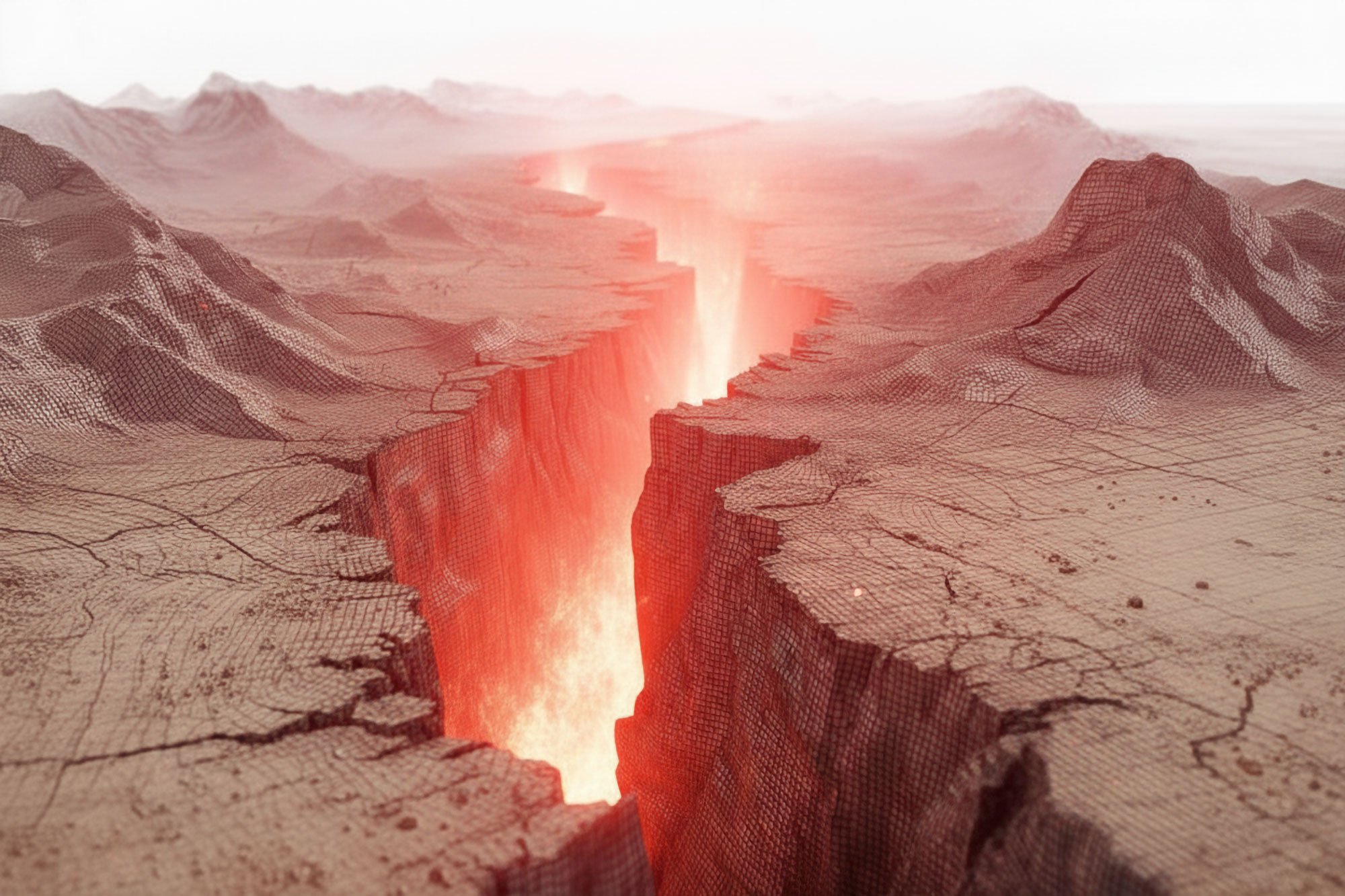
Researchers at the Statewide California Earthquake Center at USC Dornsife warn that powerful, fast-moving earthquakes could hit California and are calling for stronger building codes along with improved monitoring.
Most Californians are accustomed to experiencing earthquakes, but scientists caution that the state faces a lesser-known danger: “supershear” earthquakes, which move so quickly they outrun their own seismic waves.
In an opinion article in Seismological Research Letters, researchers from the USC Dornsife College of Letters, Arts and Sciences explain that these rare events produce stronger and more widespread shaking than ordinary earthquakes. They argue that California must revise its hazard preparedness strategies and building standards to account for this greater level of risk.

The science behind supershear ruptures
“While California is no more likely to have supershear earthquakes than other, similar regions with large fault systems like the San Andreas, the threat has gone unnoticed for too long,” said Yehuda Ben-Zion, professor of Earth sciences and director of the Statewide California Earthquake Center (SCEC), based at USC Dornsife. “The frequency of these supershear ruptures has been greatly underappreciated.”
Researchers liken supershear earthquakes to sonic booms. Just as a plane exceeding the speed of sound generates a powerful shockwave in the atmosphere, a supershear rupture creates shock fronts in the ground once it surpasses the velocity of seismic shear waves, explained Ahmed Elbanna, professor of Earth sciences and director-designate of SCEC. “It breaks the shear wave speed barrier in the rocks and produces destructive waves that are stronger than what’s generated by a normal earthquake,” he said.
This additional force can strike communities with severe impact. Supershear quakes not only spread intense shaking over larger regions but also deliver what Elbanna describes as a “double strike” — a sharp jolt from the shock front followed by the trailing seismic waves.
Global frequency and California’s vulnerability
Worldwide, about one-third of large strike-slip earthquakes are supershear. That matters in California, where many faults near large metropolitan areas are strike-slip and capable of magnitude 7 or higher temblors.
“We cannot say exactly when and where the next earthquake will be and which one will be supershear,” Ben-Zion said, “but we can say with certainty that over the next few decades, we will have multiple magnitude 7 earthquakes in California.
“They are coming, whether we are prepared or not,” he added.
Preparing for stronger shaking
The authors warn that current design standards don’t fully account for a supershear quake’s extra punch. Buildings and infrastructure are generally engineered for the strongest shaking perpendicular to faults, but supershear quakes direct their energy along the fault line itself.
“Critical structures should be built to this higher standard, and so far, they are not,” Ben-Zion said.
To prepare, the team calls for denser monitoring near major faults, advanced computer simulations of supershear scenarios, and stronger building codes.
“This is a collaborative effort where everybody has to chip in,” Elbanna said. “And I think here at USC and SCEC, with their reputation in the community, this is the right time and right place to get this effort started.”
Reference: “Supershear Earthquakes: Their Occurrence and Importance for Seismic Hazard, Early Warning, and Design Standards” by Ahmed Elbanna, Mohamed Abdelmeguid, Domniki Asimaki, Napat Tainpakdipat, Grigorios Lavrentadis, Ares Rosakis and Yehuda Ben‐Zion, 19 August 2025, Seismological Research Letters.
DOI: 10.1785/0220250118
Elbanna and Ben-Zion co-authored the opinion piece with researchers from Caltech and the University of Illinois Urbana-Champaign.
Never miss a breakthrough: Join the SciTechDaily newsletter.
Follow us on Google and Google News.
5 Comments
The gov of Cali is too concerned about his hairdo to institute stronger building codes and preparedness. The Jan 7 wildfires are an example. Ultimately, the free market might solve this, but it is simply be too expensive to build in Cali to minimize earthquake and fire damage. Insurance companies can’t insure beyond a certain risk level.
“Free market” might solve it at around year 1 000 000 AD… maybe.
Scientists don’t know anything about the California fault lines and are making this S*** up to feel important!
Promises, promises…
Anyone familiar with seismology or vulcanology knows that the California coastline is a subversion zone that will eventually over an eon of time raise the coastline as the pacific plate creeps very slowly to the northwest. I wouldn’t be surprised if Soros or some government agency looking for more taxes and fees didn’t pay for this speculative nothing! In fact, the earthquakes and volcanic activity in the mediterrainian, though it erased civilizations, did not substantially alter the geography of the region.