
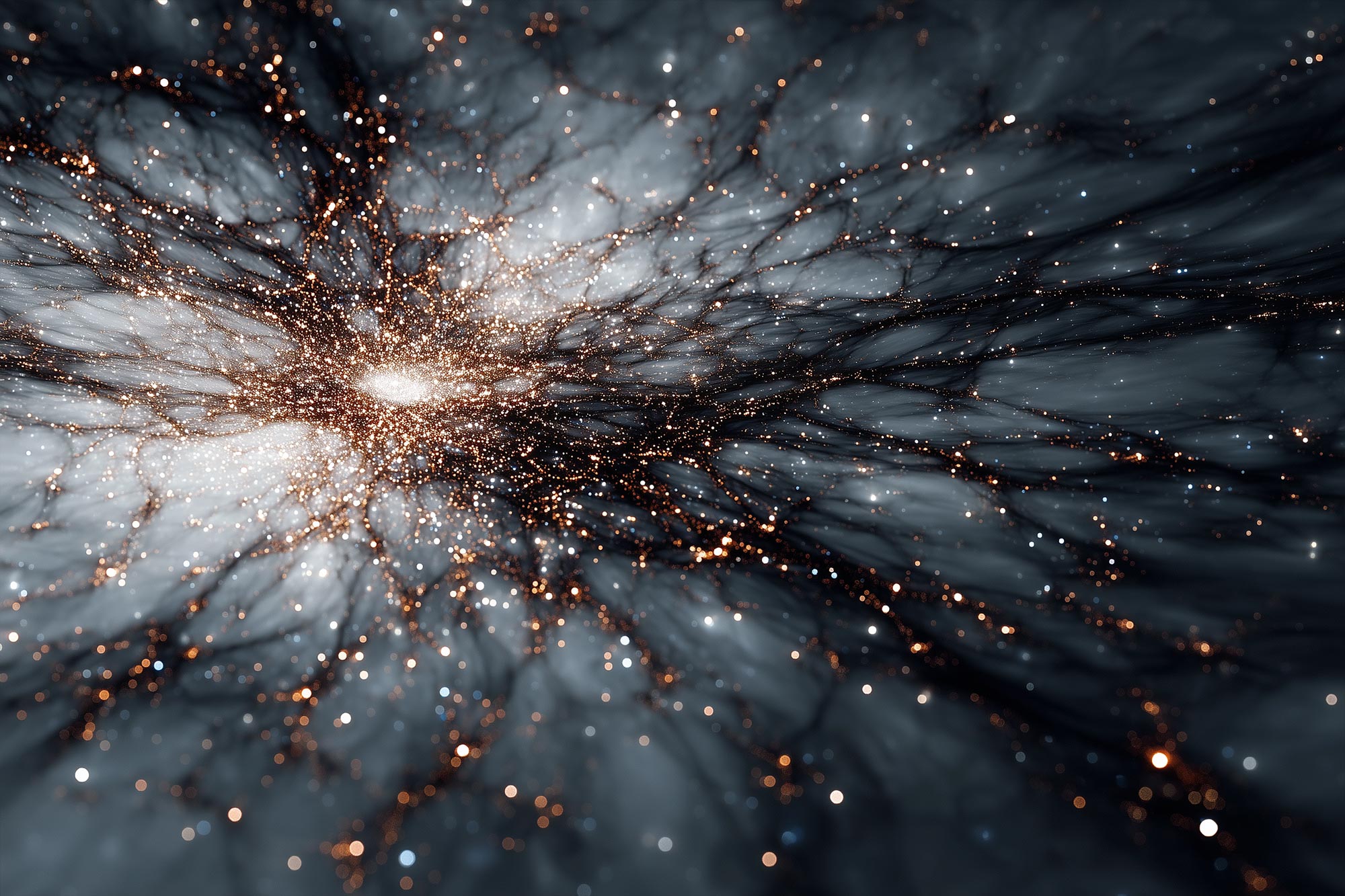
Possible interactions between dark matter and neutrinos may help explain a persistent mismatch in how cosmic structure evolved.
Everything visible, stars, planets, gas, and galaxies, accounts for only a small fraction of the universe. Most of the cosmos is dominated by dark matter and other invisible ingredients that scientists are still trying to understand. Now, researchers at the University of Sheffield have found evidence that two of these hidden components, dark matter and neutrinos, may interact with one another, pointing to new physics beyond the standard cosmological model.
Dark matter makes up about 85% of all matter in the universe, yet it has never been detected directly. Instead, astronomers infer its existence from the gravitational pull it exerts on galaxies and galaxy clusters. Neutrinos are extraordinarily light particles that rarely interact with matter, allowing billions to pass through every square centimeter of Earth each second almost unnoticed.
Hidden particles challenge standard theory
The Standard Model of Cosmology (Lambda-CDM), rooted in Einstein’s General Theory of Relativity, treats dark matter and neutrinos as independent ingredients of the universe. In that framework, they do not interact with each other.
The University of Sheffield work, published in Nature Astronomy, points to a possible crack in that assumption. The analysis finds signs that dark matter and neutrinos may interact, which would offer a new way to study parts of the cosmos that cannot be seen directly.
To look for that signal, the researchers compared observations from different periods in cosmic history. That matters because an interaction between dark matter and neutrinos would not only affect invisible particles. It could also leave traces in how galaxies and other large structures formed over time.
Evidence spans cosmic history
The data spans the history of the universe:
- Early universe data came from two major sources: the highly sensitive ground-based Atacama Cosmology Telescope (ACT), and the Planck Telescope, a space observatory operated by the European Space Agency (ESA) from 2009 to 2013. Both were designed to measure the faint afterglow of the Big Bang.
- Later universe data came from a large catalog of astronomical observations made with the Dark Energy Camera on the Victor M. Blanco Telescope in Chile, together with galaxy maps from the Sloan Digital Sky Survey.
Cosmic clumping remains puzzling
Co-author of the study Dr. Eleonora Di Valentino, a Senior Research Fellow at the University of Sheffield, said: “The better we understand dark matter, the more insight we gain into how the Universe evolves and how its different components are connected. Our results address a long-standing puzzle in cosmology. Measurements of the early Universe predict that cosmic structures should have grown more strongly over time than what we observe today.”
She continues, “However, observations of the modern Universe indicate that matter is slightly less clumped than expected, pointing to a mild mismatch between early- and late-time measurements. This tension does not mean the standard cosmological model is wrong, but it may suggest that it is incomplete.”
She concludes, “Our study shows that interactions between dark matter and neutrinos could help explain this difference, offering new insight into how structure formed in the Universe.”
Future surveys can test it
The next test will come from sharper observations. Future telescopes, Cosmic Microwave Background (CMB) experiments, and weak lensing surveys could help determine whether the possible interaction is real. Weak lensing uses tiny distortions in light from distant galaxies to map where mass is spread across the universe, including mass that cannot be seen.
Dr. William Giarè, co-author of the study and former Postdoctoral Researcher at the University of Sheffield, now based at the University of Hawaiʻi, said: “If this interaction between dark matter and neutrinos is confirmed, it would be a fundamental breakthrough.
“It would not only shed new light on a persistent mismatch between different cosmological probes, but also provide particle physicists with a concrete direction, indicating which properties to look for in laboratory experiments to help finally unmask the true nature of dark matter.”
Reference: “A solution to the S8 tension through neutrino–dark matter interactions” by Lei Zu, William Giarè, Chi Zhang, Eleonora Di Valentino, Yue-Lin Sming Tsai and Sebastian Trojanowski, 2 January 2026, Nature Astronomy.
DOI: 10.1038/s41550-025-02733-1
This work is supported by the National Key Research and Development Program of China (grant no. 2022YFF0503304), the China Manned Space Program (grant no. CMS-CSST-2025-A03) and the Project for Young Scientists in Basic Research of the Chinese Academy of Sciences (grant no. YSBR-092).
Never miss a breakthrough: Join the SciTechDaily newsletter.
Follow us on Google and Google News.