
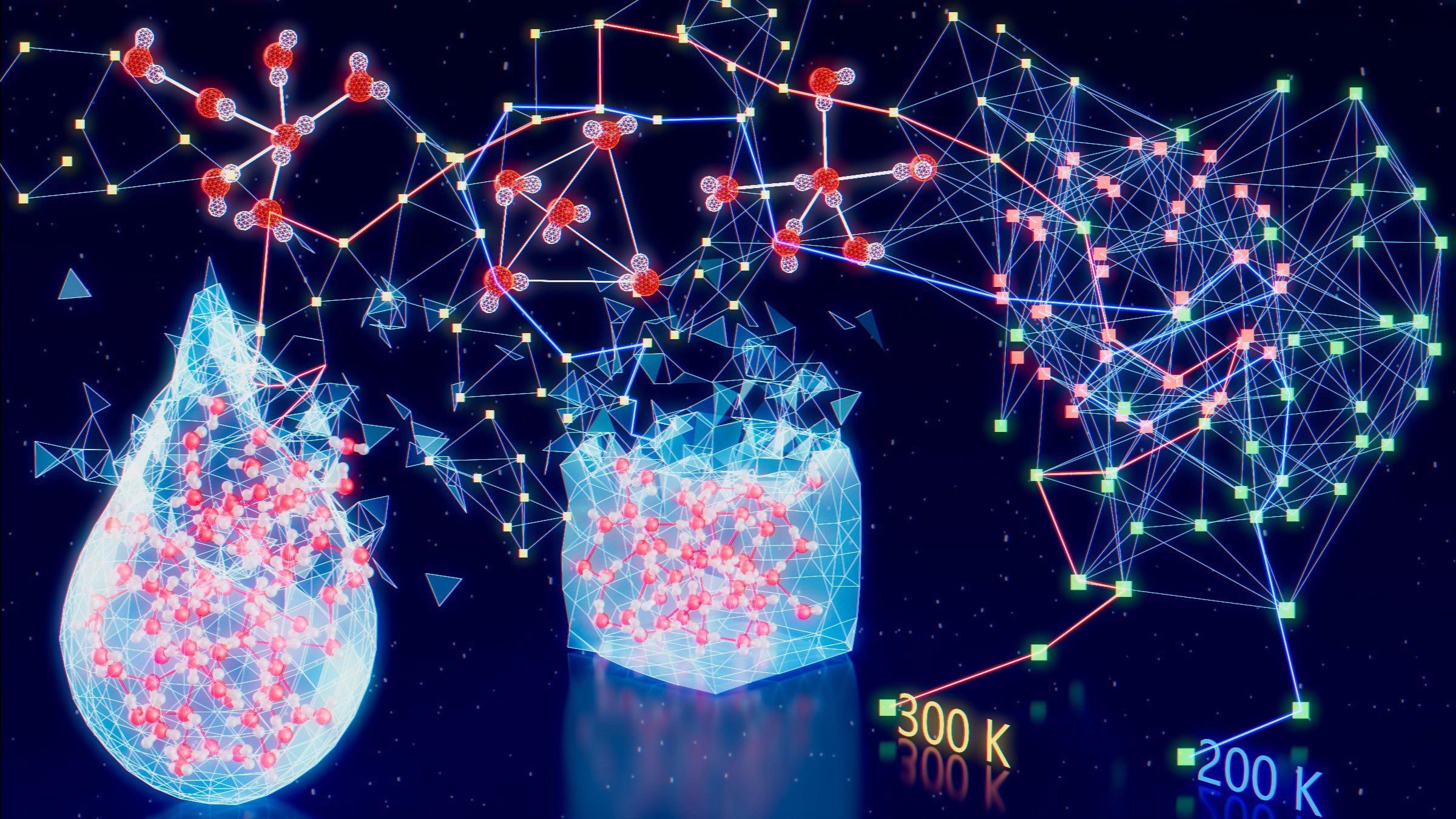
AI is helping scientists uncover the hidden molecular structure behind water’s famously strange behavior.
Water covers most of Earth’s surface, yet it continues to puzzle scientists because it behaves differently from almost every other liquid. One of its best-known quirks is that it expands instead of shrinking when it freezes. Researchers have long connected these unusual properties to changes in water’s microscopic structure as temperature and pressure vary, but they have lacked a consistent way to measure and compare those structural changes.
Now, a team at the University of Osaka has turned to artificial intelligence (AI) to tackle that challenge. Their study, published in Communications Chemistry, introduces an AI-based framework that evaluates and compares different ways of describing the structure of supercooled water.
AI Helps Decode Supercooled Water
For liquid water to become ice, its molecules must arrange themselves into an organized crystal lattice. This process begins at a nucleation site, which acts as a starting point for crystal growth. Tiny impurities in the water or even microscopic scratches on the inside of a container can provide these nucleation sites.
If those starting points are absent, water can remain liquid even after being cooled below its normal freezing temperature. This unusual state is known as supercooled water.
Scientists have found that water’s unusual behavior becomes even more pronounced in this supercooled state. One leading explanation suggests that supercooled water shifts between two competing liquid structures: a high-density liquid (HDL) and a low-density liquid (LDL). These structures are created by an ever-changing network of hydrogen bonds between water molecules. As the temperature rises, the more compact HDL structures become increasingly dominant over the more open LDL arrangements.
Comparing Water’s Hidden Structures
Researchers have developed many different ways to describe water’s local molecular structure, including measurements such as tetrahedral bond order and local density. Because these structural descriptors were created independently, they rely on different scales, dimensions, and types of information. That has made it difficult to directly compare them and determine which ones provide the clearest picture of water’s behavior.
“Past studies have shown that using machine learning to classify and understand structural data is effective,” explains corresponding author Kang Kim. “We specifically wanted to incorporate a neural network model into this study to evaluate how accurate the descriptors were at capturing key structural information, in a way that is like human cognition.”
To train the AI, the researchers supplied it with structural data from molecular dynamics simulations of supercooled water. Through repeated trial and error, the neural network learned to recognize meaningful patterns within the data.
AI Identifies the Most Effective Descriptors
“The network used what it had learned to compare how 16 descriptors differentiated between LDL and HDL structures at different temperatures,” reports Nobuyuki Matubayasi, senior author. “In this way, we determined the most efficient descriptors.”
The researchers believe their framework could improve scientists’ understanding of how microscopic structural changes are connected to water’s thermodynamic behavior. Ultimately, the work may help explain the origins of water’s unusual properties while also guiding the development of more effective tools for studying one of nature’s most remarkable substances.
Reference: “Machine learning evaluation of structural descriptors for supercooled water” by Kohei Yoshikawa, Kokoro Shikata, Kang Kim and Nobuyuki Matubayasi, 6 July 2026, Communications Chemistry.
DOI: 10.1038/s42004-026-02097-1
Never miss a breakthrough: Join the SciTechDaily newsletter.
Follow us on Google and Google News.
5 Comments
I have to wonder if phase change, in general, requires nucleation sites with other, if not most, molecular chemistry.
Perhaps there is evidence of quantum effects revealed at the super cooled state. Particles, seen to exhibit continual movement, are everywhere functional. The strange behavior of water might point to the wave nature of, for example, cellular reality and function.
This partially explains how and why stagmites form in ice cubes in a refrigerator. A super cooled region in the center of the cube container creates the lattice and it floats allowing the lattice to continue growing only on the bottom portion and expanding outward allowing the entire cube to freeze. But in the mean time the central stagmite becomes a fixed feature.
This partially explains how and why stagmites form in ice cubes in a refrigerator. A super cooled region in the center of the cube container creates the lattice and it floats allowing the lattice to continue growing only on the bottom portion and expanding outward allowing the entire cube to freeze. But in the mean time the central stagmite becomes a fixed feature.
The perfect science. Very nice.