
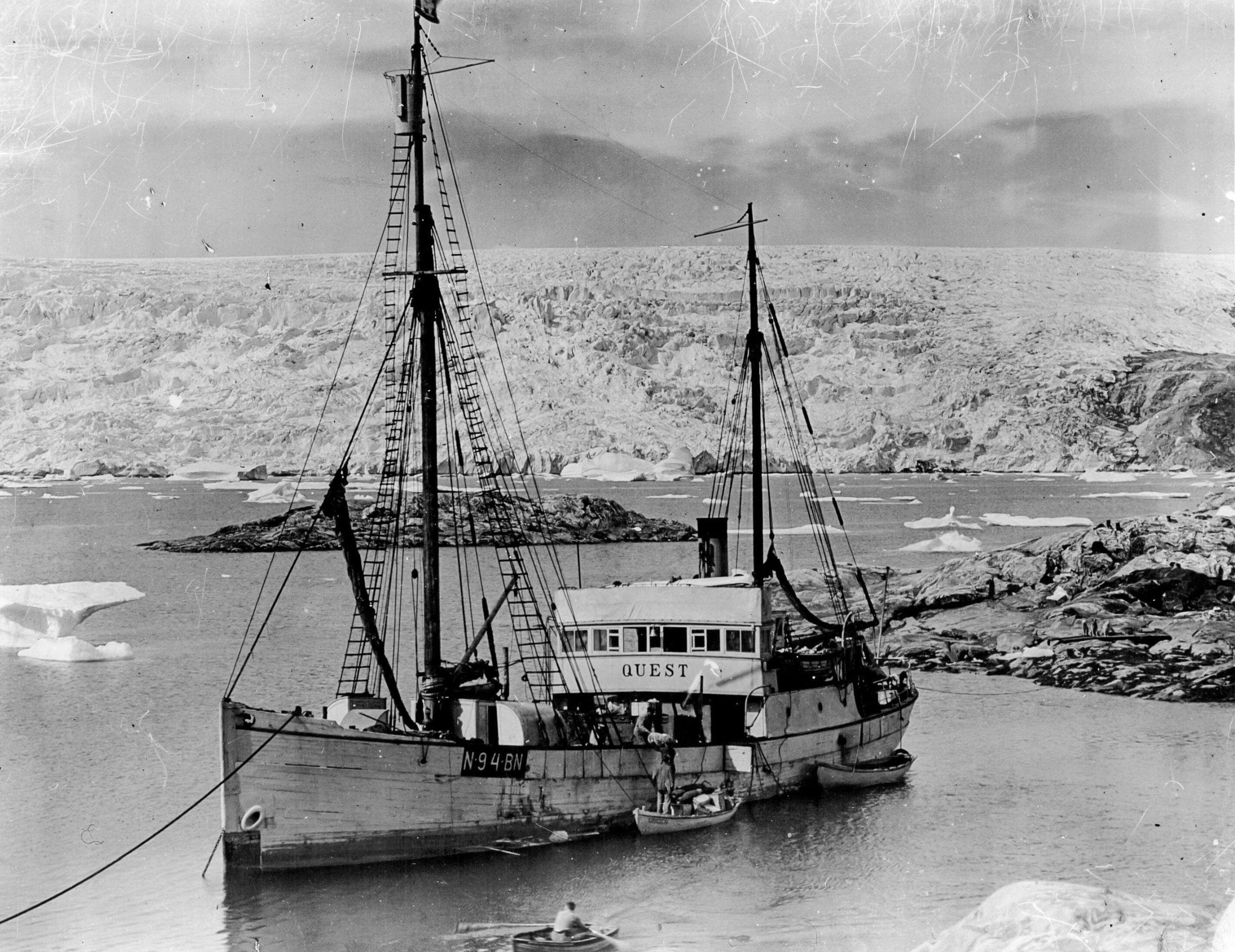
More than a century after Ernest Shackleton last walked its deck, his final ship has emerged from the darkness at the bottom of the Labrador Sea.
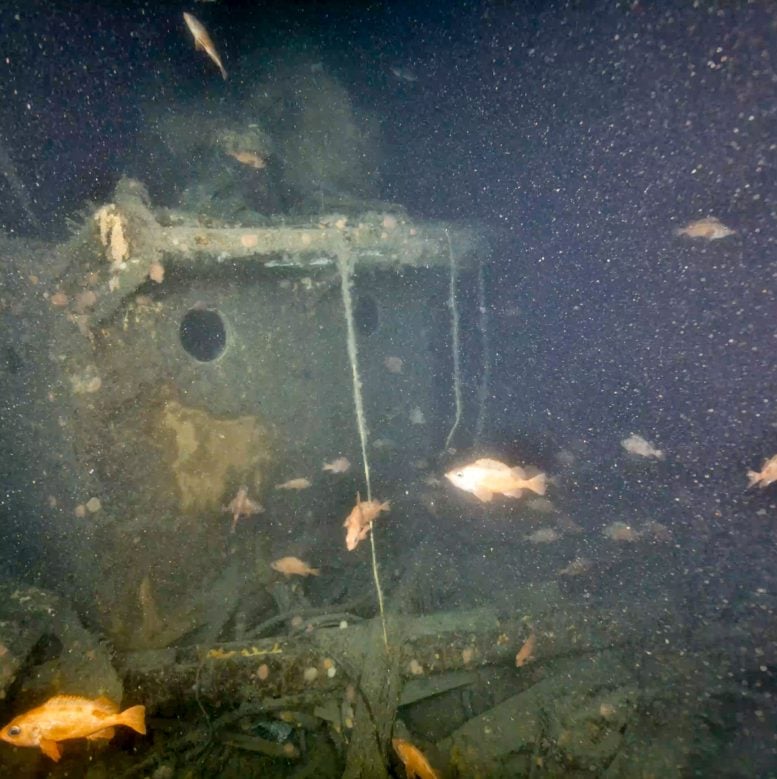
The first close-up images of Quest reveal a vessel that is damaged but still unmistakable. Its bow, deck, and several portholes remain visible beneath pink corals, while cod, redfish, wolffish, and other marine life now move through the wreck.
A joint expedition led by the Royal Canadian Geographical Society and Woods Hole Oceanographic Institution captured the images using WHOI’s Falcon remotely operated vehicle and the human-occupied submersible Alvin. The celebrated deep-sea vehicle also carried the first people to the wreck of the Titanic 40 years ago.
John Geiger, the expedition leader and CEO of the Royal Canadian Geographical Society, joined Alvin’s first dive to Quest and described the encounter as a “moving experience.”
“To see Shackleton’s ship, and to think that Shackleton was standing on that deck a century ago. At first, there was a lot of darkness, but suddenly the bow emerges as you are going towards it. It’s incredible,” said Geiger.
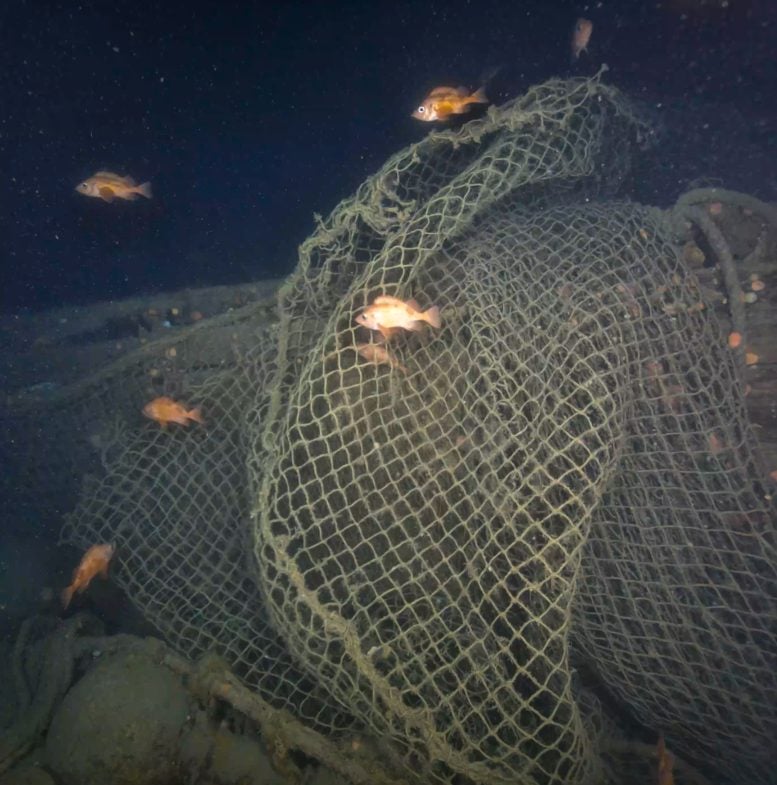
Fishing Nets Obscure the Historic Wreck
Quest was discovered in 2024, resting upright about 390 meters (1,280 feet) below the surface. That expedition could only produce side-scan sonar images, leaving the ship visible as an outline rather than a detailed wreck.
The latest mission allowed researchers to examine it directly for the first time. They found the main mast lying down and significant damage across the ship. Large fishing nets also covered parts of the wreck, blocking the team’s view and raising concerns about the lasting effects of commercial activity on the ocean floor.
“There is a lot of damage to the ship,” said Geiger. “The nets are a sad story, limiting our ability to look at the wreck. I think we have to take responsibility for what we are doing to our oceans; that’s a huge issue.”
A Shipwreck Transformed Into a Living Reef
Despite that damage, Quest has become a thriving artificial reef. Corals cling to its wooden remains, and fish shelter around a ship once built to survive some of the world’s most hostile seas.
Chief Mission Specialist Mark Pathy, who helped locate the wreck with Geiger in 2024, returned to see it at close range. He hopes the expedition will encourage a new generation to explore the planet with the same curiosity associated with Shackleton and fellow polar explorer Robert Falcon Scott.
“I hope it inspires people to explore the planet and to understand that there are undiscovered wonders to see and experience out there. It really is a magical place, our planet,” said Pathy.
The Final Chapter of Shackleton’s Life
Quest occupies a unique place in exploration history because it became the setting for the final chapter of Shackleton’s life.
Shackleton is best remembered for the Endurance expedition, one of history’s most extraordinary survival stories. After Endurance became trapped and destroyed by ice in the Weddell Sea, he led every member of his crew to safety through nearly two years of isolation, dangerous sea crossings, and brutal Antarctic conditions.
He returned to the southern polar regions aboard Quest in 1921. Shackleton died on the ship in 1922 at age 47 while it was anchored at South Georgia, before the expedition could fully begin.
Quest’s story continued for another four decades. The vessel later returned to Arctic work, served during World War II, and resumed sealing after the war. On May 5, 1962, ice floes crushed its hull near Labrador, sending it to the seabed. The crew escaped safely.
Building a Digital Twin of Quest
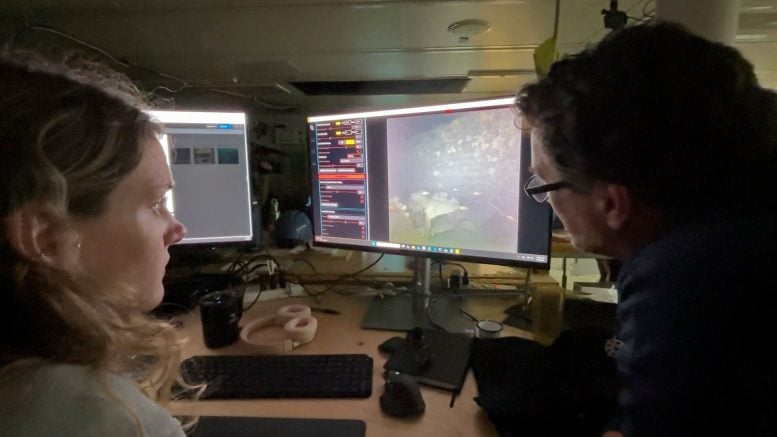
The current expedition took years to organize and brought together specialists in deep-sea operations, marine archaeology, mapping, and underwater imaging. Among them was Alvin pilot Bruce Strickrott.
“Exploring any wreck with a human-occupied submersible is a complicated task,” said Strickrott. “Our success today and the coming days is a direct result of having a group of deep-submergence professionals with extensive experience operating in extremely complicated surroundings.”
Over three days, the team surveyed and mapped Quest using Canadian-made underwater photogrammetry equipment from Voyis. Thousands of overlapping images will be combined to produce a highly detailed digital twin of the wreck.
The model will preserve the ship’s present condition even as currents, fishing equipment, marine organisms, and the slow deterioration of its wooden structure continue to alter the site. It will also allow researchers and the public to explore Quest virtually without disturbing the wreck.
“In addition to using Alvin to put the first human eyes on Quest in more than 60 years, we’ll be using the very best imaging technology available to create a digital twin of the ship,” said Dwight Coleman, Co-Chief Scientist from WHOI for the expedition. “This type of 3D modeling has only existed in ocean science for the last couple of years, and it’s giving us entirely new ways to explore these historic wrecks and make them real for the public.”
Shackleton and Scott’s Final Ships Reunited
The expedition will next travel northeast toward Greenland to survey Terra Nova, another vessel closely linked to the Heroic Age of Antarctic exploration.
Terra Nova carried Robert Falcon Scott on his final Antarctic expedition. Scott reached the South Pole in 1912, only to discover that a Norwegian team led by Roald Amundsen had arrived five weeks earlier. Scott and four companions died during the return journey.
Like Quest, Terra Nova later worked as a sealing vessel in Canadian waters before sinking. Shackleton had originally planned to take Quest into the Canadian Arctic before redirecting his final expedition toward Antarctica. The two wrecks now offer researchers a rare opportunity to document the final ships associated with two of the most famous and tragic figures in polar exploration.
Alvin and Atlantis are owned by the U.S. Navy and operated by WHOI with support from the U.S. National Science Foundation (NSF). The mission’s remotely operated vehicle is provided through the NSF-supported Ocean Observatories Initiative (OOI) at WHOI.
Never miss a breakthrough: Join the SciTechDaily newsletter.
Follow us on Google and Google News.