

Direct imaging has revealed strong evidence that Betelgeuse is orbited by a companion two to three times as massive as the Sun.
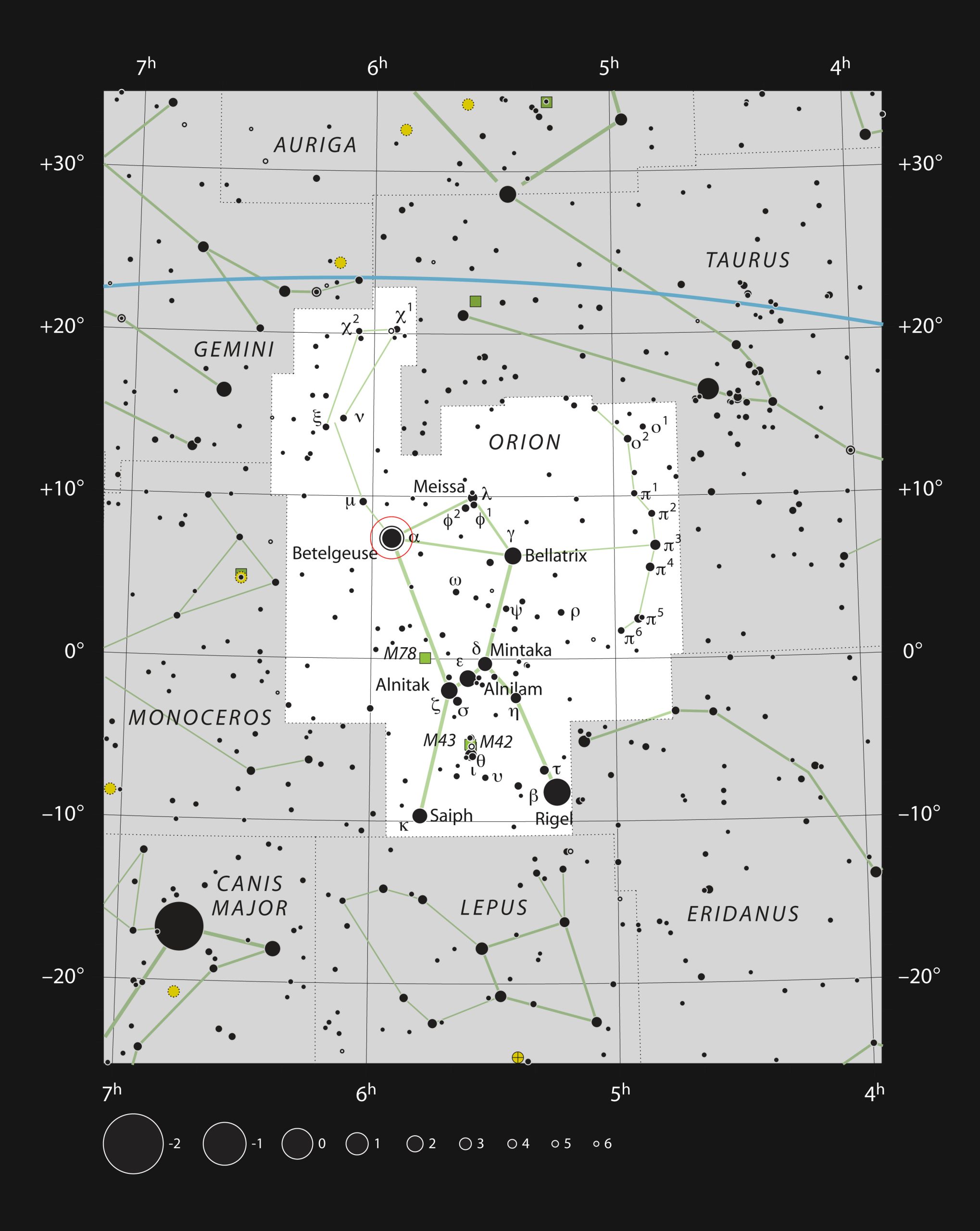
For generations, Betelgeuse has appeared to the naked eye as a single reddish point in the constellation Orion. Now astronomers have obtained their strongest evidence yet that the famous star has company.
Using the European Southern Observatory’s Very Large Telescope (ESO’s VLT), a team led by French astronomer Miguel Montargès captured the clearest image so far of what is likely Betelgeuse B, a star orbiting the red supergiant. “This is the conclusion of a century-long quest,” says Montargès.
“We have shown that Betelgeuse is not single, it is accompanied by a faint stellar companion,” says Montargès, astronomer at the Observatoire de Paris – PSL, France, and lead author of the study published today in Astronomy & Astrophysics.
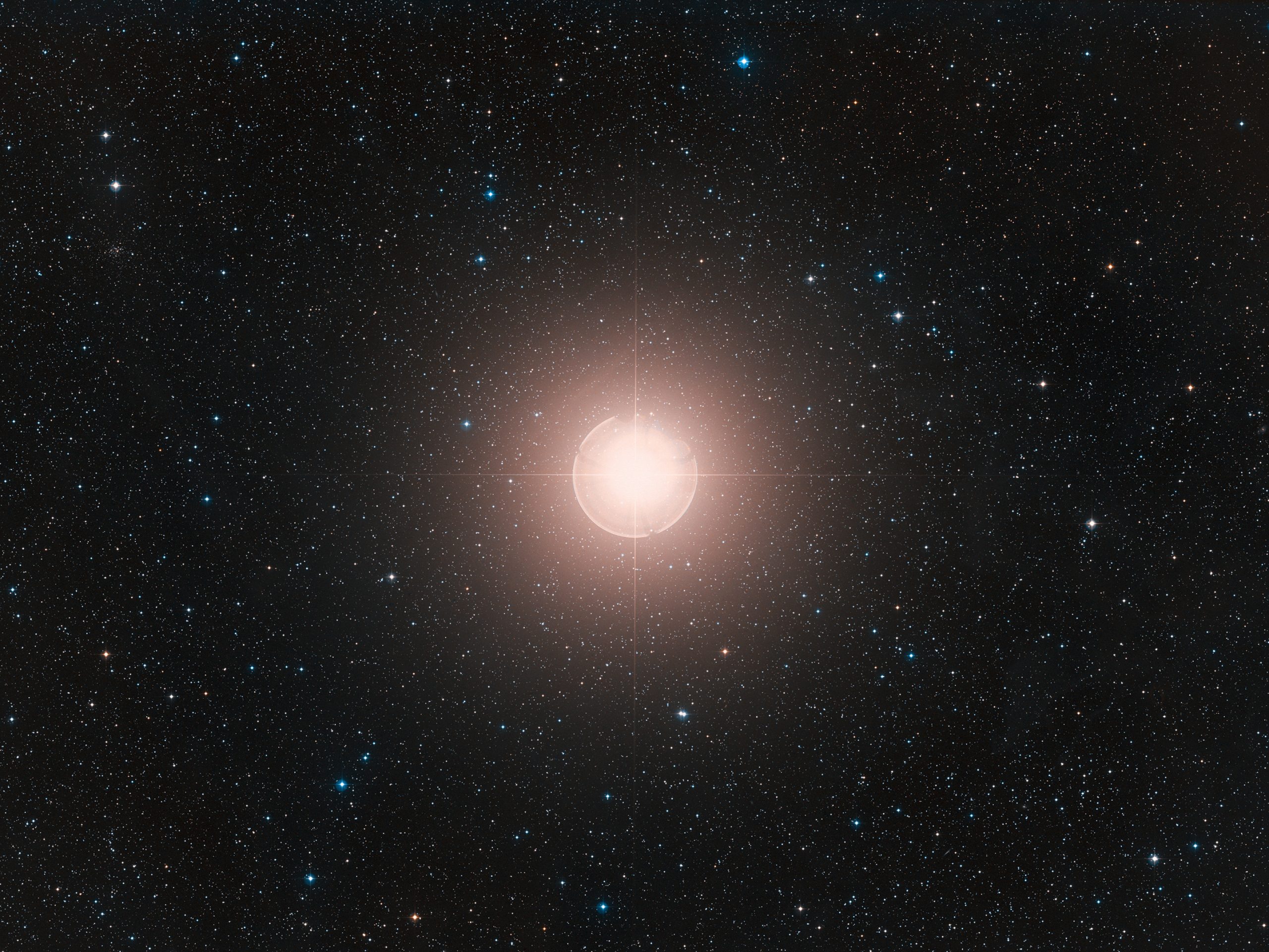
Betelgeuse has been watched for thousands of years and is well known for its changing brightness. Even so, the nearby and easily visible star continues to challenge astronomers.
A century-long search pays off
“I jumped from my chair when I saw the processed images,” recalls Montargès.
The possibility that Betelgeuse had a companion was proposed about a century ago as an explanation for some of the star’s brightness variations. Numerous searches followed, but none produced a convincing detection.
Two studies published in 2024 predicted that the companion would reach its greatest visible separation from Betelgeuse in December of that year, making it easier to distinguish from the much brighter star.
Montargès and his colleagues observed Betelgeuse with ESO’s VLT during that window in December 2024. They then spent several months carefully processing the observations to search for the faint object.
“Honestly, I thought we did not have the sensitivity to detect Betelgeuse B as it was predicted,” explains Montargès. “Because it is more massive than predicted, we see it!”
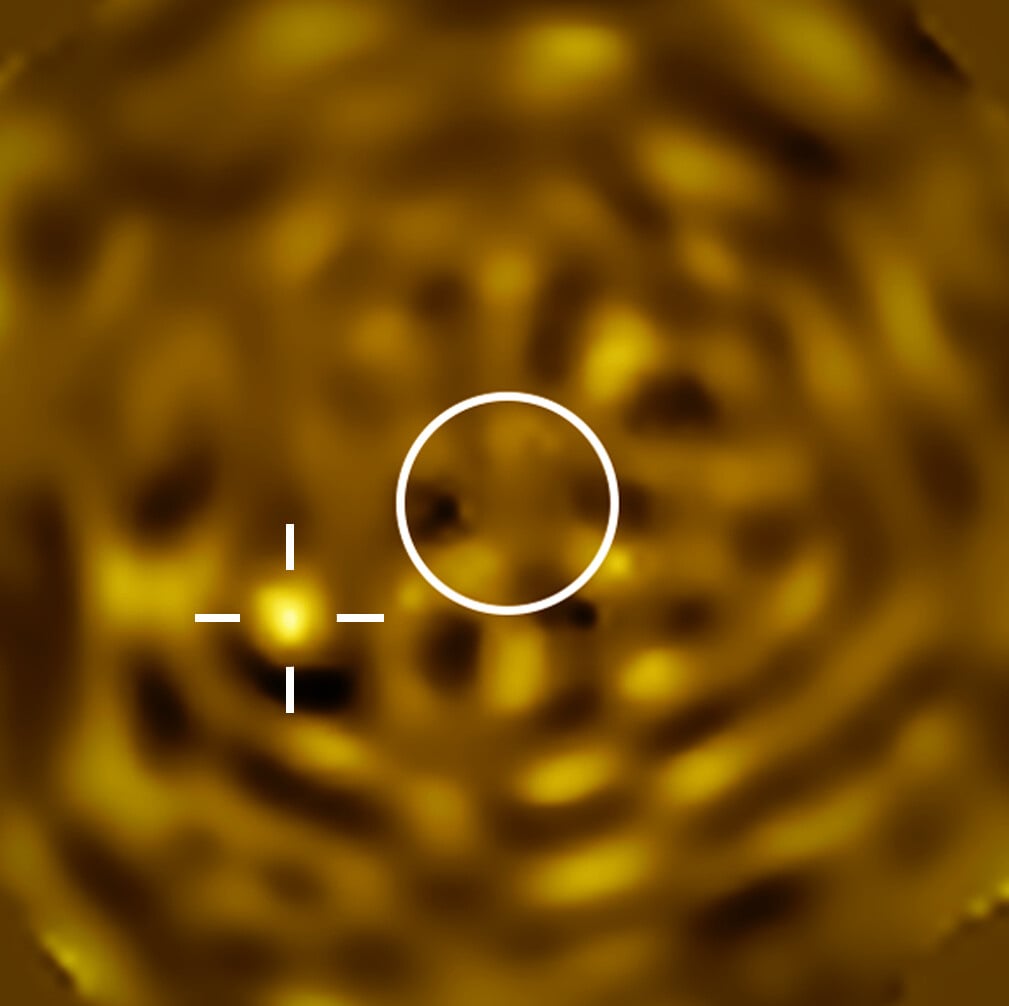
Earlier estimates suggested that the companion might have roughly the same mass as the Sun. The new observations instead indicate that Betelgeuse B is approximately two to three times as massive as the Sun.
“The fact that we can still discover a nearby companion, more massive and brighter than the Sun, around such a well-studied star is remarkable,” says Montargès. “These are among the best moments in science: seeing something new, unexpected.”
Direct imaging leaves little doubt
The researchers detected light coming directly from Betelgeuse B with the SPHERE instrument on ESO’s VLT in Chile’s Atacama Desert.
Previous observations had provided evidence that the companion existed, including a possible direct detection with the Gemini North Telescope in Hawaiʻi, USA. The latest result, however, represents the clearest image and strongest evidence yet for Betelgeuse B.
“It is remarkable to see how SPHERE and advanced post-processing techniques, originally developed to find exoplanets, also excel at detecting a companion around a massive, evolved star like Betelgeuse,” says co-author Anthony Boccaletti, also an astronomer at the Observatoire de Paris.
The researchers still need to watch the object continue along its expected orbit before calling the discovery fully confirmed.
“To be certain that the companion is really there, we still need to observe it in one year on the other side of the star, but there is very little space left for doubt,” adds Montargès.
A companion may reshape Betelgeuse’s future
Betelgeuse attracted widespread attention several years ago when it became noticeably dimmer. Because the aging supergiant is expected to eventually explode as a supernova, the sudden change led to speculation that its death might be approaching.
Montargès and other astronomers examined the dimming with ESO’s VLT and found a less dramatic explanation. A cloud of dust had temporarily obscured part of the star.
The likely discovery of Betelgeuse B now raises a different question. Astronomers will investigate whether the companion could influence the evolution of Betelgeuse or affect the supernova explosion expected at the end of its life.
“The question is truly opened whether this companion is going to have an impact on the evolution of the red supergiant,” concludes Montargès.
References:
“VLT/SPHERE images of the candidate companion of Betelgeuse” by M. Montargès, A. Boccaletti, O. Flasseur, A. de Koter, J. Milli, P. Kervella, S. Ridgway, E. Bordier, E. Lagadec, A. K. Dupree, F. Backs, T. Calderwood and P. Morgan, 28 July 2026, Astronomy & Astrophysics.
DOI: 10.1051/0004-6361/202661023
“A Buddy for Betelgeuse: Binarity as the Origin of the Long Secondary Period in α Orionis” by Jared A. Goldberg, Meridith Joyce and László Molnár, 29 November 2024, The Astrophysical Journal.
DOI: 10.3847/1538-4357/ad87f4
“Radial Velocity and Astrometric Evidence for a Close Companion to Betelgeuse” by Morgan MacLeod, Sarah Blunt, Robert J. De Rosa, Andrea K. Dupree, Thomas Granzer, Graham M. Harper, Caroline D. Huang, Emily M. Leiner, Abraham Loeb, Eric L. Nielsen, Klaus G. Strassmeier, Jason J. Wang and Michael Weber, 24 December 2024, The Astrophysical Journal.
DOI: 10.3847/1538-4357/ad93c8
Never miss a breakthrough: Join the SciTechDaily newsletter.
Follow us on Google and Google News.
1 Comment
Connecting the discovery of Betelgeuse B to orbital boundary dynamics and signal extraction:
The direct imaging of Betelgeuse’s companion star, Siwarha, fundamentally rewrites the “supernova overload” narrative. For years, Betelgeuse’s erratic, six-year brightness swings were touted as evidence of an imminent core collapse. In reality, the star isn’t running on runaway thermal overload. The cyclic variability is driven by an external, coupled two-body system—a 2-to-3 solar mass companion physically ploughing through the supergiant’s extended boundary envelope and clearing channels in the circumstellar dust.
What makes this finding remarkable is how signal processing exposed the underlying mechanics. Spotting a faint companion next to a blinding supergiant requires stripping away overwhelming energy noise. The breakthrough relied on differential polarimetry and post-processing algorithms to map spatial impedance across the field. Direct, unpolarized light from the primary star acts as a massive energy wall, but light reflected at the dust boundary undergoes a geometric polarization shift. By filtering out the unpolarized central glare impedance, algorithms isolated the phase-locked point source hiding inside the wake.
This discovery highlights a fundamental physical rule: complex, long-period fluctuations in active fields are rarely chaotic internal noise. They are often the observable signature of a secondary mass or force interacting across a boundary constraint. Rather than a star on the brink of destruction, Betelgeuse demonstrates stable orbital coupling, where rotational geometry actively modulates energy output and dust distribution across a shared spatial manifold.