
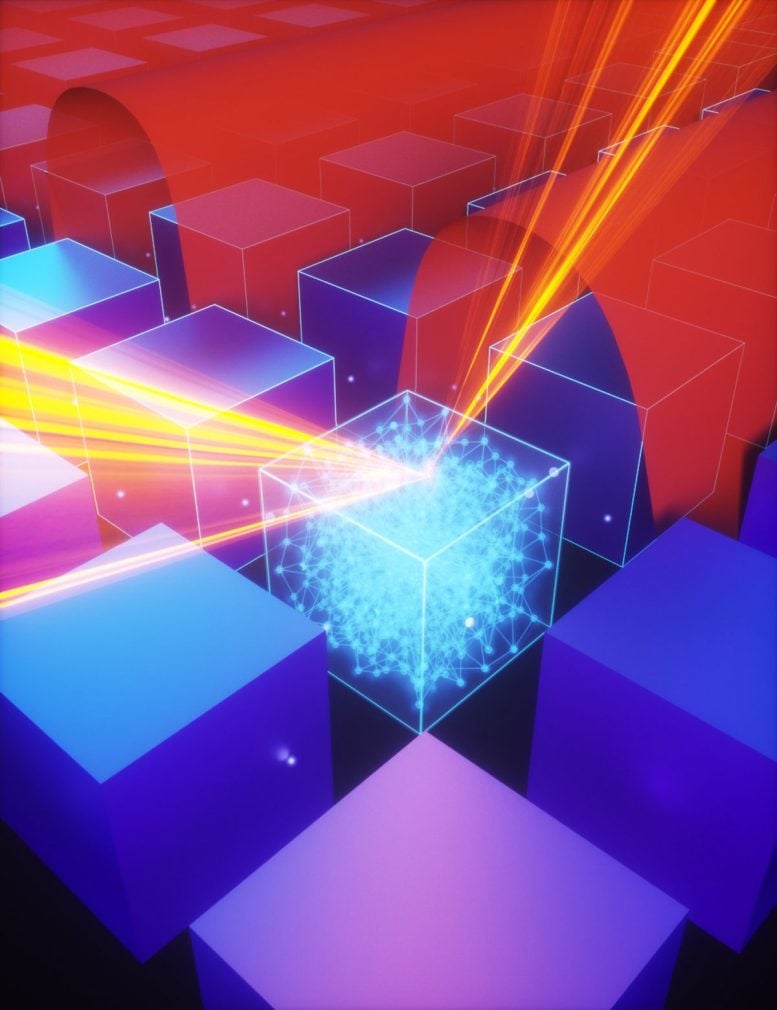
An ultrathin silicon surface can steer and reshape light in just 74 femtoseconds, opening a path toward a new generation of high-speed optical technology.
A pulse of light can cross the width of a human hair in roughly 74 femtoseconds. In that same vanishingly brief interval, a new device developed at the California Institute of Technology (Caltech) can change the direction and shape of another light beam.
The experimental technology could point toward optical systems that respond far faster than today’s beam steering hardware. Such control is important in cameras, sensors, communication networks, scientific instruments, and emerging forms of photonic computing.
Most equipment used to manipulate light cannot keep pace with light itself. Mirrors may need to rotate, liquid crystals must rearrange, or electronic signals must alter a material’s properties. Even when these processes are considered fast by ordinary standards, they can be slow compared with the fundamental timescales of light.
Researchers have now demonstrated an ultrathin surface that steers and reshapes light in only 74 femtoseconds, or 74 quadrillionths of a second. The findings were published in Nature Nanotechnology.
How the Silicon Metasurface Works
The work was carried out in the laboratory of Prof. Harry Atwater at Caltech. Dr. Claudio Hail, now an assistant professor at the University of California, Berkeley, led the research. Dr. Lior Michaeli, now head of the Meta-Optomechanics Laboratory at Tel Aviv University’s Fleischman Faculty of Engineering, was a coauthor.
The device is a metasurface, a thin optical layer patterned with structures smaller than the wavelength of light. Unlike a traditional lens, which changes a beam as it travels through curved glass, a metasurface can alter light using carefully arranged nanoscale features across an almost flat surface.

In this case, the surface contains tiny silicon structures engineered to trap and concentrate light for a brief moment. This resonant design intensifies the interaction between the incoming light and the silicon.
A short control pulse changes the silicon’s optical properties through a phenomenon known as the optical Kerr effect. Under this effect, intense light briefly changes a material’s refractive index, which determines how light travels through it.
The Kerr effect can occur in less than a femtosecond, but it is usually too weak to produce a useful result. The researchers overcame that problem by designing a high-quality factor metasurface that amplifies the interaction. This allowed one pulse of light to control another without mechanical movement or slower changes involving excited charge carriers.
Programmable Beam Steering and Shaping
“The key idea was to create a metasurface whose optical response is not fixed once it is fabricated,” says Dr. Hail. “By changing the illumination pattern, we can reconfigure how the device steers and shapes light and do so on an ultrafast timescale.”
During laboratory tests, the team redirected a light beam by as much as 13 degrees to either side. The researchers could determine the direction by changing the spatial pattern of the control pulse.
They also used the same approach to reshape the outgoing beam and produce different light patterns. Rather than being permanently designed for one task, the surface could be reprogrammed through illumination.
Prof. Atwater explains, “Light usually interacts only weakly with matter, so controlling one beam of light with another is extremely challenging. The metasurface enhances that interaction, allowing a very small and very fast material response to produce a useful change in the outgoing beam.”
Faster Switching With No Moving Parts
“For me, the most exciting aspect is seeing an idea that had been with us for years become an experimental reality,” says Dr. Michaeli. “The ultrafast effect we wanted to use is naturally very weak. We had to design the metasurface so that it would amplify the effect enough not only to measure it, but to use it to steer and shape light.”
The observed switching time was close to the duration of the laser pulse used in the experiment. That suggests the metasurface itself may not yet have reached its fundamental speed limit. Shorter pulses could potentially produce even faster switching.
The surface also resets rapidly after the control pulse disappears. Because its operation does not rely on moving parts or long-lived electrical charges, it can return almost immediately to its original optical state.
Toward All-Optical Computing and Communications
Modern communication networks already use light to move enormous amounts of information. However, that information often must be converted into an electrical signal before it can be processed, routed, or modified. The result is then converted back into light for transmission.
These repeated conversions add complexity and can create delays and energy costs. A programmable device capable of manipulating light directly could eventually allow some operations to remain entirely optical.
Potential uses could include rapidly reconfigurable communication hardware, compact imaging systems, advanced sensors, dynamic holography, and photonic processors. Active metasurfaces are being studied as a way to control properties such as a beam’s direction, intensity, phase, polarization, and spectrum on a compact platform.
Dr. Michaeli adds, “This work points to a broader opportunity: using engineered structures to strengthen interactions between light and matter and turn them into tools for control, sensing, and information processing. This is closely connected to research directions we are now pursuing at Tel Aviv University.”
From Laboratory Demonstration to Future Technology
The researchers stress that the experiment is a proof of principle, not a finished component ready to replace conventional optical hardware.
Even so, the study demonstrates that optical components do not necessarily have to remain the slow part of a light-based system. By using nanoscale structures to strengthen an otherwise faint physical effect, the researchers showed that one beam of light can rapidly and programmably control another.
Reference: “Ultrafast, reconfigurable all-optical beam steering and spatial light modulation” by Claudio U. Hail, Lior Michaeli and Harry A. Atwater, 22 June 2026, Nature Nanotechnology.
DOI: 10.1038/s41565-026-02199-w
Never miss a breakthrough: Join the SciTechDaily newsletter.
Follow us on Google and Google News.
2 Comments
“The experimental demonstration of reprogramming light propagation within 74 femtoseconds highlights a foundational principle: wave properties are dictated by dynamic background medium impedance, not fixed particle trajectories.
By switching a material’s refractive index faster than a single optical oscillation, researchers create a temporal boundary condition—forcing light to alter its frequency and phase in real time while inside the medium.
This exact rule governs wave-medium interactions across all physical domains:
The phrase ‘wave-medium interactions across physical domains’ is the precise, universally recognized nomenclature that unifies these fields in academic physics, allowing even the layman to follow along.
Ultrafast Optics: Rapid dielectric modulation redefines light frequency via time-refraction rather than spatial boundaries.
Space Plasma Physics (Physical Review Research): Resolution-limited observations blurred continuous field geometry into false ‘random diffusion,’ masking structured field-guided transport.
Condensed Matter Physics (Science Advances): Electron transport in flat-band magnets locks into coherent wave states defined by local lattice impedance rather than chaotic particle collisions.
Biophysics & Oncology (Genome Medicine / Cell): Tissue and membrane boundaries manipulate localized field resistance and impedance to isolate cellular nodes from external interactions.
Across optics, plasma dynamics, materials science, and biophysics, control over energy vectors is achieved not through brute-force collisions, but by engineering the local background geometry.”
The researchers stress that the experiment is a proof of principle, not a finished component ready to replace conventional optical hardware.
Very good!
Artificial experiments can only verify nature, not dictate it.
Treating artificially manipulated or simulated laboratory results as equivalent to nature is an act of arrogance and ignorance. For example, the asymmetry of two artificially rotated cobalt-60 setups is extrapolated to parity nonconservation in nature.