
A recent study proposes using Molybdenum Trioxide instead of traditional metamaterials to develop optical devices capable of rendering objects invisible. This new approach could lead to simpler, more cost-effective invisibility cloaks and enhance capabilities in areas like infrared imaging.
Invisibility devices may soon no longer be the stuff of science fiction. A new study published in the De Gruyter journal Nanophotonics by lead authors Huanyang Chen at Xiamen University, China, and Qiaoliang Bao, suggests the use of the material Molybdenum Trioxide (a-MoO3) to replace expensive and difficult to produce metamaterials in the emerging technology of novel optical devices.
The idea of an invisibility cloak may sound more like magic than science, but researchers are currently hard at work producing devices that can scatter and bend light in such a way that it creates the effect of invisibility.
Thus far these devices have relied on metamaterials – a material that has been specially engineered to possess novel properties not found in naturally occurring substances or in the individual particles of that material – but the study by Chen and co-authors suggests the use of a-MoO3 to create these invisibility devices.
How a-MoO3 Enables Electromagnetic Invisibility
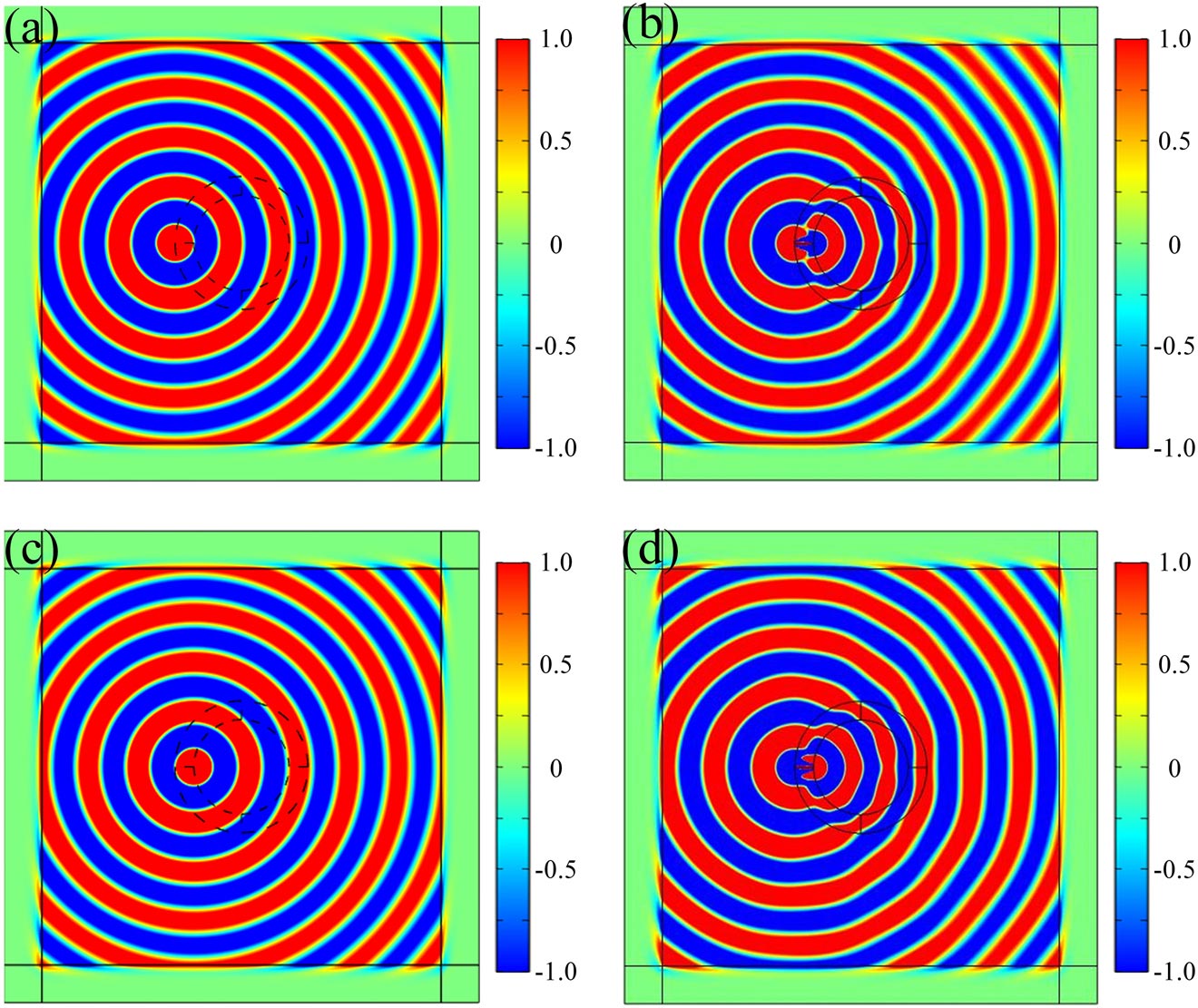
Possessing some unique properties, this material can provide an excellent platform for controlling energy flow. The team’s simulation results showed that when cylindrical or rolled up a-MoO3 materials replace metamaterials, the simplified invisibility concentrator can gain the effects of electromagnetic invisibility and energy concentration that would be demonstrated by a near perfect-invisibility device.
As a result, the study shows that hyperbolic materials such as a-MoO3 and Vanadium pentoxide (V2O5) could serve as a new basis for transformation optics, opening the possibility of photonic devices beyond invisibility concentrators, including improved infrared imaging and detection systems.
Transformation optics has been a hot topic in physics over recent decades thanks to the discovery that the path light takes through a continuous medium can be the same as its propagation through a curved space that has undergone a coordinate transformation.
The consequence of this is that the behavior of light can be manipulated as it passes through a material, something that has led to the creation of a multitude of novel optical devices, such as invisibility cloaks – a camouflage material that could cover an object and bend light around it making it almost disappear – and other optical illusion devices.
A Simpler Path to Optical Illusions and Energy Concentration
“It is the first time that 2D materials have been used for transformation optical devices. Usually, we need metamaterials but this is much simpler,” says Chen. The researcher continued by explaining that the first application for the results of this study might be a large size energy concentrator capable of improving such devices. “We are now performing experiments by rolling up the a-MoO3, the results of which we hope will appear very soon.”
Reference: “Invisibility concentrator based on van der Waals semiconductor a-MoO3” by Tao Hou, Sicen Tao, Haoran Mu, Qiaoliang Bao and Huanyang Chen, 30 November 2021, Nanophotonics.
DOI: 10.1515/nanoph-2021-0557
Never miss a breakthrough: Join the SciTechDaily newsletter.
Follow us on Google and Google News.
3 Comments
There is just no good justifiable reason for developing such a thing. What? Hiding weapons of war? Sneaking into locker rooms? Burglary?
Put your brains to better use.
I mean you’re not wrong, but you forgot profit. Almost anything being developed right now is probably getting its funding from the government because it has military applications. sadly how it works.
PLEASE ANNOUNCE!
CRIMINAL ARE NOW USING THIS INVISIBLE MEMS & MOTES SMART NEURAL DUST TECHNOLOGY AGAINST THE PUBLIC WITHOUT THEIR CONSENT. I KNOW THIS BECAUSE I HAVE BECOME A TARGET AND IT IS HAPPENING TO ME. THIS TECHNOLOGY HAS BECOME A DANGER TO THE PUBLIC! PLEASE HELP!
HELLO! I am a US citizen, and my Name is Mary Ann Burt. I am 81 years old. My neighbor has targeted me using these invisible mems and motes smart neural dust technology. The FOM Actuator, which is also new technology, creates precise movements to mimic complex tactile sensations, including pressure, vibration, stretching, sliding, and twisting hair and scalp, and sends a hurtful sensation to the body when used by criminals.
And also, a micro-wave-type radio sensor that can read minds, this is just part of the new smart neural dust technology with electrical current sensors, which is also being used by this criminal. And I do not know how many more people are being tortured daily, PLEASE HELP!
“The combination of small, low-power, autonomous sensors with wireless communication and computation capabilities — pioneered a decade ago by UCLA researchers William Kaiser and Greg Pottie — paved the way for embedded networked systems. “What’s so powerful is that you can take these sensors, distribute them in the environment and sense phenomena up close, even in the presence of obstacles, in ways that would be impossible with remote sensing,” explains Deborah Estrin, professor of computer science and founding director of CENS.” This criminal is using this technology and has made a network of sensors in the condo building to communicate without being present.
The Board President at Providence Towers Condominiums has turned the building into his criminal haven and uses this new technology to terrorize co-owners and force some out of their apartment with daily death threats.
Contact: Mary Ann Burt
Providence Towers Condominium
15801 Providence Dr., unit 10B
Southfield, MI 48075
(248) 905-3400