
Close Menu
    Facebook X (Twitter) Instagram
    SciTechDaily
    • Biology
    • Chemistry
    • Earth
    • Health
    • Physics
    • Science
    • Space
    • Technology
    Facebook X (Twitter) Pinterest YouTube RSS
    SciTechDaily
    Home»Space»Skywatching Highlights for January 2022: Don’t Miss Quadrantid Meteor Shower and Mars Rising
    Space

    Skywatching Highlights for January 2022: Don’t Miss Quadrantid Meteor Shower and Mars Rising

    By Jet Propulsion LaboratoryJanuary 2, 2022No Comments4 Mins Read
    Facebook Twitter Pinterest Telegram LinkedIn WhatsApp Email Reddit
    Share
    Facebook Twitter LinkedIn Pinterest Telegram Email Reddit
    Skywatching Astronomy Meteor Shower
    January’s celestial highlights include the new moon enhancing the Quadrantid meteor shower and clear views of key constellations and planets, with Mars beginning to rise in visibility towards the end of the month.

    January features the Quadrantid meteor shower and excellent stargazing conditions thanks to the new moon. Key events include viewing the Winter Circle and Orion early in the month, observing Jupiter close to the crescent Moon on the 5th, and spotting Mars near Venus and the Moon on the 29th as Mars emerges in the morning sky.

    What’s Up for January? New year, new Moon; midnight meteors; and Mars rises.

    January begins with a new moon on the 2nd. And that means the first week of the month is ideal for stargazing because the few days before and after the new moon are the darkest. Head outside around 8 or 9 p.m. all week and look southward to be dazzled by all the bright stars of the Winter Circle, along with the Pleiades, and Orion.
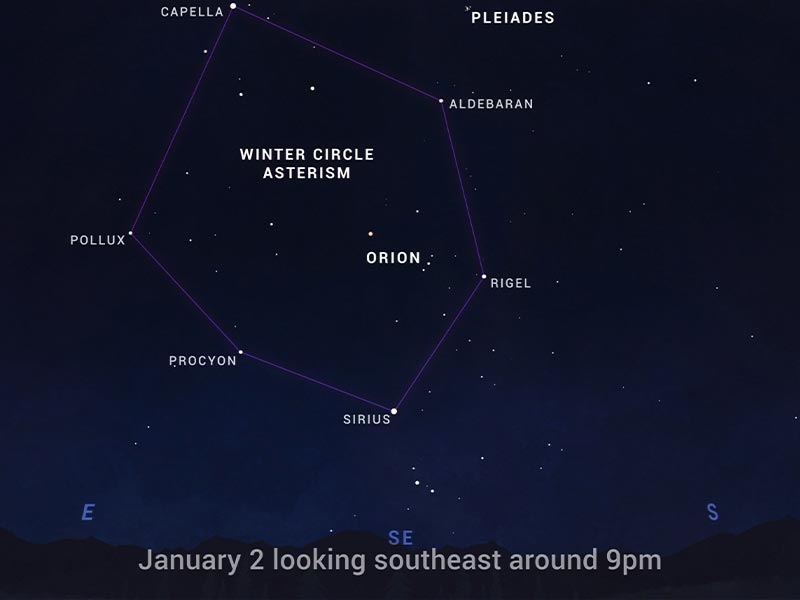
    Skywatching January 2, 2022
    The couple of days around January 2 new moon phase are ideal for stargazing, as there’s no bright moonlight to interfere with the fainter stars. This sky chart shows how the bright stars Winter Circle will appear mid-evening. Credit: NASA/JPL-Caltech

    The Quadrantid meteor shower peaks on the night of January 2nd and the morning of the 3rd. This tends to be one of the better meteor showers of the year, and often produces a number of bright meteors called fireballs. This year the peak coincides with the new moon, making for great viewing conditions, given the skies are clear. You should be able to see a few meteors on the couple of nights before and after as well. 

    For the best Quadrantid meteor viewing, find a dark location away from bright city lights, point your feet roughly toward the northeast, and look up. The meteors appear to radiate from the constellation Boötes, which includes the bright star Arcturus. (But they can appear anywhere in the sky!) Generally, the best viewing will be after midnight, once Boötes rises above your local horizon. The source of the Quadrantids is thought to be the asteroid 2003 EH1, which might actually be an extinct comet. So start off your new year by catching a few shooting stars after midnight on January 3rd.

    Skywatching January 3, 2022
    The Quadrantid meteors appear to radiate from the constellation Boötes, which rises around midnight local time. Credit: NASA/JPL-Caltech

    Finally, a couple of highlights at dusk and dawn. On January 5th, look to the southwest after sunset to find the crescent Moon in a close pairing with brilliant Jupiter. The two will be only about 4 degrees apart, which should make them appear together through most binoculars.

    Skywatching January 5, 2022
    Find the crescent Moon only about 4 degrees away from Jupiter on January 2. Credit: NASA/JPL-Caltech

    Then at the end of the month, on January 29th, if you happen to be up early, you can catch sight of the Moon near the Red Planet. Joining the pair in the southeastern sky will be Venus. Having left the evening skies last month, Venus is now rising before the Sun as the “Morning Star.” Now, Mars is slowly returning to view after passing behind the Sun over the past few months. In fact, NASA stops communicating with our spacecraft at Mars for about 2 weeks every two years, when the planet is directly opposite the Sun. That event, called solar conjunction, took place in October.
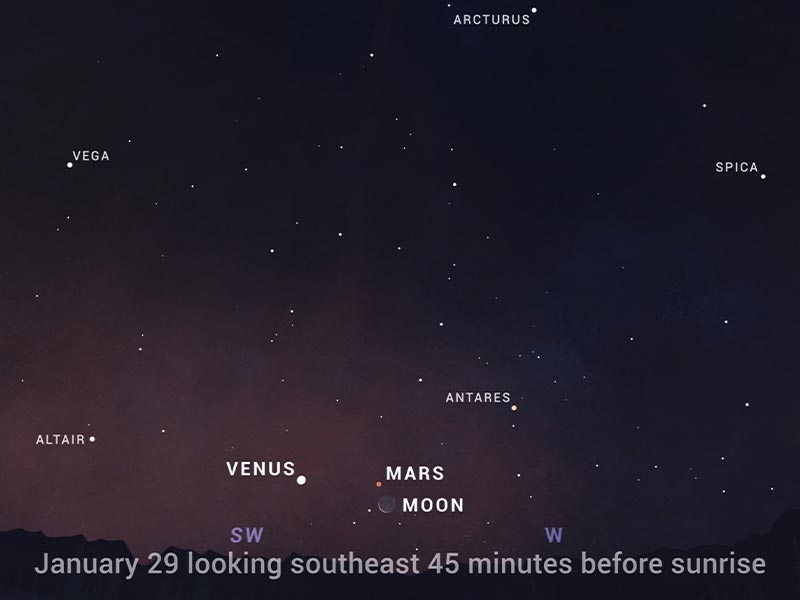
    Skywatching January 29. 2022
    Mars and Venus return to the morning sky in January. Find them with the Moon on the 29th. Credit: NASA/JPL-Caltech

    Mars will continue to brighten and climb higher over the next few months, where it’ll have super-close conjunctions with Saturn and Jupiter, which we’ll tell you about in future videos, so stay tuned!

    Preston Dyches, Christopher Harris, and Lisa Poje are the science communicators and space enthusiasts who produce this monthly video series for NASA at the Jet Propulsion Laboratory. Additional astronomy subject matter guidance is provided by Bill Dunford, Gary Spiers, and Lyle Tavernier.

    Never miss a breakthrough: Join the SciTechDaily newsletter.
    Follow us on Google and Google News.

    Astronomy JPL NASA Popular
    Share. Facebook Twitter Pinterest LinkedIn Email Reddit

    Related Articles

    Don’t Miss: Total Solar Eclipse, Mars and Saturn Rising, Slim Lunar Crescent, Comet 12P

    Webb’s Ethanol Discovery Fuels Search for Alien Life

    Don’t Miss: Jupiter Plows Through the Pleiades

    NASA’s Next-Gen Exoplanet-Imaging Technology Advances Search for Extraterrestrial Life

    NASA Telescopes Are Unlocking the Secrets Behind Mysterious Deep Space Signals

    Catch the Quadrantid Fireballs: A January Sky Spectacle With Moon and Planet Pairings

    From IRAS to Webb: The Incredible Evolution of NASA’s Infrared Telescopes

    End of an Era: NASA’s NEOWISE 10-Year Mission Ending Due to Solar Activity

    Don’t Miss: Geminid Meteor Shower and Asteroid Vesta

    Leave A Reply Cancel Reply

    • Facebook
    • Twitter
    • Pinterest
    • YouTube

    Don't Miss a Discovery

    Subscribe for the Latest in Science & Tech!

    Trending News

    Largest-Ever Study Finds Medicinal Cannabis Ineffective for Anxiety, Depression, PTSD

    250-Million-Year-Old Egg Solves One of Evolution’s Biggest Mysteries

    Living With Roommates Might Be Changing Your Gut Microbiome Without You Knowing

    Century-Old Cleaning Chemical Linked to 500% Increased Risk of Parkinson’s Disease

    What if Your Memories Never Happened? Physicists Take a New Look at the Boltzmann Brain Paradox

    One of the Universe’s Largest Stars May Be Getting Ready To Explode

    Scientists Discover Enzyme That Could Supercharge Ozempic-Like Weight Loss Drugs

    Popular Sweetener Linked to DNA Damage – “It’s Something You Should Not Be Eating”

    Follow SciTechDaily
    • Facebook
    • Twitter
    • YouTube
    • Pinterest
    • Newsletter
    • RSS
    SciTech News
    • Biology News
    • Chemistry News
    • Earth News
    • Health News
    • Physics News
    • Science News
    • Space News
    • Technology News
    Recent Posts
    • Bone-Strengthening Discovery Could Reverse Osteoporosis
    • The Most Elusive Number in Physics Just Got Even More Mysterious
    • Scientists Uncover Hidden Trigger Behind Stem Cell Aging
    • Scientists Discover Coral Reefs Are Teeming With Previously Unknown Life
    • Scientists Find Way to Reverse Fatty Liver Disease Without Changing Diet
    Copyright © 1998 - 2026 SciTechDaily. All Rights Reserved.
    • Science News
    • About
    • Contact
    • Editorial Board
    • Privacy Policy
    • Terms of Use

    Type above and press Enter to search. Press Esc to cancel.