

Scientists have broken a fundamental limit in optics by decoupling angle and wavelength using innovative bilayer metagratings.
Wavelength and the direction in which light travels (angle) are two essential characteristics that define how light behaves. Gaining precise control over both of these properties is critical to the function of many advanced optical technologies.
However, in systems with repeating structures (periodic systems), a natural dispersion effect creates a built-in link between wavelength and angle. This connection, known as angle-wavelength locking, means that adjusting the angle of incoming light typically causes a shift in the device’s filtering wavelength.
This intertwined relationship has long been viewed as unavoidable and presents a major challenge for applications that require separate tuning of angle and wavelength. It leads to significant technical hurdles, such as rainbow-like color artifacts in augmented reality (AR) displays, blurring in wide-field imaging caused by color spreading across angles, reduced accuracy in spectral data from photodetectors due to angular interference, and design constraints for efficient, direction-specific light sources.
A Breakthrough in Radiation Directionality
In a new paper published in eLight, a team of scientists, jointly led by Professor Jian-Wen Dong from Sun Yat-sen University, and Lei Zhou from Fudan University, have discovered that the radiation directionality of optical modes is key to overcoming this fundamental challenge. Through theoretical analysis, they established a complete phase diagram for engineering resonant spectra via radiation directionality, revealing that spatial inversion symmetry and highly directional radiation of optical modes are the essential physical conditions for breaking angle-wavelength locking.
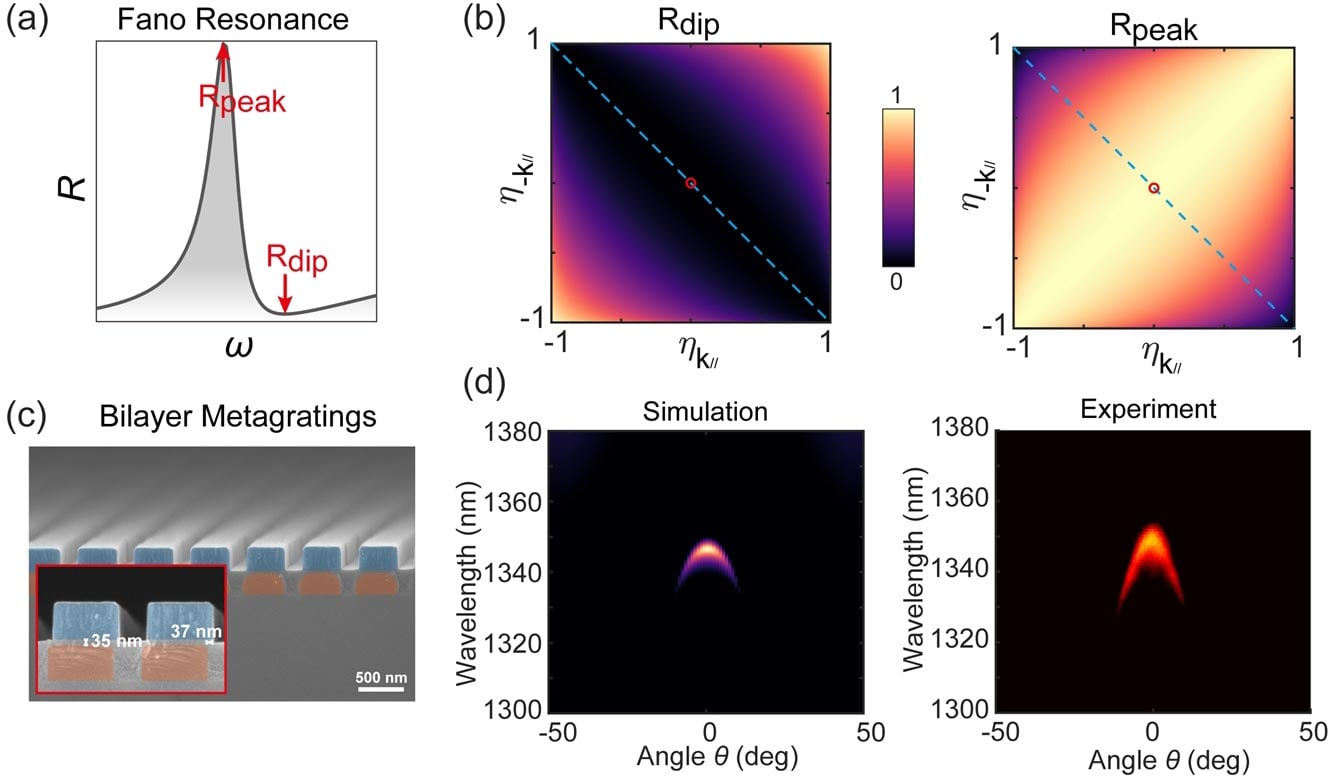
Based on this, they introduced a degree of lateral displacement in bilayer metagratings. This design preserves spatial inversion symmetry while breaking vertical mirror symmetry, enabling precise angular control of radiation directionality. Theoretically, they predicted that resonant reflection occurs only at normal incidence and near the central wavelength. They also proposed general designs for achieving spatio-spectral selectivity at arbitrary angles and wavelengths.
“Radiation directionality acts like a ‘magical eraser’, allowing us to precisely suppress light’s spectral signature along a dispersion curve. This capability allows for independent selectivity of angle and wavelength, overcoming the limitation imposed by intrinsic dispersion,” they summarized.
Overcoming Fabrication Challenges
“Experimental fabrication of the bilayer metagratings is another challenge, since achieving both the flatness of ultra-thin spacer layers and the precise lateral misalignment between layers requires sophisticated nanofabrication techniques,” they added.
To address this, they have developed a novel fabrication approach involving multiple etching steps, indirect thickness measurements, and iterative deposition processes. This was combined with a high-precision bilayer alignment technique to successfully fabricate high-quality, near-infrared working bilayer metagratings. This method offers excellent spacer flatness and thickness tunability, ~10 nm alignment accuracy, and compatibility with various spacer materials, establishing a flexible experimental platform for studying bilayer photonic systems.
Using this platform, they experimentally demonstrated high reflectance happening only at a single angle and a single wavelength. To confirm that the novel reflectance roots in the radiation directionality, they also performed angle-resolved optical microscopy measurements to characterize the radiation directionality of the sample. By combining temporal coupled-mode theory with cross-polarization measurement techniques, they quantitatively measured the unidirectional radiation of the resonant modes.
Furthermore, the research team has pioneered the development of millimeter-scale, high-precision bilayer metagratings and successfully achieved high-contrast imaging with concurrent spatial- and spectral-frequency selectivity at 0° and 1342 nm. This opens new opportunities for compact optical imaging and optical computing technologies.
“This research not only offers an innovative solution to address the fundamental challenge of independently controlling angle and wavelength, but also provides new insights for technological applications such as AR/VR displays, spectral imaging, coherent thermal radiation, and advanced semiconductor manufacturing,” the scientists forecast.
Reference: “Overcoming intrinsic dispersion locking for achieving spatio-spectral selectivity with misaligned bilayer metagratings” by Ze-Peng Zhuang, Xin Zhou, Hao-Long Zeng, Meng-Yu Li, Ze-Ming Chen, Xin-Tao He, Xiao-Dong Chen, Lei Zhou and Jian-Wen Dong, 8 July 2025, eLight.
DOI: 10.1186/s43593-025-00092-y
Never miss a breakthrough: Join the SciTechDaily newsletter.
Follow us on Google and Google News.
2 Comments
One Tiny Structure Just Broke a Fundamental Rule of Optics.
very good.
Please ask researchers to think deeply:
1. Is the Fundamental Rule you have always believed in science or pseudoscience?
2. Is your observation and understanding incorrect, or is your Fundamental Rule pseudoscience?
Many people do not believe that so-called peer-reviewed publications (such as the Nature, Science, Physical Review series, etc) have been systematically disseminating pseudoscience. If researchers are willing to believe in science rather than so-called peer-reviewed publications, please visit https://zhuanlan.zhihu.com/p/1927657274920383767, https://zhuanlan.zhihu.com/p/1925124100134790589 and https://zhuanlan.zhihu.com/p/1928738508329169149 (If the link is not blocked).
Note 2507190454_Source1.Reinterpreting [】
Source 1.
https://scitechdaily.com/one-tiny-structure-just-broke-a-fundamental-rule-of-optics/
1.
A small structure broke the fundamental laws of optics.
Presented by Light Publishing Center July 17, 2025
Schematic diagram of regulating resonant reflections via radiative directivity in misaligned metaglating.
The new bilayer metagrating selects only a single angle and a single wavelength when incident from a wide angle with the broadband spectrum. This is implemented through a “directional eraser” that precisely suppresses the spectral properties of light along the dispersion curve. Source: Ze-Peng Zhuang, Xin Zhou et al.
1-1.
Scientists broke the fundamental limitations of optics by separating angles and wavelengths using innovative double-layer metaglating.
The wavelength and the direction in which the light travels (angle) are two essential properties that determine the light’s behavior. Precise control of these two properties is critical to the functioning of many advanced optical technologies.
_[1-1] The characteristic of the duality of light is that the wavelength is represented in msbase and the particle is represented in qpeoms.
However, the reason for this stems from structural problems. The msbase has a thin surface angle of 0 ⁰, but it is actually caused by the interference (reinforcing and offsetting) of the quantum particles of qpeoms. Uh-huh.
_[]So, the wavelength of light is superposition with structural grain quantum elements. Entanglement.
1-2.
However, in systems with recurrent structures (periodic systems), intrinsic connections between wavelengths and angles arise due to natural dispersion effects.
This association, called angle-wavelength locking, means that adjusting the angle of incident light usually changes the filtering wavelength of the device.
1-3.
These intertwined relationships have long been considered inevitable, creating great challenges for applications that require separate adjustments of angles and wavelengths.
This leads to serious technical challenges, including rainbow-colored artifacts in augmented reality (AR) displays, blurring of wide-field imaging due to color diffusion over angle, decreasing accuracy of photodetector spectral data due to angle interference, and constraints on efficient directional specific light source design.
2. Breakthrough in the direction of radiation
In a new paper published in eLight, a team of scientists, co-led by Professor Jen-Wendong of Zhongshan University and Ray Zhou of Fudan University, found that the radiation orientation of optical modes is a key factor in overcoming this fundamental challenge.
2-1.
Through theoretical analysis, they have constructed a complete phase diagram for designing resonant spectra through radiation directivity, revealing that spatial inversion symmetry and high directional radiation in optical modes are essential physical conditions for breaking angular-wavelength fixation.
_[2]In optical mode, the symmetry of spatial inversion is mirror symmetry. But what directional wavelength does the chiral symmetry of the mirror have if the space is a surface of 0 ⁰? There is only msbase on a 2d surface (a surface angle of 0 ⁰). A chiral symmetry of the mirror appears in sample 1. Light could move deeply on a TV screen in the picture. Furthermore, from there, the future tv reaches a stage where it can move into a person’s 3d, 4d cyber environment. Uh-huh.
sample1.
msbase12.qpeoms.2square.vector
oms.vix.a’6,vixx.a(b1,g3,k3,o5,n6)
b0acfd|0000e0
000ac0|f00bde
0c0fab|000e0d
e00d0c|0b0fa0
f000e0|b0dac0
d0f000|cae0b0
0b000f|0ead0c
0deb00|ac000f
ced0ba|00f000
a0b00e|0dc0f0
0ace00|df000b
0f00d0|e0bc0a
2-2.
Theoretical design and experimental implementation of misaligned bilayer metaglating. a. Typical Pano resonance due to induced resonance modes of bilayer metaglating. b. Reflective dip and peak of Pano resonance according to radiative directivity of induced resonance modes in which in-plane momentum k/// and -k// coincide. The red dot indicates the case of mirror symmetry, and the dotted line indicates the case of P symmetry. c. Scanning electron microscope images of the fabricated bilayer metaglating samples. d. Angle-resolved reflection spectra in simulations and experiments. Source: Ze-Peng Zhuang, Xin Zhou et al.
2-3.
Based on this, they introduced a certain degree of lateral displacement in the bilayer metaglating. The design maintains spatial inversion symmetry while breaking the vertical mirror symmetry, enabling precise angle control in the radiative direction.
Theoretically, they predicted that resonant reflections occur only near the vertical incidence and the central wavelength. In addition, we proposed a general design to achieve spatial-spectral selectivity at arbitrary angles and wavelengths.
2-4.
“Radiant orientation can act like a ‘magic eraser’ and precisely suppress the spectral properties of light along the dispersion curve. This ability allows independent selectivity for angles and wavelengths, overcoming the limitations of intrinsic dispersion,” the researchers summarized.
3. Overcoming manufacturing challenges
“Experimental fabrication of double-layer metaglating is another challenge, as achieving both the flatness of the ultra-thin spacer layer and the precise lateral alignment between the layers requires sophisticated nano-fabrication techniques,” they added.
To solve this problem, the research team developed a new manufacturing method that includes multiple stages of etching, indirect thickness measurement, and repetitive deposition processes. Combining them with high-precision bilayer alignment techniques, we have successfully produced high-quality near-infrared operating bilayer metagrating. The method provides excellent spacer flatness and thickness adjustability, ~10 nm alignment accuracy, and compatibility with various spacer materials to establish a flexible experimental platform for the study of bilayer photon systems.
3-1.