
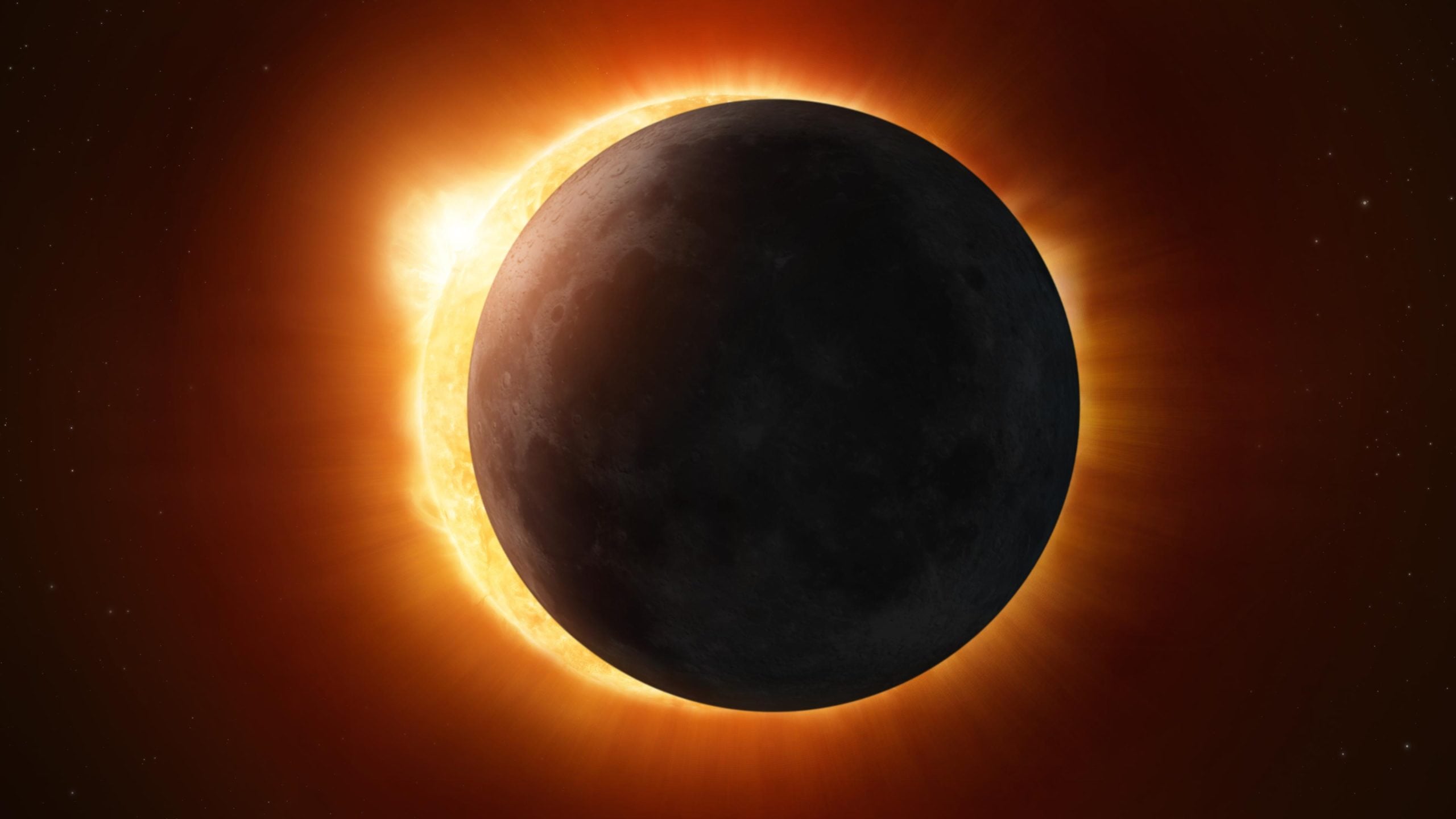
A rare total solar eclipse will sweep across parts of Europe on August 12, 2026, briefly turning daylight into darkness as the Moon completely covers the Sun.
Europe is about to experience a total solar eclipse, and people around the world will be able to watch it live. The European Space Agency (ESA) will begin its broadcast at 1:30 p.m. EDT on August 12, bringing the rare celestial event directly to viewers wherever they are.
Quick links
- ESA live broadcast on YouTube (August 12, 1:30–2:45 p.m. EDT)
- Live telescope coverage on YouTube (August 12, 1:30–2:45 p.m. EDT)
- Public event schedule in León, Spain (August 12, 4:00–8:00 a.m. and 11:30 a.m.–3:45 p.m. EDT)
A solar eclipse happens when the Moon moves directly between Earth and the Sun, temporarily covering the Sun and casting a narrow shadow across part of Earth’s surface.
When the Moon hides the Sun’s brilliant disk, the Sun’s faint, wispy outer atmosphere becomes visible. The sudden change can transform the sky and the environment below. Stars and planets may become visible, temperatures can fall, winds can strengthen, and some birds and insects may begin behaving as though night has arrived.
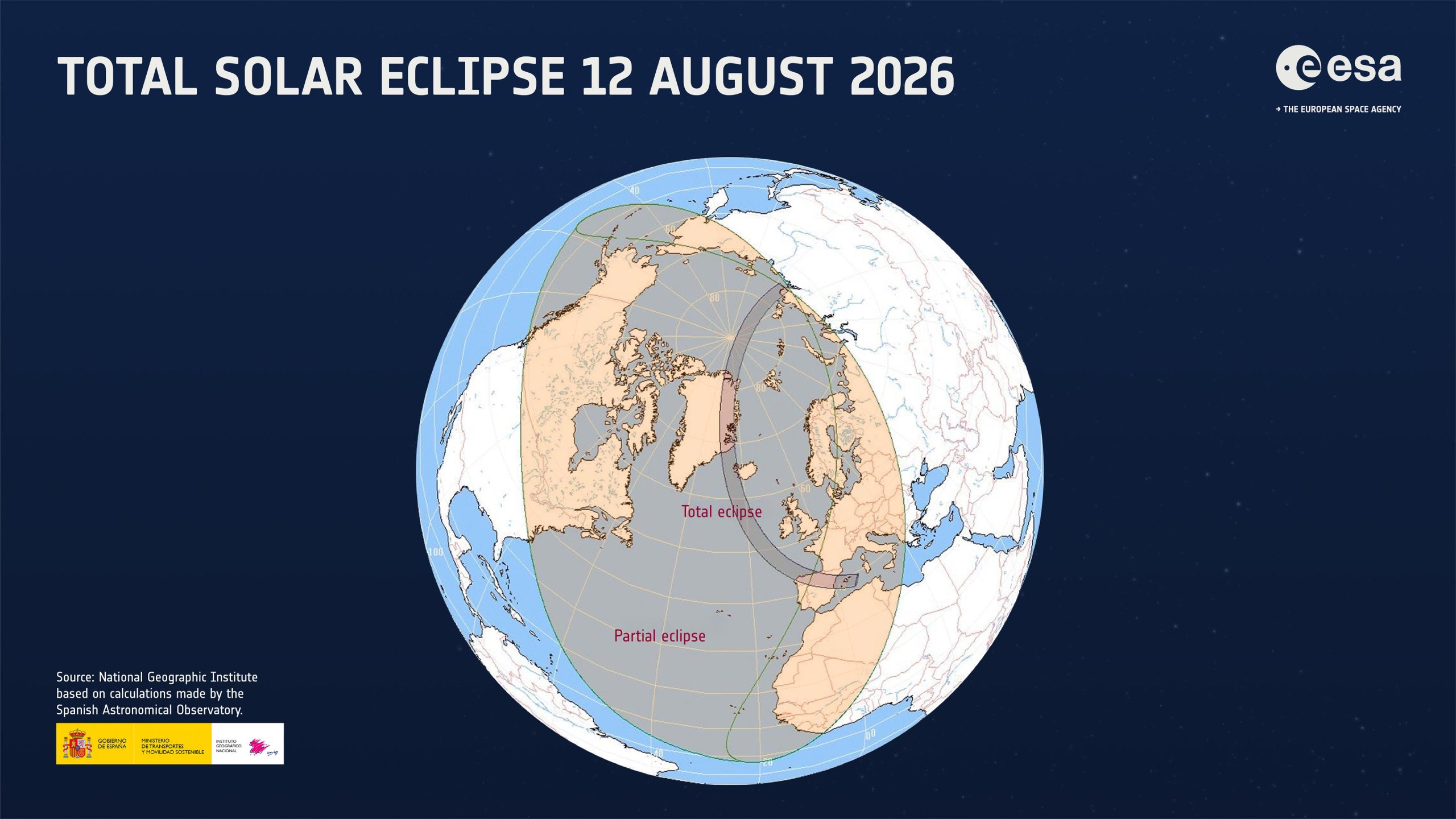
On August 12, 2026, people across a large portion of Europe will be able to see a solar eclipse. The narrow path of totality, where the Moon completely covers the Sun, will pass across Greenland, Iceland, a small section of northeastern Portugal, and then Spain.
Much of the rest of Europe will experience a partial solar eclipse. From those locations, the Moon will appear to take a ‘bite’ out of the Sun, causing daylight to dim somewhat.
ESA Will Broadcast the Eclipse Live From Spain
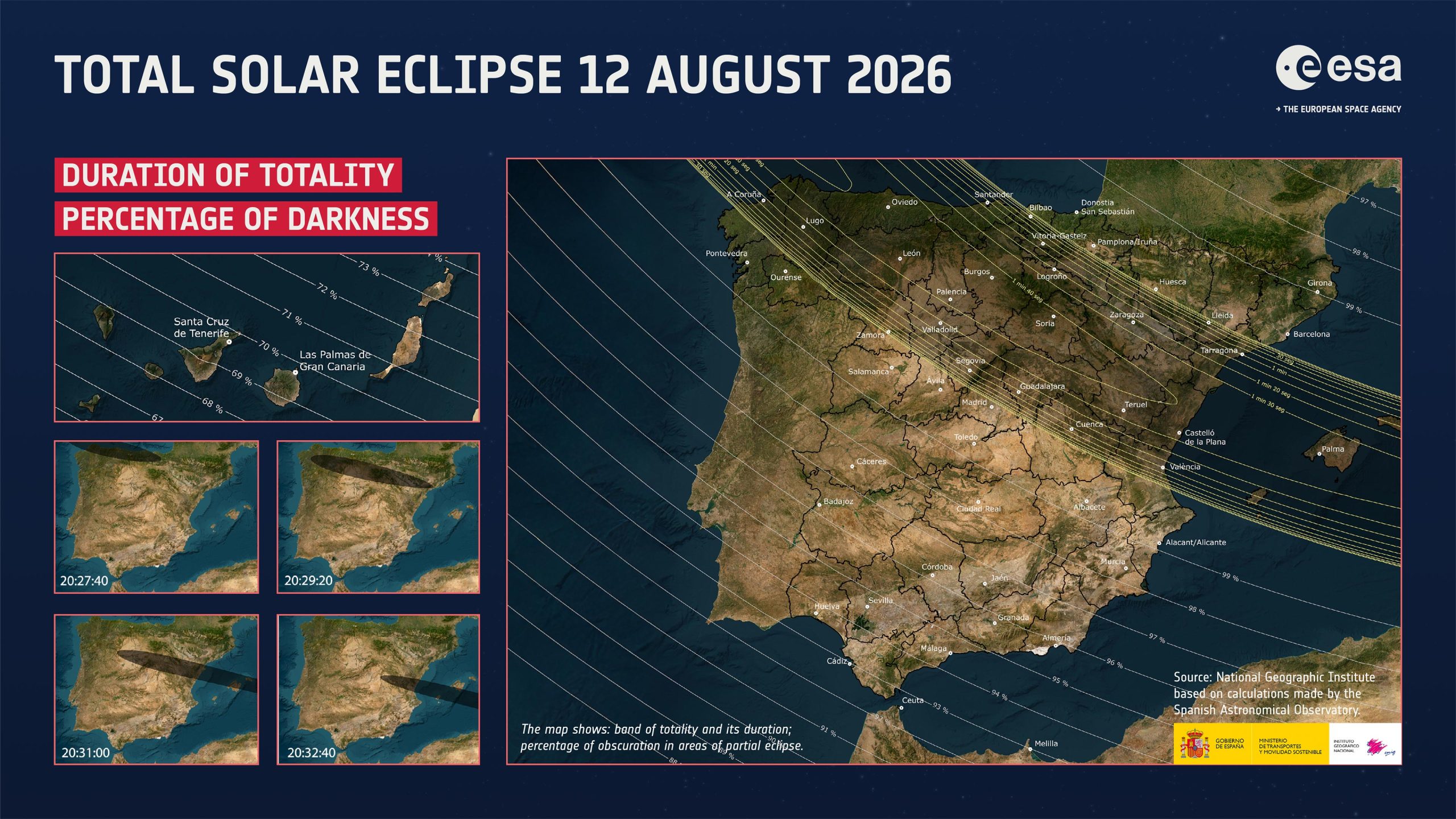
ESA will mark the occasion with a live broadcast from the Observatorio Astrofísico de Javalambre in Teruel (Spain). Spain is particularly well placed for viewing because the eclipse will travel across the country from west to east under favorable observing conditions.
Viewers can tune in through ESA Web TV or ESA’s YouTube channel beginning at 1:30 p.m. EDT on August 12.
Dame Dr. Maggie Aderin, an award-winning space scientist and science communicator, will host the broadcast. Guests will include ESA’s Director of Science Professor Carole Mundell, ESA scientists Andy To, Miho Janvier and Martin Hewitson, and observatory director Javier Cenarro.
The program will combine live interviews, accessible explanations, and dramatic eclipse imagery. Topics will include unanswered questions about the Sun and its corona, the famous eclipse that helped transform our understanding of gravity, and ESA’s efforts to create artificial solar eclipses in space.
81 Seconds of Total Darkness
The main event will arrive at 2:31 p.m. EDT, when Javalambre experiences 1 minute and 21 seconds of totality. During that brief period, the Moon will completely cover the Sun and plunge the observatory into darkness.
Coverage will include telescope views and drone footage of the eclipse. Viewers will also see Maggie and Carole react as they experience totality firsthand.
Anyone with a question about the eclipse can submit it using #AskESA on Bluesky or X. Some of those questions will be selected and answered live during the broadcast. Additional details are provided toward the end.
The program will be presented in English and is expected to finish at about 2:45 p.m. EDT.
Why Javalambre Is Ideal for Eclipse Viewing
The Observatorio Astrofísico de Javalambre is a major astronomical observatory situated directly inside the path of totality. Its primary facilities include two professional telescopes built to conduct wide-sky astronomical surveys. These observations help scientists investigate galaxies, dark energy, and the large-scale structure of the cosmos.
Conditions at Javalambre are especially favorable for astronomy. Clouds are uncommon, light pollution is minimal, and the observatory has an exceptionally clear view toward the western horizon. That will be important because the Sun will be approaching sunset as the Moon moves in front of it.
Several smaller telescopes will also be brought to the observatory specifically for eclipse observations. Their live feed will continuously follow the Moon as it crosses the Sun, providing close views of the different stages of the eclipse.
During the broadcast, observatory Director Javier Cenarro will discuss Javalambre and explain its significance for a future ESA space science mission.
Multiple Live Feeds From the Path of Totality
ESA will not rely on Javalambre alone for live eclipse imagery. Observations will also be transmitted from two additional sites inside the path of totality, improving the chances of capturing clear, high-quality views throughout the event.
One live feed will come from ESA’s public event in León. Another will originate in Frómista (Palencia), where collaborator Alejandro Sánchez de Miguel will be conducting eclipse observations. He is affiliated with the Institute of Astrophysics of Andalusia, the Complutense University of Madrid, and the Stars4All Foundation.
Never miss a breakthrough: Join the SciTechDaily newsletter.
Follow us on Google and Google News.