
Close Menu
    Facebook X (Twitter) Instagram
    SciTechDaily
    • Biology
    • Chemistry
    • Earth
    • Health
    • Physics
    • Science
    • Space
    • Technology
    Facebook X (Twitter) Pinterest YouTube RSS
    SciTechDaily
    Home»Space»ESA’s Euclid Mission Receives Final Approval
    Space

    ESA’s Euclid Mission Receives Final Approval

    By European Space Agency (ESA)June 22, 2012No Comments3 Mins Read
    Facebook Twitter Pinterest Telegram LinkedIn WhatsApp Email Reddit
    Share
    Facebook Twitter LinkedIn Pinterest Telegram Email Reddit
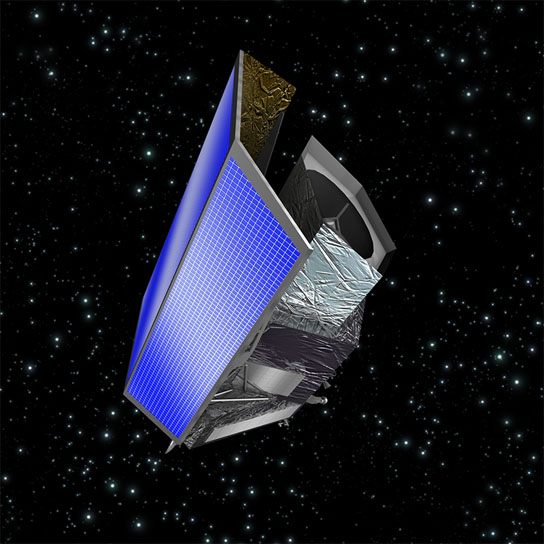
    Artist's impression of Euclid
    Artist’s impression of Euclid. Credit: ESA/C. Carreau

    Designed to help scientists understand why the Universe expanding at an accelerating rate, ESA’s Euclid mission received final approval and will move into the construction phase with its launch planned for 2020.

    Selected in October 2011 alongside Solar Orbiter as one of the first two medium-class missions of the Cosmic Vision 2015-25 plan, Euclid received final approval from ESA’s Science Program Committee to move into the full construction phase, leading to its launch in 2020.

    The committee also formalized an agreement between ESA and funding agencies in a number of its Member States to develop Euclid’s two scientific instruments, a visible-wavelength camera, and a near-infrared camera/spectrometer, and the large distributed processing system needed to analyze the data they produce.

    Finally, the committee agreed on a Memorandum of Understanding between ESA and NASA that will see the US space agency help to provide infrared detectors.

    Nearly 1000 scientists from 100 institutes form the Euclid Consortium building the instruments and participating in the scientific harvest of the mission.

    “This formal adoption of the mission is a major milestone for a large scientific community, their funding agencies, and also for European industry,” said Alvaro Giménez Cañete, ESA’s Director of Science and Robotic Exploration.

    “It took a lot of hard work to get this far, but we now have a solid blueprint for a feasible space telescope which enables very accurate measurements that will bring to light the nature of dark energy,” said Yannick Mellier, the Euclid Consortium lead.

    In the coming months, industry will be asked to make bids to supply spacecraft hardware, such as the telescope, power systems, attitude and orbit controls, and communications systems.

    Euclid will use a 1.2-m (3.9-ft) diameter telescope and the two instruments to map the 3D distribution of up to two billion galaxies and dark matter associated with them, spread over more than one-third of the whole sky.

    Stretched across ten billion light-years, the mission will plot the evolution of the Universe’s structure over three-quarters of its history.

    Euclid is optimized to answer one of the most important questions in modern cosmology: why is the Universe expanding at an accelerating rate, rather than slowing down due to the gravitational attraction of all the matter in it?

    The discovery of this cosmic acceleration in 1998 was rewarded with the Nobel Prize for Physics in 2011 and yet we still do not know what causes it.

    The term ‘dark energy’ is often used to signify this mysterious force, but by using Euclid to study its effects on the galaxies and clusters of galaxies across the Universe, astronomers hope to come much closer to understanding its true nature and influence.

    “Euclid addresses the cosmology-themed questions of ESA’s Cosmic Vision and it’s fantastic that we are moving forward into the next stage of development – we’re one step closer to learning more about the Universe’s darkest secrets,” said René Laureijs, ESA’s Euclid project scientist.

    Never miss a breakthrough: Join the SciTechDaily newsletter.
    Follow us on Google and Google News.

    Astronomy Cosmology Dark Matter European Space Agency Exploration NASA
    Share. Facebook Twitter Pinterest LinkedIn Email Reddit

    Related Articles

    Hubble’s Newest Discovery Isn’t a Star, It’s a Window Into the Dark Universe

    Dark Matter Surplus Captured by Hubble

    Hubble Captures Edge of the Cygnus Supernova Blast Wave

    NuSTAR Helps Solve Forty-Year-Old Neutron Star Mystery

    Astronomers Use Galaxy Clusters to Reveal New Dark Matter Insights

    ESA Euronews Video: The Dark Side

    Module for ESA’s Euclid ‘Dark Universe’ Mission in Development

    Detailed Map Reveals New Information about the Age, Contents and Origins of the Universe

    The Bolshoi Simulation: Boxing the Universe

    Leave A Reply Cancel Reply

    • Facebook
    • Twitter
    • Pinterest
    • YouTube

    Don't Miss a Discovery

    Subscribe for the Latest in Science & Tech!

    Trending News

    Bone-Strengthening Discovery Could Reverse Osteoporosis

    Scientists Uncover Hidden Trigger Behind Stem Cell Aging

    Scientists Find Way to Reverse Fatty Liver Disease Without Changing Diet

    Could Humans Regrow Limbs? New Study Reveals Promising Genetic Pathway

    Scientists Reveal Eating Fruits and Vegetables May Increase Your Risk of Lung Cancer

    Scientists Reverse Brain Aging With Simple Nasal Spray

    Scientists Uncover Potential Brain Risks of Popular Fish Oil Supplements

    Scientists Discover a Surprising Way To Make Bread Healthier and More Nutritious

    Follow SciTechDaily
    • Facebook
    • Twitter
    • YouTube
    • Pinterest
    • Newsletter
    • RSS
    SciTech News
    • Biology News
    • Chemistry News
    • Earth News
    • Health News
    • Physics News
    • Science News
    • Space News
    • Technology News
    Recent Posts
    • Wind Farms Are Disrupting Ocean Currents, Moving Millions of Tons of Mud Each Year
    • Scientists Discover Massive Magma Reservoir Beneath Tuscany
    • Scientists Create “Neurobots” – Living Machines With Their Own Nervous Systems
    • Europe’s Most Active Volcano Just Got Stranger – Here’s Why Scientists Are Rethinking It
    • Why Are Giant Ants Letting Tiny Ants Crawl All Over Them?
    Copyright © 1998 - 2026 SciTechDaily. All Rights Reserved.
    • Science News
    • About
    • Contact
    • Editorial Board
    • Privacy Policy
    • Terms of Use

    Type above and press Enter to search. Press Esc to cancel.