
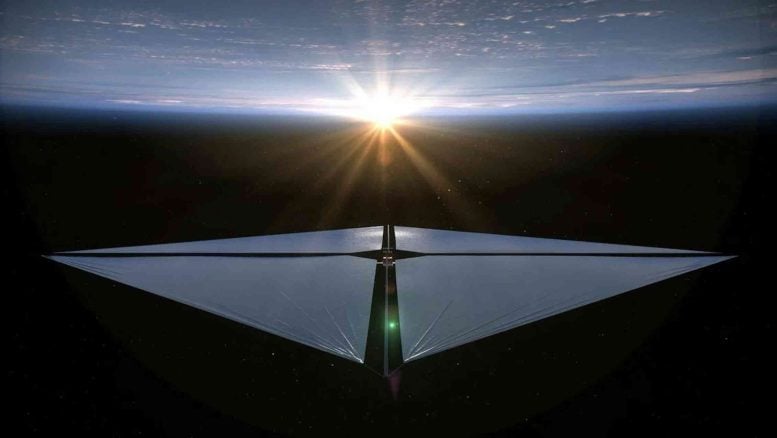
Tiny spacecraft riding beams of light could put humanity within reach of another star system in a single lifetime.
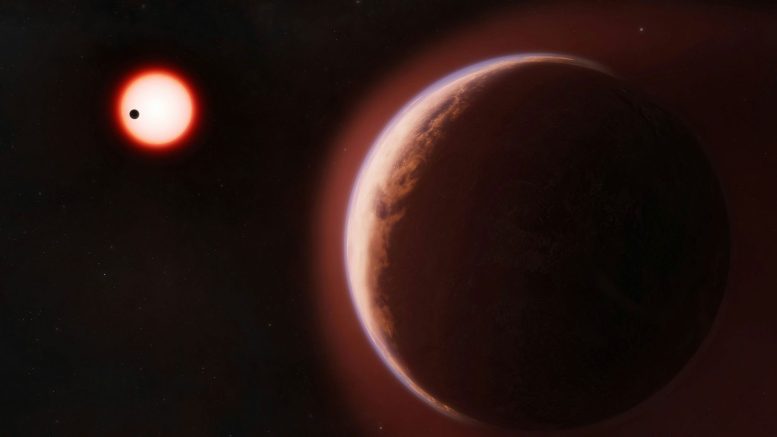
The recent confirmation of an atmosphere around a rocky exoplanet called LHS 1140b has created a wave of interest within the astronomy community. The planet orbits within the habitable zone around its parent star—a red dwarf located some 48 light-years from Earth.
The habitable zone is the region around the star where temperatures are just right for water to remain liquid at a planet’s surface. Astronomers detected helium being lost from the upper atmosphere of LHS 1140b. But heavier chemical compounds, such as water, which is a key ingredient for life, could exist lower in its atmosphere.
Observing distant exoplanets using telescopes opens new doors for science, but will it ever be possible to travel to these worlds and observe them up close? While this has generally been seen as the stuff of science fiction until now, emerging technologies allow us to imagine a future where such missions are possible in the decades ahead.
Tiny Spacecraft for Interstellar Exploration
There is particular interest in miniaturized spacecraft for interstellar voyages. In large part, this is because it’s easier and cheaper to propel a small spacecraft to another star system—and have it get there within a person’s lifetime—than it is to do the same with a large vehicle.
Miniaturization of sensors has seen great advances, for example, through smartphone technology, where highly capable cameras with low mass, power, and volume are routinely used. Researchers have even developed “smart dust” sensors that are millimeter-scale in size or smaller that can detect light, temperature, or chemicals.
The space probe itself would need a form of propulsion capable of accelerating it to mildly relativistic speeds, say 10-20% of the speed of light. After a travel time of many decades, the sensors would pass through a target star system without stopping, making in-situ observations and then very slowly dripping data back to Earth.
Light Sails Could Reach Nearby Stars
This isn’t quite Star Trek, but it’s a potentially plausible idea that would enable us to study neighboring stars and their planets up close. This kind of concept has been actively pursued by a philanthropically funded venture known as Breakthrough Starshot. This program investigated the key technologies required for an interstellar journey using small probes.
Light sails are seen as one of the most suitable forms of propulsion for such a mission. As the name implies, these are thin, reflective membranes.
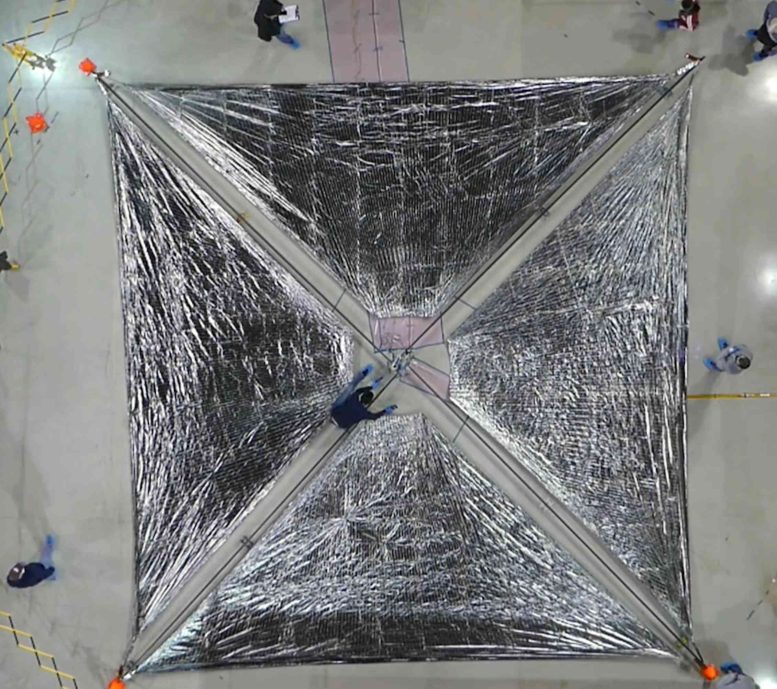
For interstellar travel, directed energy from a laser could be used to push the spacecraft forward. Photons, the quantum packets of energy of which light is composed, transport momentum as well as energy. Therefore, when light reflects off a mirror, it exerts a pressure on the mirror.
Lasers Could Propel Probes at Relativistic Speeds
In most circumstances, the pressure due to light is imperceptibly small. However, for an intense enough beam of light and an ultra-lightweight membrane mirror, light pressure can act as a means of spacecraft propulsion.
In order to accelerate a light sail to relativistic speeds, a hefty laser would be required, with an effective power of tens of gigawatts. This wouldn’t be a single device. Instead, it would probably comprise an array of separate laser devices synchronized together to generate a beam of coherent light.
Pushing a reflective light sail a few meters across with such a laser would accelerate the sail to its cruising speed in a matter of minutes.
The Promise—and Limits—of Beam-Powered Flight
The advantage of beam-power propulsion systems is that the laser assembly is left behind, and only a small payload is accelerated to the stars. In contrast, conventional rockets have to haul their own propellant, which puts them at a severe disadvantage for such ultra-high energy missions.
The disadvantage of beam power propulsion is that the payload can’t easily stop, so a probe would pass through its target star system in only a few days.
While multi-gigawatt laser-pushed light sails may seem to be a bit of a stretch at present due to the colossal scale of such a venture, advances in miniaturization could pave the way for tiny intelligent sensor nodes to be our first interstellar voyagers.
Perhaps we’ll first travel to the stars with an AI asleep at the wheel for decades, until it awakens for a few days of frantic activity as our machine proxies get their first glimpse of alien worlds.
Solar Sails Are Already Taking Flight
Aside from pushing light sails with gigawatt lasers, reflective membranes can also be pushed by light pressure from the Sun. These “solar sails” have a long and rich history and were first proposed in the 1920s by Konstantin Tsiolkovsky and Friedrich Tsander, two of the great Russian pioneers of astronautics. Tsiolkovsky wrote of using “tremendous mirrors of very thin sheets”.
While laser-propelled light sails are for the future, solar sails are for the present. A number of small solar sails have already been launched into Earth orbit for technology demonstration purposes. Scaling up solar sails for deep space missions could deliver a new set of tools for exploring our solar system.
Propellant-Free Missions to Comets and Beyond
First, since solar sails do not need to carry propellant, they are capable of high-energy, long-duration missions, some of which are just about impossible for conventional spacecraft. For example, rendezvousing with a long-period comet on an elliptical or highly inclined orbit about the Sun requires significant energy.
Moreover, returning a surface sample from such a comet to Earth becomes even more difficult. For conventional rocket propulsion, the spacecraft needs to haul propellant for the return journey all the way to the target comet.
For solar sails, returning to Earth is little different from reaching the comet in the first place. Solar sails can “tack” by tilting the sail to gain momentum and so spiral away from the Sun or flipping the sail to lose momentum and spiral back inwards towards the Sun.
From the Solar System to Alien Worlds
Solar sails can also move along unconventional orbits with light pressure used to offset gravity. For example, this could allow a solar sail to hover stationary high above the poles of the Earth.
Solar sails and light sails are stepping stones from the present to the future and from exploring our own solar system to exploring distant stars. Perhaps exoplanet LHS 1140b will be visited by a light sail at some point in our future.
Colin McInnes receives funding from the Royal Academy of Engineering, the European Research Council and the Advanced Research + Inventions Agency.
Adapted from an article originally published in The Conversation. 
Never miss a breakthrough: Join the SciTechDaily newsletter.
Follow us on Google and Google News.
10 Comments
Could you ask these scientists to hurry up please because I am 75 years old this year and would love to see this happen on my lifetime.
I am really happy that we humans (not me) are doing research and finding ways and means to find, to know, and to reach, the Universe. But it is also necessary to know or can i ask whether our (we humans) thoughts are uplifted upto the extent that ever if we reach the alian world, are we ready to accept them as an existance, and the creation of god ( The Supreme Power)
48 light years away means it takes at least 48 years to get there if they launch today. So you only need to live to 123 plus a few years to build the craft. No big deal.😚
Get a solar sail going at just 100 miles per second and we can reach Pluto again in about a year.
Send a bunch, get good imagery of the side of Pluto the New Horizons probe couldn’t see.
Science fiction fantasy. Solar sails might be somewhat feasible for propulsion within our solar system but the logistics, implementation, and cost are formidable obstacles with limited possibility of success. Trying to propel a spacecraft to another star system is an unrealistic fantasy.
James, you are peeing in my cornflakes.
Who else watched the DS9 episode where Ben & Jake Sisko piloted a vintage Bajoran solar sailship to Cardassia?
48 light years away means it takes at least 48 years to get there if they launch today. So you only need to live to 123 plus a few years to build the craft. No big deal.😚
At the rate civilization is going we are going to need to leave directions for how to open a sealed can in 50 years let alone have them understand what a meaage from anothef star is supposed to mean assuming it gets there.
Surely at 10% – 20% of the speed of light it would take between 480 and 240 years to travel 48 light years. Slightly more than a human lifetime.