
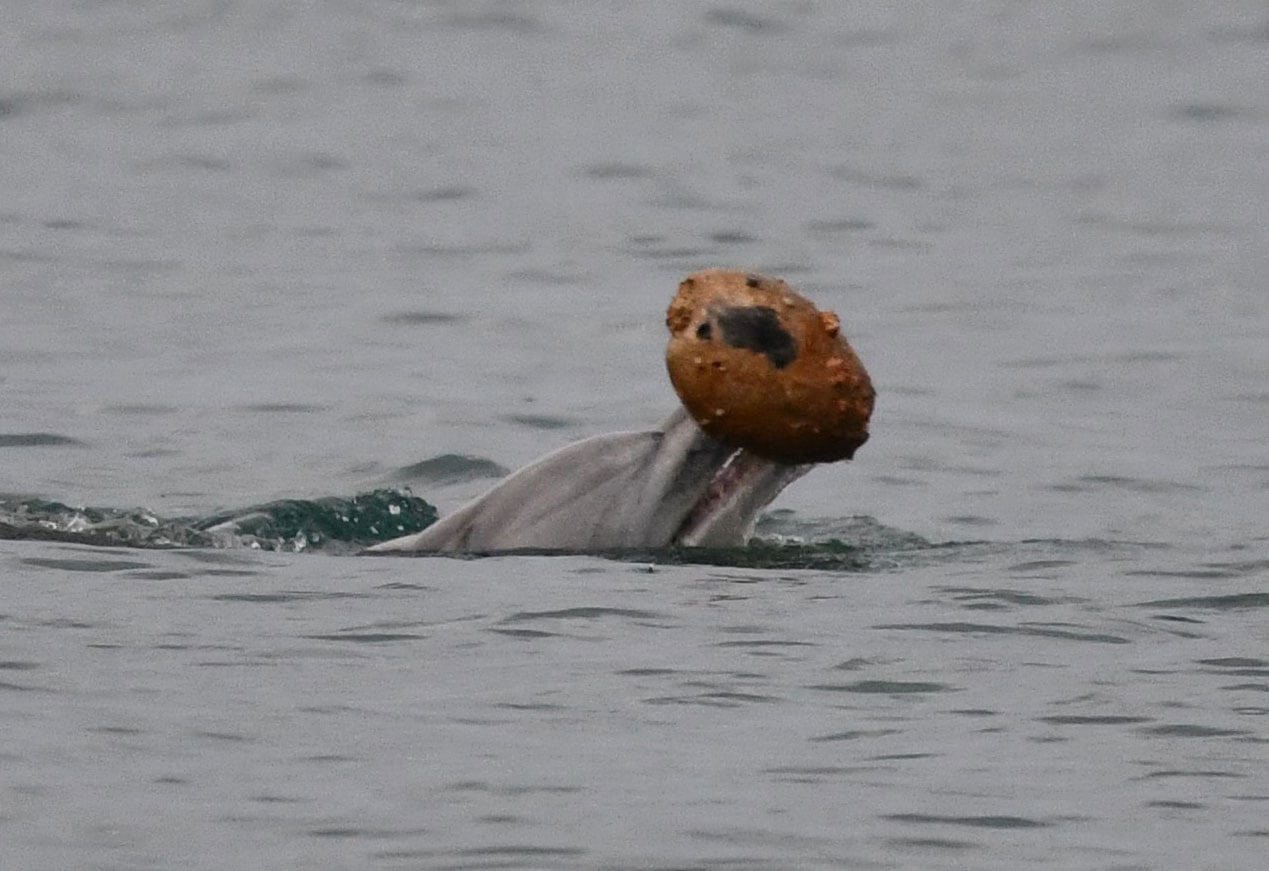
A dolphin rises from the water carrying an empty seashell in its jaws, but the shell is not empty for long. Inside, a trapped fish is about to become dinner.
An unusual hunting strategy, known as shelling, involves dolphins trapping fish inside empty seashells, carrying the shells to the surface, and shaking out the water so the prey slides into their mouths.
Scientists have now filmed this behavior on Australia’s east coast for the first time. The discovery comes thousands of kilometers from the Western Australian population where shelling was previously documented, and one observation suggests calves may learn the technique from their mothers.
Dolphins Turn Seashells Into Fishing Tools
Researchers from the University of the Sunshine Coast recorded two shelling events involving bottlenose dolphins in the Great Sandy Marine Park near Hervey Bay, Queensland, between July and October 2025. Until these observations, published scientific reports of the behavior had come from dolphins in Shark Bay on the opposite side of Australia.
Animal behaviorist and marine mammal expert Dr. Alexis Levengood, who led the new study, immediately recognized what was happening when the team encountered one of the dolphins.
“We were on a research boat off Hervey Bay when we spotted a dolphin raising something large out of the water. I started screaming because I know what shelling looks like,” Levengood said.
“It’s a hunting behavior where dolphins chase fish into large empty shells, bring the shell to the surface, and then shake it to drain the fish into their mouths.
“We were able to record footage and take photographs of dolphins shelling in the Great Sandy Marine Park, which is the first published record of it on the east coast of Australia.”
Calf Appears to Copy Its Mother
The most revealing encounter involved an adult female and her calf.
“We saw the mother surface with a shell; the fish inside escaped, and the dolphin dropped the shell to chase the fish. Then, minutes afterwards, the dolphin calf picked up the shell and held it the same way as its mother,” Levengood said.
That brief interaction raises a larger question about how dolphins acquire complex hunting skills.
“Our footage provides the first potential evidence of maternal social transmission – a process by which offspring learn behavior by observing the actions of its mother. It challenges the belief that dolphins learn this tool use from their peers.”
Dolphin calf captured on film by UniSC researchers while ‘shelling’ to catch fish. Credit: University of the Sunshine Coast Australia (or UniSC Australia)
Dolphin Tool Use and Social Learning
Social learning is especially important in long-lived, highly social animals because useful behaviors do not always need to be rediscovered by every generation. Instead, successful techniques can potentially spread through groups or persist as traditions.
Shelling has a scientific history stretching back years in Shark Bay, where researchers have studied dolphins placing fish inside large shells and manipulating those shells to extract their prey. Previous work there suggested that the unusual technique can spread socially rather than simply appearing at random in isolated individuals.
Shark Bay dolphins are also famous for another form of tool use: some carry marine sponges on their snouts while searching the seafloor for prey. Research has linked that behavior to access to fish that can be difficult to detect with echolocation, making the region one of the best known natural laboratories for studying dolphin innovation and socially transmitted foraging traditions.
The Queensland discovery is striking because the east coast dolphins apparently developed the same shell-based solution independently.
Same Hunting Strategy on Opposite Coasts
“Our observations in Queensland show that dolphins on opposite sides of Australia have learned to use tools in the exact same way, independent of one another,” Levengood said.
When separated animal populations arrive at a similar solution to the same problem, researchers can begin asking what environmental conditions, cognitive abilities, or opportunities make that innovation possible.
The technique is not necessarily new to the Hervey Bay dolphins.
After the researchers documented it, they discovered that Blue Dolphin Marine Tours had photographed shelling during trips in 2013 and again in 2019. Those earlier images suggest dolphins in the region may have been using shells as hunting tools for well over a decade without the behavior receiving scientific attention.
A Dolphin Behavior Hidden for Years
“We learned shelling had been photographed during boat trips run by Blue Dolphin Marine Tours during 2013 and 2019, indicating shelling has occurred in this population for longer than expected, but went unnoticed due to limited research in the region.”
That gap highlights a practical challenge in studying wild dolphins. Rare behaviors can last only seconds, occur unpredictably, and disappear beneath the surface before researchers have a chance to document them. In regions with relatively little long-term fieldwork, unusual traditions may persist for years without entering the scientific record.
What Scientists Still Want to Know
UniSC has increasingly enlisted members of the public to help researchers collect dolphin observations along the Queensland coast, partly because scientists cannot continuously survey such a large marine area on their own.
For Levengood, the new footage opens more questions than it answers. Researchers still want to determine how common shelling is around Hervey Bay, which dolphins perform it, how young animals acquire the skill, and whether environmental conditions influence where it emerges.
“There’s still a lot we don’t know and many questions we will hopefully ask and answer with time. But better understanding shelling and other tool use in non-human animals will continue to teach us more about ourselves and how and why we evolved the way we did.”
Reference: “Observations of Shelling Behavior and Potential Evidence of Vertical Social Learning by Bottlenose Dolphins in the Great Sandy Marine Park, Queensland Australia” by Alexis L. Levengood, Georgina V. Hume, Jessica M. Buckman, Isla Steel, Bridget E. Toohey, Peter Lynch and Cassandra Smith, 8 August 2026, Marine Mammal Science.
DOI: 10.1111/mms.70252
This article was supported by the Winifred Violet Scott Charitable Trust.
Never miss a breakthrough: Join the SciTechDaily newsletter.
Follow us on Google and Google News.