
In extreme heat, sweat can lose much of its cooling power for a reason scientists have largely overlooked: the air directly above the skin can become almost perfectly still.
Arizona State University researchers have identified a physical effect that can reduce sweat evaporation by more than half in hot, dry, windless conditions. The finding could change how scientists estimate heat danger inside tents, unfinished buildings, enclosed worksites, and other places with little airflow.
The discovery adds an unexpected chapter to a question that has fascinated researchers for centuries. In 1775, English physician Charles Brian Blagden and several friends entered rooms heated above 230° Fahrenheit. Raw meat was cooked in the same rooms, but the volunteers maintained nearly stable core temperatures as sweat poured from their bodies and evaporated.
“It turns out that the impact is huge,” said Konrad Rykaczewski, an associate professor of engineering at ASU. “It can change how much sweat evaporates from your skin by over 50 percent.”
When Sweat Stops Cooling the Body
Sweating alone does not remove much heat. Cooling happens when liquid sweat absorbs energy from the skin and escapes into the air as water vapor. Sweat that remains on the body or drips away provides far less benefit.
Evaporation becomes especially important when the surrounding air is hotter than the skin. Under those conditions, the body can gain heat from its environment, leaving sweat evaporation as its primary defense against overheating.
The ASU team examined how temperature and humidity create competing air currents near the body. Hot air that touches cooler skin becomes denser and sinks. At the same time, moisture released by evaporating sweat creates an upward current because humid air is lighter than dry air.
At around 105° F, with low humidity and no wind, those currents can completely cancel each other. With little air moving across the skin, evaporation slows, and the body stores more heat. When researchers excluded this effect from their calculations, they underestimated the rise in a resting person’s core temperature by nearly 2° F after two hours of exposure.
Testing Extreme Heat With ANDI
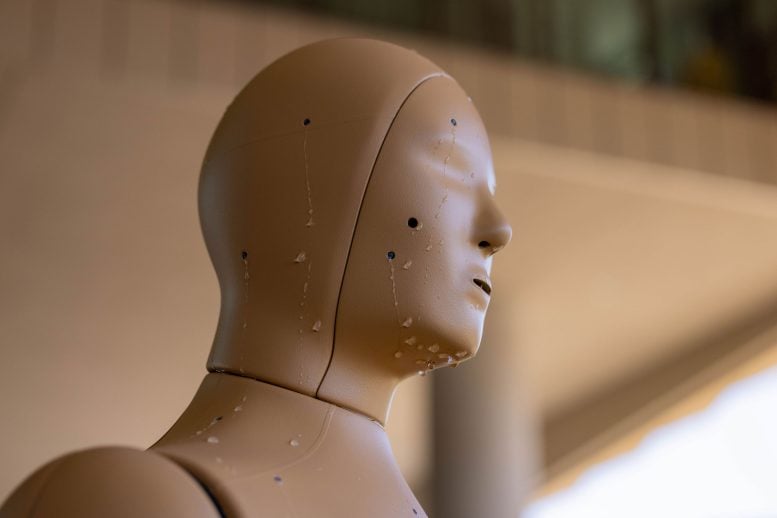
Instead of placing volunteers in dangerous conditions, the researchers used ANDI, a customized manikin built to simulate human heat exchange. Sensors distributed throughout its body measure heat gain and loss, while pores on its surface release simulated sweat as temperatures increase.
The team conducted dozens of experiments with the manikin, developed a computerized version of ANDI, and ran about 100 sweating simulations across a wide range of environmental conditions. These tests allowed the researchers to separate the many ways heat moves between the body and its surroundings.
“There are multiple heat-transfer pathways involved, so isolating each one, making sure we could replicate it computationally, and then combining them all into one model took a tremendous amount of effort,” Rykaczewski said.
Rykaczewski published the findings in Science Advances with first author Shri Viswanathan and eight other ASU researchers.
A Blind Spot in Heat Models
The competing buoyancy forces are already familiar to engineers who study heat exchange in electronics, “but it’s been overlooked in terms of the human body,” Rykaczewski said. “I think the reason is that most people working in this area don’t come from an engineering background. It really shows the benefit of having engineers and physiologists working together in interdisciplinary research.”
Most human heat balance models do not account for the way humidity from sweat alters air movement near the skin. As a result, they may predict more evaporation than actually occurs and underestimate how quickly someone becomes dangerously hot in a dry environment without wind.
“This is really important for indoor settings or places with very little air movement,” Rykaczewski said. “Think about a tent, or a partially enclosed worksite or an unfinished building.”
More accurate models could strengthen safety recommendations for workers exposed to extreme heat. They could also improve cooling clothing and heat management systems designed for first responders, soldiers, athletes, and others who must remain active in high temperatures.
How Sweat Forms a Cooling Film
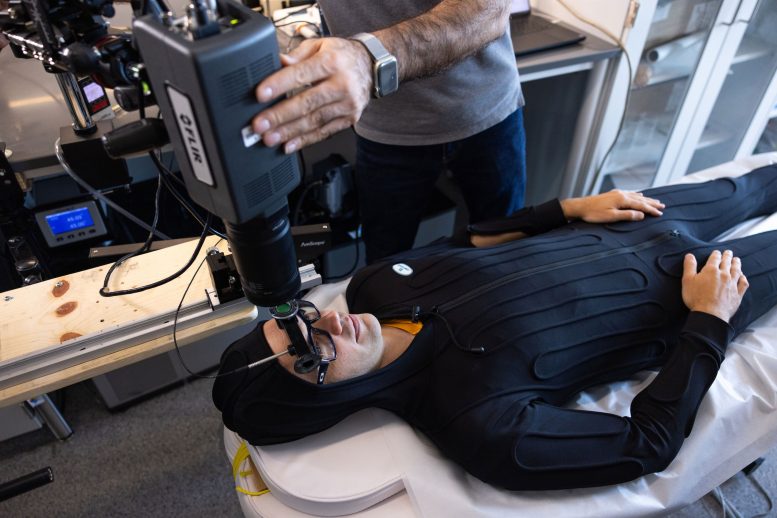
The latest discovery builds on earlier ASU research into how perspiration moves across human skin. Last year, the team uncovered hidden details using volunteers dressed in body suits lined with tubes carrying hot or cold water. By heating and cooling the participants, the researchers could watch sweat emerge and spread.
They found that perspiration first saturated the skin’s outermost layer. It then gathered in shallow pools around individual pores before joining into a thin, continuous film.
After that initial sweat evaporated, it left a faint salt residue. When the volunteers were heated again, the salt helped fresh sweat wick across the skin more quickly, allowing the film to develop without repeating the earlier pooling stage.
A continuous film can expose more liquid to the air and potentially make evaporation more efficient. The findings also indicate that sweat may behave differently across the body as hair coverage, gland density, and skin structure change from one area to another.
Building Better Protection From Heat
Major questions remain about what determines whether sweat clings to the skin and evaporates or runs off the body before providing much cooling. The ASU team plans to investigate how skin, perspiration, and clothing textiles interact under different conditions.
“The bigger question is how you manage that sweat and what kinds of materials you can put next to the skin to optimize cooling,” Rykaczewski said.
The work could lead to clothing that spreads sweat across a larger area, keeps it near the skin, and encourages evaporation. Across Arizona, the researchers are also combining advanced environmental sensors with improved models of sweating and temperature regulation to study how different populations experience extreme heat. Their results are helping inform heat adaptation strategies and the design of safer buildings and outdoor spaces.
Sweating was not a subject Rykaczewski expected to pursue when he began his career, but its combination of complex physics and universal relevance drew him in. “It’s funny because it’s kind of an icky topic but it’s also fascinating. You can spend your entire career doing highly specialized research that only twenty experts care about. But not sweating because everybody sweats.”
Reference: “Perspiration vapor lightens near-skin air, but hinders human evaporative cooling in arid heat” by Shri H. Viswanathan, Ankit Joshi, Isabella DeClair, Bryce Twidwell, Muhammad Abdullah, Lyle Bartels, Faisal Abedin, Joseph Rotella, Cibin T. Jose and Konrad Rykaczewski, 19 August 2026, Science Advances.
DOI: 10.1126/sciadv.aee4703
Never miss a breakthrough: Join the SciTechDaily newsletter.
Follow us on Google and Google News.