
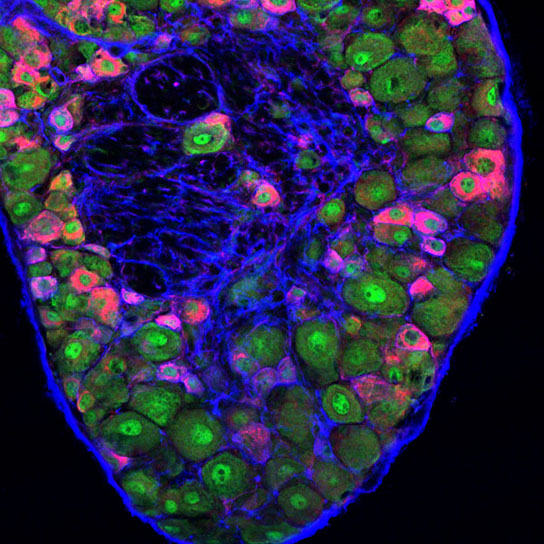
A new study from researchers at the University of North Carolina describes how they used PAPupuncture to deliver long-lasting pain relief by exploiting the molecular mechanism behind acupuncture. While working with animal models, the scientist found that by injecting PAP into the popliteal fossa, the Weizhong acupuncture point, pain relief lasted 100 times longer than traditional acupuncture treatment.
Scientists at the University of North Carolina at Chapel Hill have identified a new way to deliver long-lasting pain relief through an ancient medical practice.
In an article published in the April 23 online edition of Molecular Pain, UNC researchers describe how exploiting the molecular mechanism behind acupuncture resulted in six-day pain relief in animal models. They call this new therapeutic approach PAPupuncture.
Principal investigator Mark J. Zylka, PhD, associate professor in the Department of Cell and Molecular Physiology and the UNC Neuroscience Center, said this is a promising study that moves his lab’s work with prostatic acid phosphatase, known as PAP, towards translational research.
Several years ago, Zylka and members of his lab documented how injecting PAP into the spine eased chronic pain for up to three days in rodents. The only problem was PAP’s delivery.
“Spinal injections are invasive and must be performed in a clinical setting, and hence are typically reserved for patients with excruciating pain,” said Zylka. Though he had never received acupuncture or researched traditional Chinese medicine, Zylka said recent research showing how acupuncture relieved pain caught his eye.
“When an acupuncture needle is inserted into an acupuncture point and stimulated, nucleotides are released. These nucleotides are then converted into adenosine,” said Zylka. Adenosine has antinociceptive properties, meaning adenosine can decrease the body’s sensitivity to pain. The release of adenosine offers pain relief, but for most acupuncture patients that relief typically lasts for a few hours.
“We knew that PAP makes adenosine and lasts for days following spinal injection, so we wondered what would happen if we injected PAP into an acupuncture point?” Zylka said. “Can we mimic the pain relief that occurs with acupuncture, but have it last longer?”
To find out, Zylka and his lab injected PAP into the popliteal fossa, the soft tissue area behind the knee. This also happens to be the location of the Weizhong acupuncture point. Remarkably, they saw that pain relief lasted 100 times longer than a traditional acupuncture treatment. What’s more, by avoiding the spine the researchers could increase the dose of PAP. A single injection was also effective at reducing symptoms associated with inflammatory pain and neuropathic pain.
“Pinning down the mechanisms behind acupuncture, at least in animal models, was critical,” said Zylka. “Once you know what chemicals are involved, you can exploit the mechanism, as we did in our study.”
The next step for PAP will be refining the protein for use in human trials. UNC has licensed the use of PAP for pain treatment to Aerial BioPharma, a Morrisville, N.C.-based biopharmaceutical company.
Zylka said PAP could be applicable to any area where regional anesthesia is performed to treat pain. And PAP has the potential to last longer than a single injection of local anesthetic—the class of drugs used in regional anesthesia.
“When it comes to pain management, there is a clear need for new approaches that last for longer periods of time,” said Julie Hurt, PhD, a postdoctoral fellow in Zylka’s lab.
Reference: “PAPupuncture Has Localized and Long-Lasting Antinociceptive Effects in Mouse Models of Acute and Chronic Pain” by Julie K Hurt and Mark J Zylka, 1 January 2012, Molecular Pain.
DOI: 10.1186/1744-8069-8-28
Zylka co-authored the paper with Hurt. The research was undertaken at UNC and was supported by the National Institute of Neurological Disorders and Stroke, a component of the National Institutes of Health.
Never miss a breakthrough: Join the SciTechDaily newsletter.
Follow us on Google and Google News.
1 Comment
thank you