
Close Menu
    Facebook X (Twitter) Instagram
    SciTechDaily
    • Biology
    • Chemistry
    • Earth
    • Health
    • Physics
    • Science
    • Space
    • Technology
    Facebook X (Twitter) Pinterest YouTube RSS
    SciTechDaily
    Home»Biology»Blind Golden Moles Have a Blue-Green Iridescent Sheen, a Rare Example in Mammals
    Biology

    Blind Golden Moles Have a Blue-Green Iridescent Sheen, a Rare Example in Mammals

    By SciTechDailyFebruary 13, 20121 Comment2 Mins Read
    Facebook Twitter Pinterest Telegram LinkedIn WhatsApp Email Reddit
    Share
    Facebook Twitter LinkedIn Pinterest Telegram Email Reddit
    golden-mole-Eremitalpa
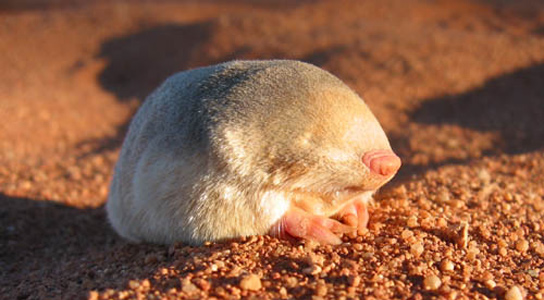
    Namib Desert Golden Mole, Eremitalpa granti namibensis. Credit: Photo by G. Rathbun

    Golden moles, mammals forming the family of Chrysochloridae, which taxonomically is distinct from true moles but to which they resemble due to species convergence, are a small, insectivorous family of burrowing mammals native to southern Africa. It was recently discovered that they have a blue green sheen to their coats, which is a rare example of iridescence in mammals.

    The golden moles bear a resemblance to the marsupial moles of Australia, so much so that, if the marsupial/placenta divide is ignored, it’s possible that they were once related.

    studied-golden-mole

    Matthew Shawkey, a biologist at the University of Akron, Ohio, and his colleagues conducted the first detailed study of the iridescent out hairs and non-iridescent downy hairs from four species of golden moles. The study was published recently in the journal Biology Letters.

    The iridescent hairs were highly flattened with much smaller scales, which form multiple layers, alternating between light and dark colors, than their counterparts. These hairs produce iridescence by a phenomenon called thin-film interference. The four studied mole species are blind, so it’s very unlikely that this evolved as sexual ornamentation.

    Iridescence is widespread among birds and arthropods, but only rarely seen in mammals. It was thought that like other metazoans, the mammalian integument is limited in color. The four examined golden mole species have sheens ranging from purple to green. The study also examined the color, morphology and optical mechanisms in these hairs.

    The authors hypothesize that the iridescence of these animals is a by-product of adaptation for durable, low-friction pelts to make burrowing easier.

    Reference: “Iridescent colour production in hairs of blind golden moles (Chrysochloridae)” by Holly K. Snyder, Rafael Maia, Liliana D’Alba, Allison J. Shultz, Karen M. C. Rowe, Kevin C. Rowe and Matthew D. Shawkey, 25 January 2012, Biology Letters.
    DOI: 10.1098/rsbl.2011.1168

    Never miss a breakthrough: Join the SciTechDaily newsletter.
    Follow us on Google and Google News.

    Biophotonics Blind Evolution Hair Iridescence Mammals Physiology
    Share. Facebook Twitter Pinterest LinkedIn Email Reddit

    Related Articles

    Mystery of How Flying Snakes Move Solved by 3D Modeling and Motion Capture

    Testing the Patience of Predators and Prey – Snakes and Frogs Appear to Anticipate Each Other

    “Hiding in Plain Sight” – Origins of Human Language Pathway in the Brain at Least 25 Million Years Old

    These Fierce Predators Have Incredible Vision and a Newly Discovered Brain Region to Process It

    How Mammals’ Complex “Frankenstein’s Monster” Backbones Evolved

    Extra Finger Discovered on Aye-Aye, Making the World’s Weirdest Primate Even Weirder [Video]

    Scientists Replicate the Molecular Processes That Led from Dinosaur Snouts to Bird Beaks

    Human Y-Chromosome Has Enough Genes to Stay for Millions of Years

    Study Measures Mammalian Growth, Taking 24 Million Years to Go from Mouse to Elephant

    1 Comment

    1. Hestia on November 18, 2014 11:47 pm

      What a wonderful website! Thank you so much for the wonderful information! I was struggling to find anything about Moles until I found this website!

      Reply
    Leave A Reply Cancel Reply

    • Facebook
    • Twitter
    • Pinterest
    • YouTube

    Don't Miss a Discovery

    Subscribe for the Latest in Science & Tech!

    Trending News

    New Study Reveals Why Ozempic Works Better for Some People Than Others

    Climate Change Is Altering a Key Greenhouse Gas in a Way Scientists Didn’t Expect

    New Study Suggests Gravitational Waves May Have Created Dark Matter

    Scientists Discover Why the Brain Gets Stuck in Schizophrenia

    Scientists Engineer “Tumor-Eating” Bacteria That Devour Cancer From Within

    Even “Failed” Diets May Deliver Long-Term Health Gains, Study Finds

    NIH Scientists Discover Powerful New Opioid That Relieves Pain Without Dangerous Side Effects

    Collapsing Plasma May Hold the Key to Cosmic Magnetism

    Follow SciTechDaily
    • Facebook
    • Twitter
    • YouTube
    • Pinterest
    • Newsletter
    • RSS
    SciTech News
    • Biology News
    • Chemistry News
    • Earth News
    • Health News
    • Physics News
    • Science News
    • Space News
    • Technology News
    Recent Posts
    • This Diet–Gut Interaction Could Transform Fat Into a Calorie-Burning Machine
    • Why Some People Reach 100: New Study Reveals Key Biological Differences
    • This Is How Ovarian Cancer Spreads Before Doctors Can Detect
    • Scientists Discover Hidden Virus Linked to Colorectal Cancer
    • Hidden Danger: Widely Used Pesticides Linked to 150% Higher Cancer Risk
    Copyright © 1998 - 2026 SciTechDaily. All Rights Reserved.
    • Science News
    • About
    • Contact
    • Editorial Board
    • Privacy Policy
    • Terms of Use

    Type above and press Enter to search. Press Esc to cancel.