
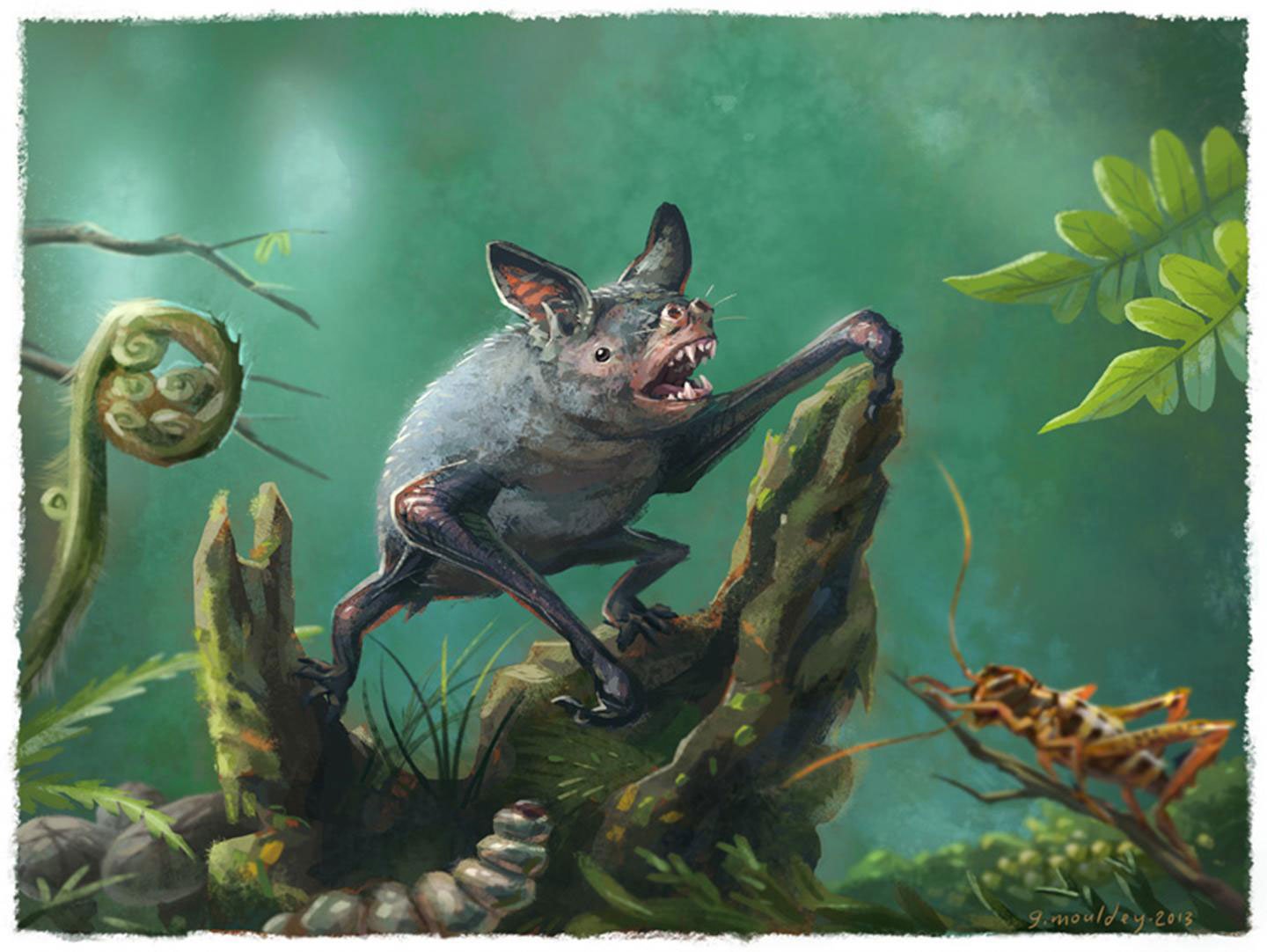
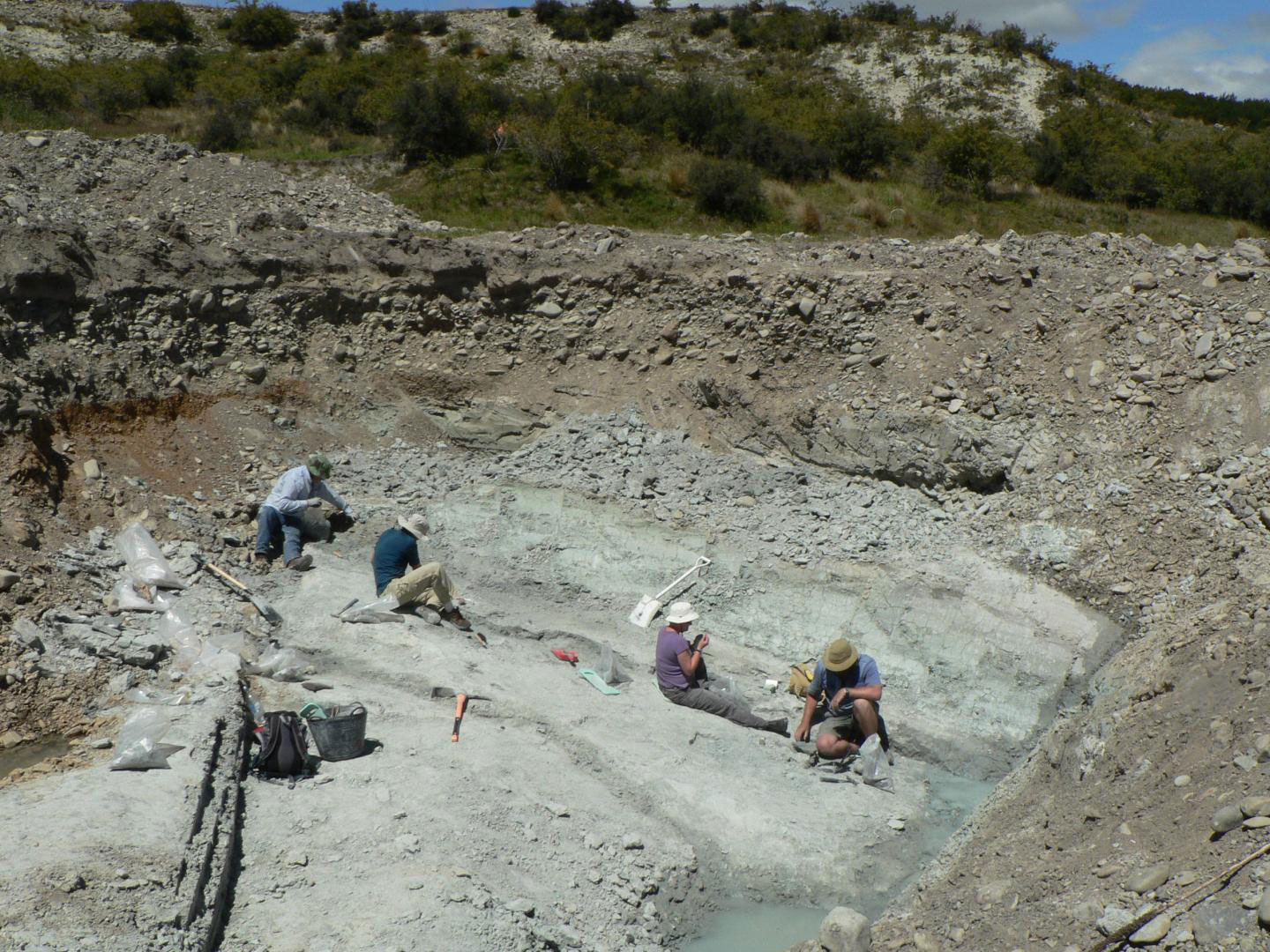
The fossilized remains of a giant burrowing bat that lived in New Zealand millions of years ago have been found by a UNSW Sydney-led international team of scientists. Teeth and bones of the extinct bat — which was about three times the size of an average bat today — were recovered from 19 to 16-million-year-old sediments near the town of St Bathans in Central Otago on the South Island.
The study, by researchers from Australia, New Zealand, the UK, and USA, is published in the journal Scientific Reports.
Burrowing bats are only found now in New Zealand, but they once also lived in Australia. Burrowing bats are peculiar because they not only fly; they also scurry about on all fours, over the forest floor, under leaf litter, and along tree branches, while foraging for both animal and plant food.
With an estimated weight of about 40 grams, the newly found fossil bat was the biggest burrowing bat yet known. It also represents the first new bat genus to be added to New Zealand’s fauna in more than 150 years
It has been named Vulcanops jennyworthyae, after team member Jenny Worthy who found the bat fossils, and after Vulcan, the mythological Roman god of fire and volcanoes, in reference to New Zealand’s tectonic nature, but also to the historic Vulcan Hotel in the mining town St Bathans.
Other research team members include scientists from UNSW Sydney, University of Salford, Flinders University, Queensland University, Canterbury Museum, Museum of New Zealand Te Papa Tongarewa, the American Museum of Natural History, and Duke University.
“Burrowing bats are more closely related to bats living in South America than to others in the southwest Pacific,” says study first author and UNSW Professor Sue Hand. “They are related to vampire bats, ghost-faced bats, fishing and frog-eating bats, and nectar-feeding bats, and belong to a bat superfamily that once spanned the southern landmasses of Australia, New Zealand, South America, and possibly Antarctica.”
Around 50 million years ago, these landmasses were connected as the last vestiges of the southern supercontinent Gondwana. Global temperatures were up to 12 degrees Celsius (22 degrees Fahrenheit) higher than today and Antarctica was forested and frost-free. With the subsequent fragmentation of Gondwana, cooling climates, and the growth of ice sheets in Antarctica, Australasia’s burrowing bats became isolated from their South American relatives.
“New Zealand’s burrowing bats are also renowned for their extremely broad diet. They eat insects and other invertebrates such as weta and spiders, which they catch on the wing or chase by foot. And they also regularly consume fruit, flowers, and nectar,” says Professor Hand, who is Director of the PANGEA Research Center at UNSW.
“However, Vulcanops’s specialized teeth and large size suggest it had a different diet, capable of eating even more plant food as well as small vertebrates — a diet more like some of its South American cousins. We don’t see this in Australasian bats today,” she says.
Study co-author, Associate Professor Trevor Worthy of Flinders University says: “The fossils of this spectacular bat and several others in the St Bathans Fauna show that the prehistoric aviary that was New Zealand also included a surprising diversity of furry critters alongside the birds.”
Study co-author Professor Paul Scofield of Canterbury Museum says: “These bats, along with land turtles and crocodiles, show that major groups of animals have been lost from New Zealand. They show that the iconic survivors of this lost fauna — the tuataras, moas, kiwi, acanthisittid wrens, and leiopelmatid frogs — evolved in a far more complex community than hitherto thought.”
This diverse fauna lived in or around a 5600-square-km (2,200-square-mi) prehistoric Lake Manuherikia that once covered much of the Maniototo region of the South Island. When they lived, in the early Miocene, temperatures in New Zealand were warmer than today and semitropical to warm temperate forests and ferns edged the vast palaeolake.
Vulcanops provides new insight into the original diversity of bats in Australasia. Its lineage became extinct sometime after the early Miocene, as did a number of other lineages present in the St Bathans assemblage. These include crocodiles, terrestrial turtles, flamingo-like palaelodids, swiftlets, several pigeons, parrots, and shorebird lineages and non-flying mammals. Most of these were probably warm-adapted species. After the middle Miocene, global climate change brought colder and drier conditions to New Zealand, with significant changes to vegetation and environments.
It is likely that this general cooling and drying trend drove the overall loss in bat diversity in New Zealand, where just two bat species today comprise the entire native land mammal fauna. All other modern land mammals in New Zealand have been introduced by people within the last 800 years.
Reference: “A new, large-bodied omnivorous bat (Noctilionoidea: Mystacinidae) reveals lost morphological and ecological diversity since the Miocene in New Zealand” by Suzanne J. Hand, Robin M. D. Beck, Michael Archer, Nancy B. Simmons, Gregg F. Gunnell, R. Paul Scofield, Alan J. D. Tennyson, Vanesa L. De Pietri, Steven W. Salisbury and Trevor H. Worthy, 10 January 2018, Scientific Reports.
DOI: 10.1038/s41598-017-18403-w
Never miss a breakthrough: Join the SciTechDaily newsletter.
Follow us on Google and Google News.
2 Comments
40 grams (.8 lbs) is not giant at all. Where’s the measurement length? D’oh. In comparison, this is what I call giant: The large flying fox is among the largest species of bat. It weighs 0.65–1.1 kg (1.4–2.4 lb) and has a wingspan of up to 1.5 m https://en.wikipedia.org/wiki/Large_flying_fox
Darin, they are talking about size of the bat, not the weight. And they are talking about extinct bats, not living ones.