
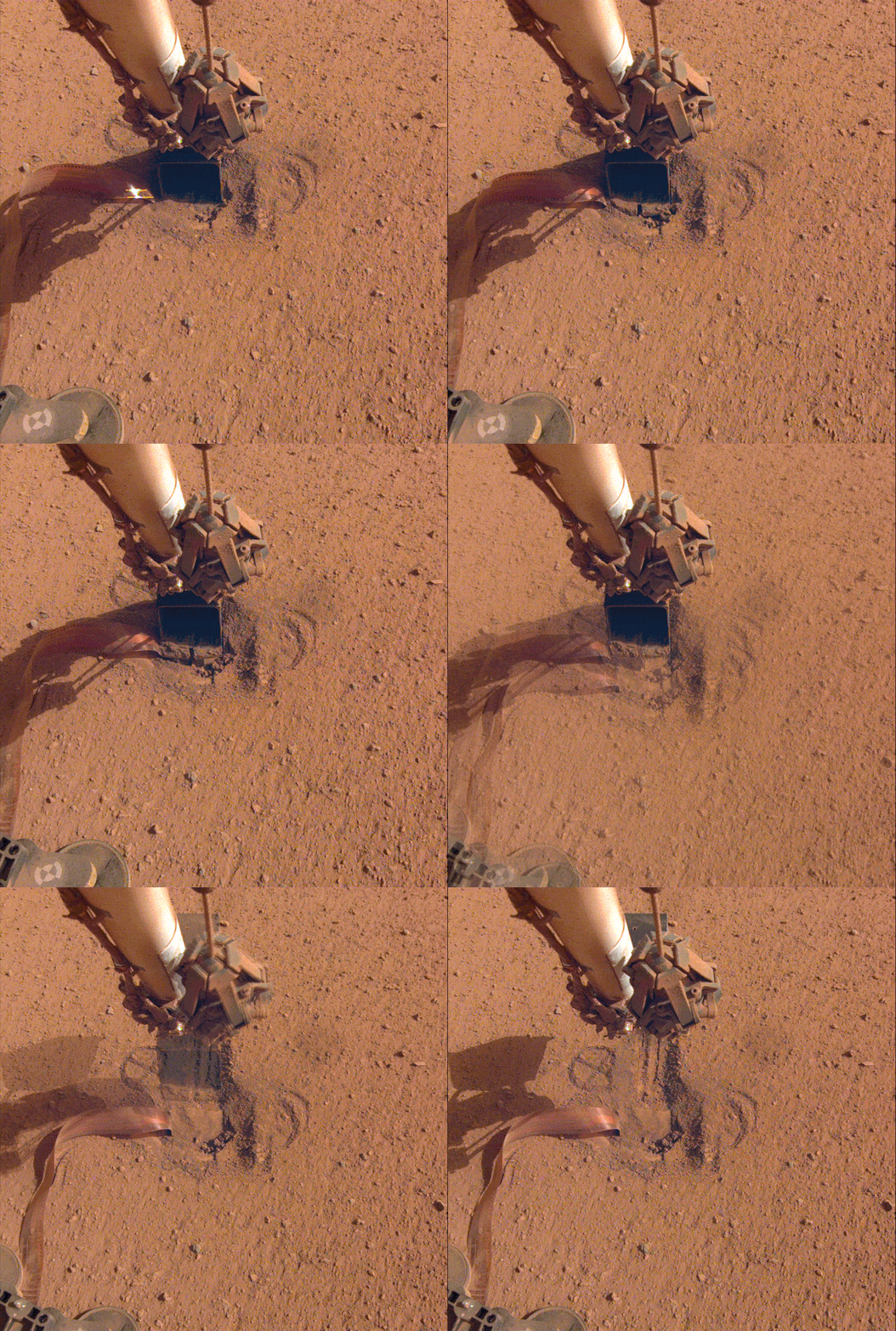
Now that the heat probe is just below the Martian surface, InSight’s arm will scoop some additional soil on top to help it keep digging so it can take Mars’ temperature.
NASA’s InSight lander continues working to get its “mole” — a 16-inch-long (40-centimeter-long) pile driver and heat probe — deep below the surface of Mars. A camera on InSight’s arm recently took images of the now partially filled-in “mole hole,” showing only the device’s science tether protruding from the ground.
Sensors embedded in the tether are designed to measure heat flowing from the planet once the mole has dug at least 10 feet (3 meters) deep. The mission team has been working to help the mole burrow to at least that depth so that it can take Mars’ temperature.
The mole was designed so that loose soil would flow around it, providing friction against its outer hull so that it can dig deeper; without this friction, the mole just bounces in place as it hammers into the ground. But the soil where InSight landed is different than what previous missions have encountered: During hammering, the soil sticks together, forming a small pit around the device instead of collapsing around it and providing the necessary friction.
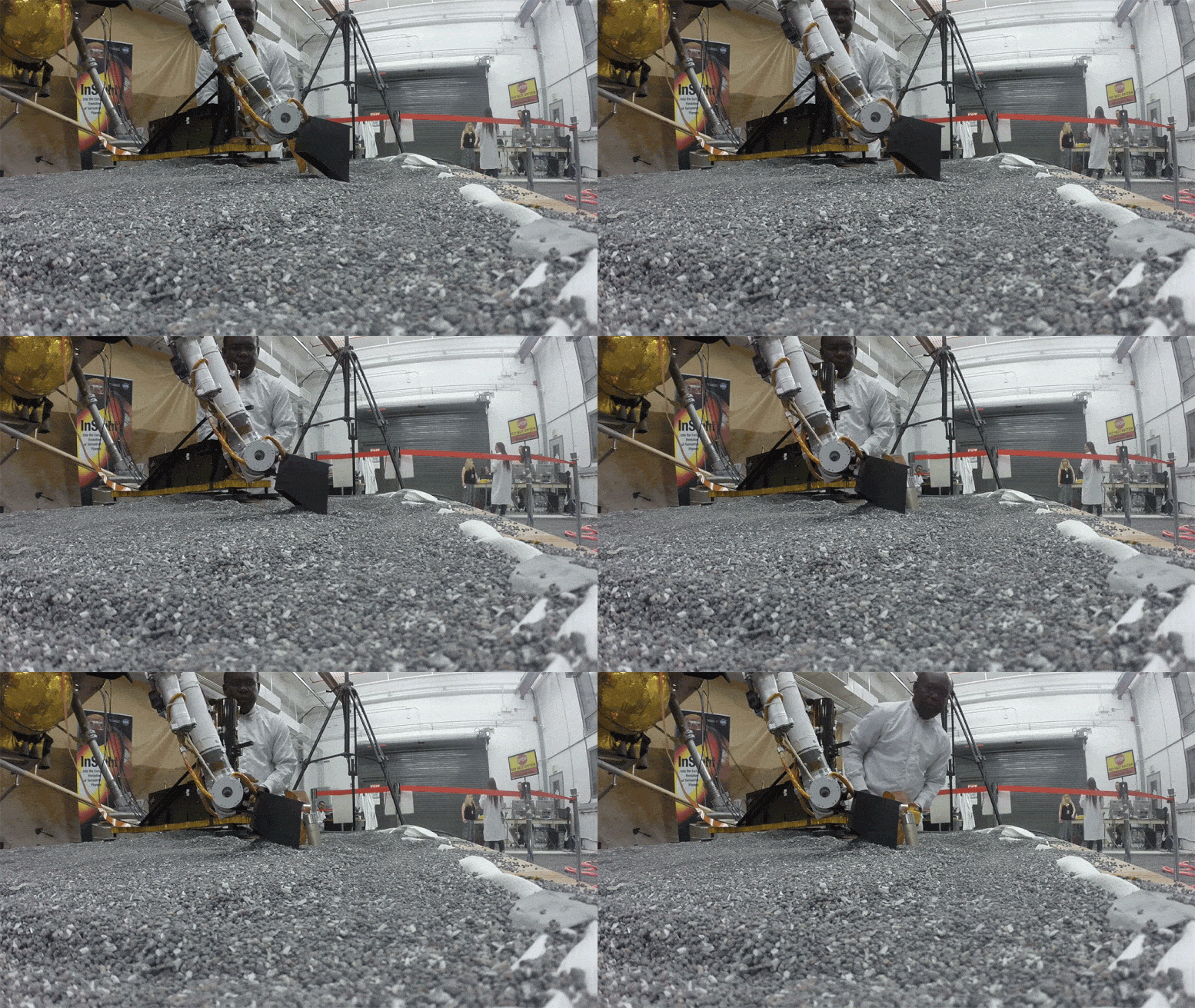
After the mole unexpectedly backed out of the pit while hammering last year, the team placed the small scoop at the end of the lander’s robotic arm on top of it to keep it in the ground. Now that the mole is fully embedded in the soil, they will use the scoop to scrape additional soil on top of it, tamping down this soil to help provide more friction. Because it will take months to pack down enough soil, the mole isn’t expected to resume hammering until early 2021.
“I’m very glad we were able to recover from the unexpected ‘pop-out’ event we experienced and get the mole deeper than it’s ever been,” said Troy Hudson, the scientist and engineer at NASA’s Jet Propulsion Laboratory who led the work to get the mole digging. “But we’re not quite done. We want to make sure there’s enough soil on top of the mole to enable it to dig on its own without any assistance from the arm.”
The mole is formally called the Heat Flow and Physical Properties Package, or HP3, and was built and provided to NASA by the German Space Agency (DLR). JPL in Southern California leads the InSight mission. Read more about the mole’s recent progress at this DLR blog.
More About the Mission
JPL manages InSight for NASA’s Science Mission Directorate. InSight is part of NASA’s Discovery Program, managed by the agency’s Marshall Space Flight Center in Huntsville, Alabama. Lockheed Martin Space in Denver built the InSight spacecraft, including its cruise stage and lander, and supports spacecraft operations for the mission.
A number of European partners, including France’s Centre National d’Études Spatiales (CNES) and the German Aerospace Center (DLR), are supporting the InSight mission. CNES provided the Seismic Experiment for Interior Structure (SEIS) instrument to NASA, with the principal investigator at IPGP (Institut de Physique du Globe de Paris). Significant contributions for SEIS came from IPGP; the Max Planck Institute for Solar System Research (MPS) in Germany; the Swiss Federal Institute of Technology (ETH Zurich) in Switzerland; Imperial College London and Oxford University in the United Kingdom; and JPL. DLR provided the Heat Flow and Physical Properties Package (HP3) instrument, with significant contributions from the Space Research Center (CBK) of the Polish Academy of Sciences and Astronika in Poland. Spain’s Centro de Astrobiología (CAB) supplied the temperature and wind sensors.
Never miss a breakthrough: Join the SciTechDaily newsletter.
Follow us on Google and Google News.
3 Comments
Very Interesting.
Has the possibility of using a high speed blower, coupled with the “Mole” been explored? This will blow away the sand and enable the solar cells to generate additional energy for digging even deeper. Their should be no issues on he planet itself, as the dust storms on the Planet are already present and kicking up a storm — And such a high speed blower along with the ” Mole”may extend its lifetime and collection of samples from deep withn the planet.Ensuring that nano sensors are implanted deep within the bowels of the planet can also yield accurate monitoring of Marsquakes once such deep digging is achoeved.
Aother option one could exlore is that future “Moles” can generate its own friction for digging rather than be dependent on the surface of the planet for generating friction! May be out of the box thinking is badly needed and the brilliant engineers from Germany who are among the best in the world can help!
Yes, it starts to become interesting.
Re a fan blower, the air pressure is 1 % of Earth surface pressure so YMMV – they are looking into electrostatics to repel dust and what not.
Interesting idea to improve the mole itself. The ExoMars rover has – if memory serves – a 2 m drill package on a mobile and solar panel driven platform in a package that looks to be twice the mole volume. If that can handle the extra mobility while penetrating any duricrust, a miniaturized and power minimized drill could be part of an improved mole system. (The drill is, IIRC, an Italian one – but you may want to check me on that.)
Imagine 5000 years from now when forgetful humans have colonized mars and exploring as we do earth uncovering earths artifacts when they come across this ‘mole’. I wonder what they will think ,what conclusions they might come to in an effort to figure out what this ‘thing’s is 🙂