
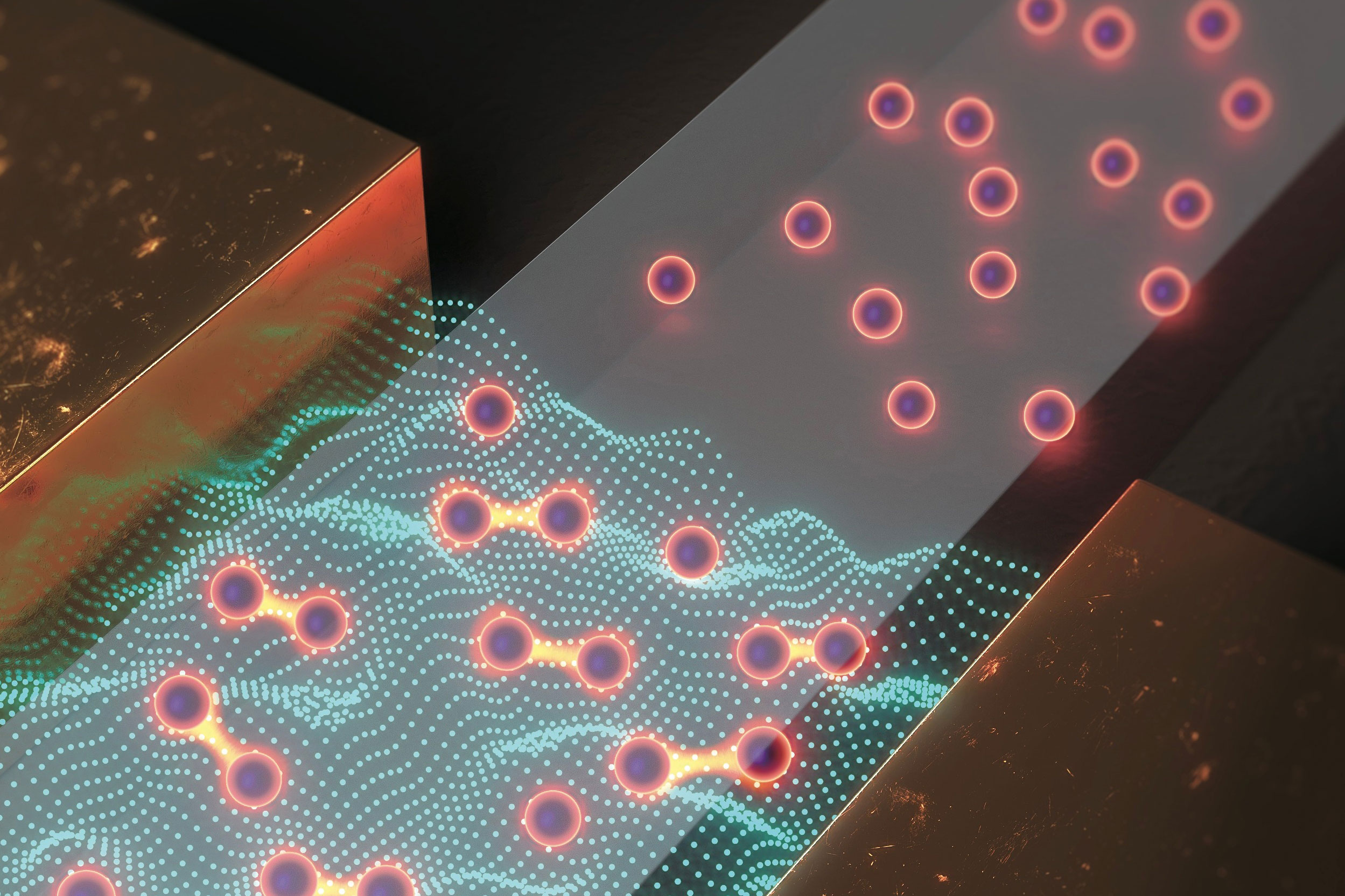
Researchers used a specially designed cavity to strengthen quantum vacuum fluctuations and enhance superconductivity in a thin material.
Empty space is not truly empty. Even a vacuum contains restless quantum fluctuations, and researchers have now shown for the first time that these normally subtle effects can be engineered to strengthen superconductivity.
The work, led by Changgan Zeng and Guanghui Cheng of the University of Science and Technology of China of the Chinese Academy of Sciences, with Qingdong Jiang of Shanghai Jiao Tong University, Frank Wilczek of the Massachusetts Institute of Technology, and other collaborators, was published in Nature.
In quantum electrodynamics, the Heisenberg uncertainty principle means that even the lowest energy state retains unavoidable activity as virtual particles continually appear and disappear. These quantum fluctuations fill what might otherwise seem like empty space. Their existence is supported experimentally by well-known effects including the Lamb shift, spontaneous emission, and the Casimir effect.
Zeng and Cheng have spent recent years investigating how these vacuum fluctuations affect condensed matter systems. In an earlier study, their team directly controlled vacuum fluctuations by using a magnetic field to reversibly switch the Casimir force from attraction to repulsion. That result raised a larger question: Could vacuum fluctuations also be used to manipulate macroscopic quantum states?
In parallel, Jiang’s team explored theoretically how the quantum vacuum might control states of matter. They introduced the idea of “vacuumronics,” in which deliberately engineered vacuum environments regulate electronic and photonic behaviors. That theoretical work provided a framework for understanding the vacuum-enhanced superconductivity observed in the new experiments.
“Vacuum fluctuations in free space are generally too weak to produce observable effects in macroscopic condensed-matter systems,” said Prof. Zeng. “To overcome this limitation, we introduced a terahertz split-ring resonator. Such a dark cavity can reshape the electromagnetic environment and substantially amplify vacuum fluctuations.”
A cavity boosted superconductivity
To test whether those amplified fluctuations could affect superconductivity, Zeng and Cheng’s team placed the superconductor NbSe2 inside the terahertz dark cavity, creating a coupled superconductor–dark–cavity device. Comparing the material inside and outside the cavity revealed a substantial increase in its superconducting critical temperature, the temperature below which it becomes superconducting.
“We observed that the critical temperature can increase by up to 5.4% in a six-layer NbSe2 device, while the critical current and critical magnetic field are significantly enhanced near the superconducting transition,” said Prof. Cheng. “This represents the first experimental observation of vacuum-fluctuation-enhanced superconductivity.”
Resonance strengthens the link to vacuum fluctuations
The researchers next tested whether more ordinary effects could explain the enhancement. They systematically varied cavity geometry and characteristic frequency, material thicknesses, dielectric materials, and metallic strips. Those control experiments effectively ruled out factors including strain, material degradation, inhomogeneity, and metallic screening effects.
A particularly important clue emerged when the superconductivity enhancement showed a peak-like dependence on the characteristic frequency of the dark cavity. “This result, closely tied to the cavity’s photonic properties, provides strong experimental evidence of the coupling between the superconducting state and dark-cavity modes,” said Prof. Zeng.
Jiang’s team and Wilczek also developed a theoretical model to explain how the effect could arise. Using a Ginzburg–Landau framework, they proposed that the superconducting state exchanges virtual photons with the dark cavity. This interaction lowers the energy of the superconducting state, which in turn strengthens superconductivity.
“When the characteristic energy of the cavity mode matched the low-energy superconducting fluctuations, the NbSe2 device exhibited resonant enhancement, producing the peak in superconductivity enhancement,” said Prof. Jiang. “In most practical physics, the vacuum serves merely as the passive stage on which phenomena play out. This work shows that the background itself can become an actor—engineered to strengthen superconductivity and reshape the behavior of quantum matter,” said Prof. Wilczek.
Vacuum could become a control tool
By engineering the cavity environment, the researchers enhanced superconductivity without applying external driving, offering a noncontact way to influence quantum states of matter. The approach suggests that carefully designed vacuum environments could become another means of controlling quantum materials.
“With further optimization of cavity structures and material systems, vacuum-fluctuation coupling may enable more pronounced and widely applicable control of quantum states,” said Prof. Zeng.
Reference: “Evidence for vacuum-enhanced superconductivity in NbSe2” by Zheyan Wang, Gabriel Cardoso, Liu Yang, Xun Gong, Chi Zhang, Yufei Zhu, Dongbo Zhang, Nan Pan, Hongbing Cai, Yong P. Chen, Qing-Dong Jiang, Guanghui Cheng, Frank Wilczek and Changgan Zeng, 19 August 2026, Nature.
DOI: 10.1038/s41586-026-11037-x
Never miss a breakthrough: Join the SciTechDaily newsletter.
Follow us on Google and Google News.