
Close Menu
    Facebook X (Twitter) Instagram
    SciTechDaily
    • Biology
    • Chemistry
    • Earth
    • Health
    • Physics
    • Science
    • Space
    • Technology
    Facebook X (Twitter) Pinterest YouTube RSS
    SciTechDaily
    Home»Physics»Superconductivity Breakthrough: Spin Correlation Between Paired Electrons Demonstrated for First Time
    Physics

    Superconductivity Breakthrough: Spin Correlation Between Paired Electrons Demonstrated for First Time

    By University of BaselNovember 23, 20222 Comments4 Mins Read
    Facebook Twitter Pinterest Telegram LinkedIn WhatsApp Email Reddit
    Share
    Facebook Twitter LinkedIn Pinterest Telegram Email Reddit
    Spin Cross-Correlation Experiments
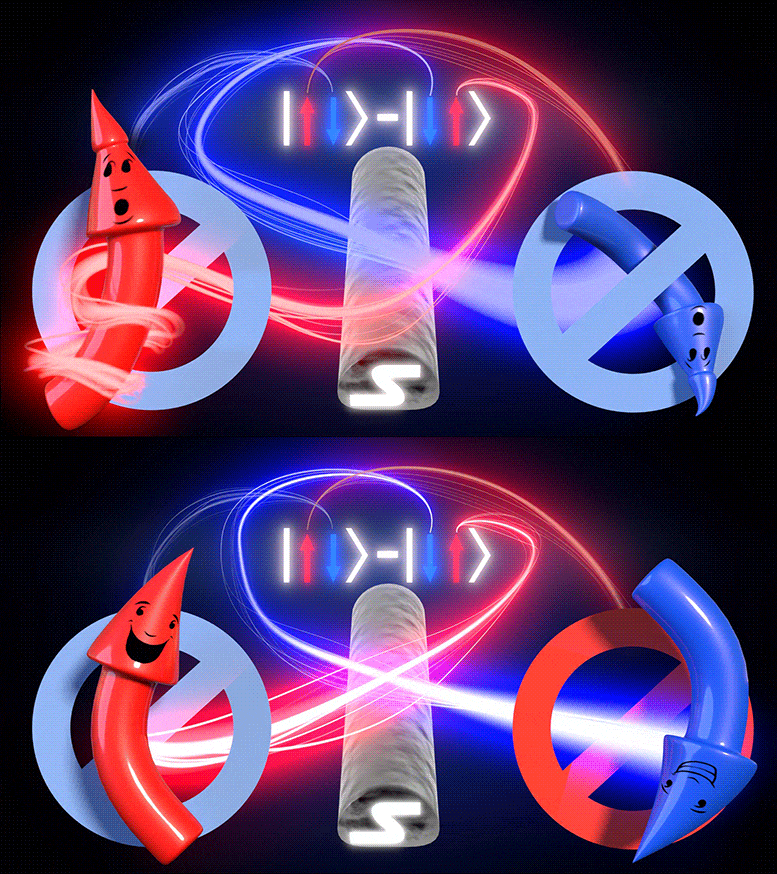
    Physicists have experimentally demonstrated for the first time that there is a negative correlation between the two spins of an entangled pair of electrons from a superconductor. Credit: Department of Physics, University of Basel, Scixel

    For the first time, physicists have experimentally demonstrated that there is a negative correlation between the two spins of an entangled pair of electrons from a superconductor. For their study, the researchers used spin filters made of nanomagnets and quantum dots.

    Some phenomena in quantum physics, such as the entanglement between two particles, are hard to reconcile with everyday experiences. If entangled, certain properties of the two particles are closely linked, even when very far apart. This strange behavior is why Albert Einstein described entanglement as a “spooky action at a distance.” Although it’s weird, it’s an important phenomenon. In fact, research on the entanglement between light particles (photons) was awarded this year’s Nobel Prize in Physics.

    Two electrons can be entangled as well – for example in their spins. In a superconductor, the electrons form so-called Cooper pairs that are responsible for the lossless electrical currents and in which the individual spins are entangled.

    For several years, researchers at the Swiss Nanoscience Institute and the Department of Physics at the University of Basel have been able to extract electron pairs from a superconductor and spatially separate the two electrons. This is achieved by means of two quantum dots – nanoelectronic structures connected in parallel, each of which only allows single electrons to pass.
    Parallel Spin Filters
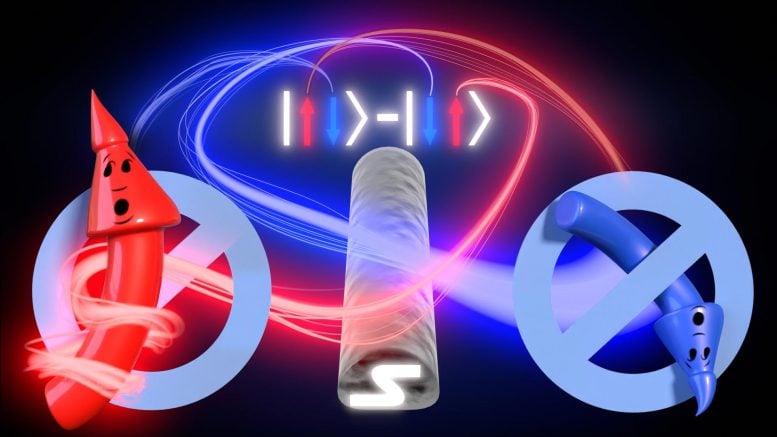
    Electrons leave a (conventional) superconductor (S) only as pairs and only with opposite spins (arrow up or down, red or blue). If both electron paths are blocked for the same type of spin by parallel spin filters (here for spin down (blue)), a single electron with spin up (red) could in principle exit, but paired electrons from the superconductor are blocked, which ideally suppresses both electrical currents. Credit: Department of Physics, University of Basel, Scixel

    Opposite Electron Spins From Cooper Pairs

    The team of Prof. Dr. Christian Schönenberger and Dr. Andreas Baumgartner, in collaboration with researchers led by Prof. Dr. Lucia Sorba from the Istituto Nanoscienze-CNR and the Scuola Normale Superiore in Pisa have now been able to experimentally demonstrate what has long been expected theoretically: electrons from a superconductor always emerge in pairs with opposite spins. They report their findings today (November 23) in the scientific journal Nature.

    Using an innovative experimental setup, the physicists were able to measure that the spin of one electron points upwards when the other is pointing downwards, and vice versa. “We have thus experimentally proven a negative correlation between the spins of paired electrons,” explains project leader Andreas Baumgartner.

    The researchers achieved this by using a spin filter they developed in their laboratory. Using tiny magnets, they generated individually adjustable magnetic fields in each of the two quantum dots that separate the Cooper pair electrons. Since the spin also determines the magnetic moment of an electron, only one particular type of spin is allowed through at a time.
    Antiparallel Spin Filters
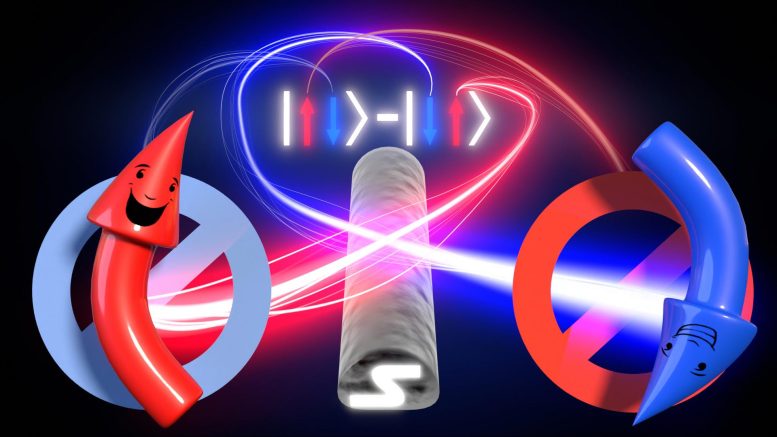
    In contrast to parallel spin filters, for antiparallel spin filters electron pairs are allowed to exit the superconductor, which can be detected as significantly enhanced electrical currents in both paths. Credit: Department of Physics, University of Basel, Scixel

    “We can adjust both quantum dots so that mainly electrons with a certain spin pass through them,” explains first author Dr. Arunav Bordoloi. “For example, an electron with spin up passes through one quantum dot and an electron with spin down passes through the other quantum dot, or vice versa. If both quantum dots are set to pass only the same spins, the electric currents in both quantum dots are reduced, even though an individual electron may well pass through a single quantum dot.”

    “With this method, we were able to detect such negative correlations between electron spins from a superconductor for the first time,” Andreas Baumgartner concludes. “Our experiments are a first step, but not yet a definitive proof of entangled electron spins, since we cannot set the orientation of the spin filters arbitrarily – but we are working on it.”

    The research, which was recently published in Nature, is considered an important step toward further experimental investigations of quantum mechanical phenomena, such as the entanglement of particles in solids, which is also a key component of quantum computers.

    Reference: “Spin Cross-Correlation Experiments in an Electron Entangler” by Arunav Bordoloi, Valentina Zannier, Lucia Sorba, Christian Schönenberger and Andreas Baumgartner, 23 November 2022, Nature.
    DOI: 10.1038/s41586-022-05436-z

    Never miss a breakthrough: Join the SciTechDaily newsletter.
    Follow us on Google and Google News.

    Quantum Dots Quantum Mechanics Quantum Physics Superconductivity University of Basel
    Share. Facebook Twitter Pinterest LinkedIn Email Reddit

    Related Articles

    The Holy Grail of Physics: Scientists Discover New Path to Room-Temperature Superconductors

    A Path to Superconductivity: Unlocking the Bizarre Mysteries of the Quantum “Pseudogap”

    Defying Current Theories of Superconductivity – “Sudden Death” of Quantum Fluctuations Stuns Scientists

    Atomic-Scale Window Into Superconductivity Paves Way for Advanced New Quantum Materials

    Time-Reversal Symmetry-Breaking Magnetic Fields Discovered Inside a Kagome Superconductor

    Laser Loop Acts as a Mechanical Spring to Couple Quantum Systems Over a Distance

    Efficient Quantum-Mechanical Interface Leads to a Strong Interaction Between Light and Matter

    Researchers Entangle Two Independent Photons with Different Frequencies

    New Quantum Dots Design for Solotronics

    2 Comments

    1. Bao-hua ZHANG on November 23, 2022 8:59 pm

      The interactions and balances of topological vortex fields cover all short-distance and long-distance contributions, and are the basis of the formation and evolution of cosmic matter. According to the topological vortex field theory, the nature of electricity is perfect fluid.It has no shear stresses,viscosity,or heat conduction. The heat generated by electric current is due to the interaction of vortices. Good luck to your team.

      Reply
    2. Ety on November 24, 2022 6:58 pm

      spoon-key action at a distance

      Reply
    Leave A Reply Cancel Reply

    • Facebook
    • Twitter
    • Pinterest
    • YouTube

    Don't Miss a Discovery

    Subscribe for the Latest in Science & Tech!

    Trending News

    New Study Reveals Why Ozempic Works Better for Some People Than Others

    Climate Change Is Altering a Key Greenhouse Gas in a Way Scientists Didn’t Expect

    New Study Suggests Gravitational Waves May Have Created Dark Matter

    Scientists Discover Why the Brain Gets Stuck in Schizophrenia

    Scientists Engineer “Tumor-Eating” Bacteria That Devour Cancer From Within

    Even “Failed” Diets May Deliver Long-Term Health Gains, Study Finds

    NIH Scientists Discover Powerful New Opioid That Relieves Pain Without Dangerous Side Effects

    Collapsing Plasma May Hold the Key to Cosmic Magnetism

    Follow SciTechDaily
    • Facebook
    • Twitter
    • YouTube
    • Pinterest
    • Newsletter
    • RSS
    SciTech News
    • Biology News
    • Chemistry News
    • Earth News
    • Health News
    • Physics News
    • Science News
    • Space News
    • Technology News
    Recent Posts
    • The Surprising Reason You Might Want To Sleep Without a Pillow
    • Household Cats Could Hold the Secret to Fighting Breast Cancer
    • Scientists Say This Natural Hormone Reverses Obesity by Targeting the Brain
    • This 15,000-Year-Old Discovery Changes What We Know About Early Human Creativity
    • 35-Million-Year-Old Mystery: Strange Arachnid Discovered Preserved in Amber
    Copyright © 1998 - 2026 SciTechDaily. All Rights Reserved.
    • Science News
    • About
    • Contact
    • Editorial Board
    • Privacy Policy
    • Terms of Use

    Type above and press Enter to search. Press Esc to cancel.