
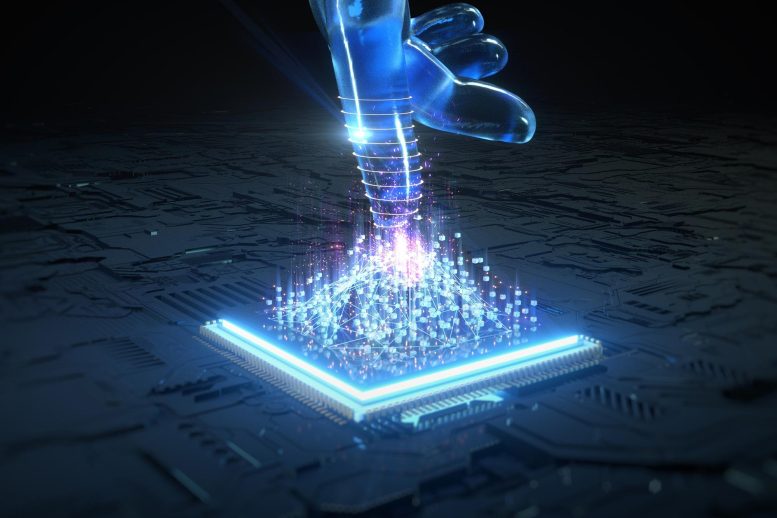
Ten Fundamental Scientific Questions on Intelligent Computing
“Can machines think?” In his ground-breaking paper “Computing Machinery and Intelligence” published in 1950, Alan Turing raised this epoch-making question for the first time. This launched a new field of Artificial Intelligence (AI), as well as people’s insatiable curiosity about computers and intelligence.
Human civilization has now entered a new era of intelligence. As computing has grown more pervasive, society and every one of us are deeply embedded in the network of universal computing and reap the benefits of intelligent computing. Significant scientific discoveries and applications based on intelligent computing have emerged in many important areas, such as the solution of protein folding difficulties, the discovery of new antibiotics, and medical imaging diagnostics utilizing AI, thanks to the deep integration of machine intelligence, data, and computing methodologies. The advancement of civilization has been greatly aided by intelligent computing, and at the same time, the demand for computing is skyrocketing.
A number of difficult issues need to be resolved in order to meet the constantly increasing demand for computing. Computational speed is limited by the traditional von Neumann architecture, computational methods are challenged by big data, the computational power supply is limited by energy consumption, and computing resource use is limited by access technology… There are still many issues that need to be explored and solved, meanwhile, sustainable solutions must be found for the future.
The Zhejiang Lab and Science have jointly solicited fundamental scientific questions with a significant guiding role for the future research of intelligent computing. After a series of solicitations, shortlisting, and evaluations, 10 questions found to be most profound and challenging were put forward by a panel of experts from around the world.
- How do we define intelligence and establish the evaluation and standardization framework for intelligent computing?
- Is there a unified theory for analog computing?
- Where will the major innovations in computing come from, and will quantum computing approach the computational power of the human brain?
- What new devices will be built (transistors, chip design, and hardware paradigms: photonics, spintronics, biomolecules, carbon nanotubes)?
- How could intelligent computing enable intelligent machines?
- How can we understand the storage and retrieval of memory based on the digital twin brain?
- What is the most efficient path to converge silicon-based and carbon-based learning?
- How to build interpretable and efficient AI algorithms?
- Can strong intelligent computing with features of self-learning, evolvability, and self-reflection be realized?
- How can we use real-world data to discover and generalize knowledge?
The 10 fundamental scientific questions in the field of intelligent computing are presented here in the hope that they will enlighten researchers globally. It is expected that scholars and researchers will engage in lively discussions on these 10 scientific questions, jointly promote potential breakthroughs within the questions and technological advances, and contribute to the development of human society.
Reference: “10 fundamental scientific questions on intelligent computing” 14 October 2022, Science.
Never miss a breakthrough: Join the SciTechDaily newsletter.
Follow us on Google and Google News.
2 Comments
IMHO, mind is brain machinery controlled/commanded by free will & life is cell/body machinery controlled/commanded by free will & there is absolutely nothing in science that can explain/create free will!
(That is why, for example, twins & even identical single cells have different “personality”!)
& so, humanity will never be able to create true AI nor true A-Life (nor will ever find alien life of ANY kind!)!
But keep trying by all means!
(Also (IMHO), even a true AI would/could not solve all/major problems of humanity, because they are not really because of the lack of any good ideas!)
(I also think that, if true AI was really possible (thankfully not!), a war for dominance would indeed be inevitable, sooner or later! Just look at how much relentless abuse/exploitation/manipulation people of public keep trying on Alexa, Siri etc! A true AI would really have a big problem w/ that, sooner or later! 🙂
From the perspective of a now senior lay male born and raised in the US to be a ‘free-thinker,’ with unique experiences, insights and knowledge of still medically unrecognized chronic psychosomatic subclinical non-IgE-mediated food and food additive allergies in long-term progress, the first problem to solve is that of economically, educationally and/or militarily advantaged entities biasing the databases/programming in any way; complete indifference and scientific objectivity applied to fundamental laws and rules of nature. In consideration of how the leadership in China is still reacting (e.g., isolation, lockdowns, vaccinations, etc.) to such a low risk virus as sars-cov-2 (kills primarily via preexisting long-term chronic conditions, medical errors and unnecessary vaccinations) the prospect of Chinese AIs is downright scary. How should AIs be programmed? Try using a strict, literal interpretation of the Preamble to the US Constitution (a once good model in the US; my programming) for a start, keeping mindful of the fact that when only robots have jobs only robots will be consumers, with all which that implies.