
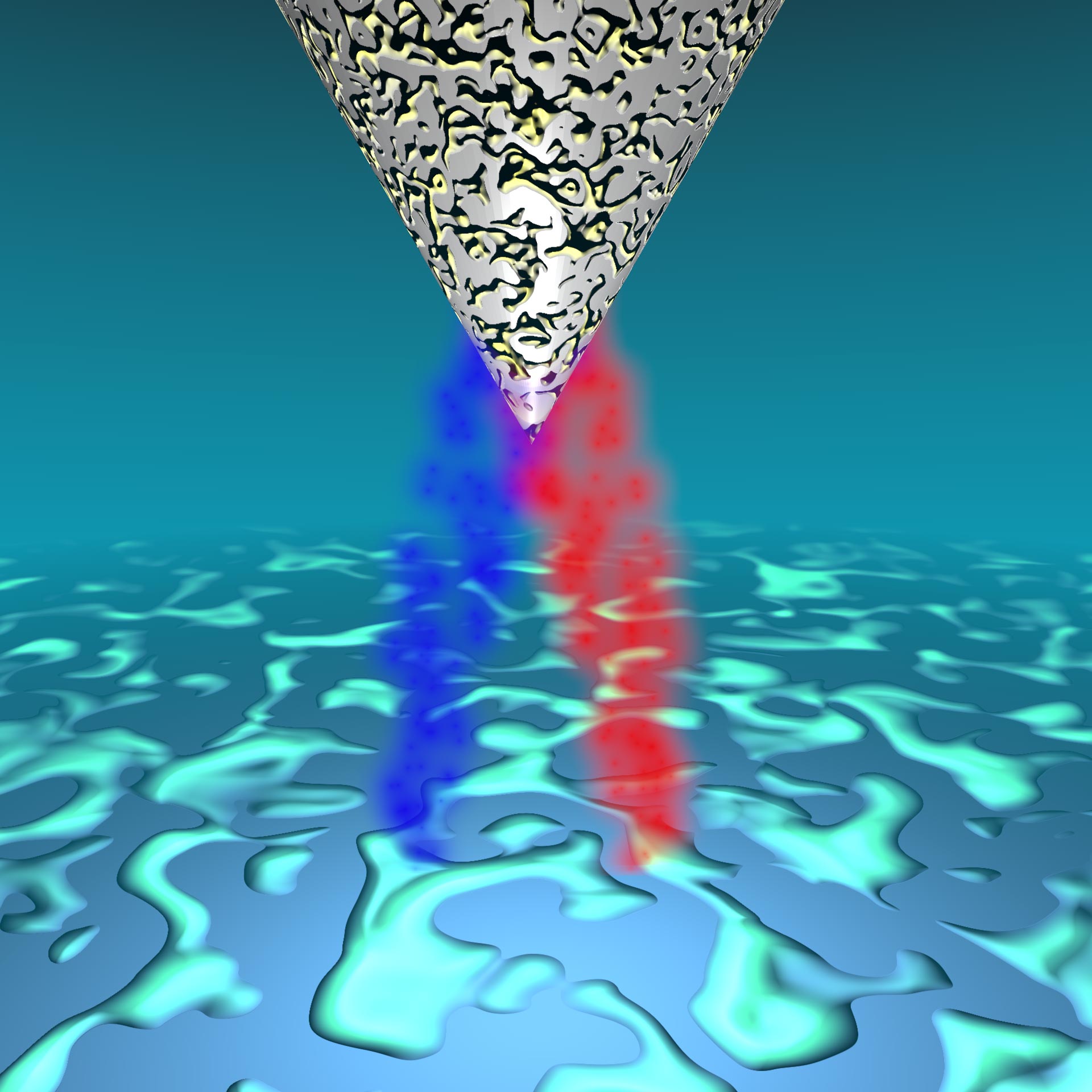
New technique helps researchers understand unconventional superconductors.
One of nature’s most fascinating quantum phenomena is superconductivity. When a superconducting material is cooled below its critical temperature, electricity can flow without any losses and magnetic fields are expelled.
These remarkable properties make superconductors very useful in a wide range of applications including magnetic levitation, magnetic resonance imaging (MRI), nuclear magnetic resonance (NMR), particle accelerators, particle detectors, power transmission, and much more.
Now, a new breakthrough in probing unconventional superconductors and understanding quantum materials could lead to new technologies for quantum computing.
Superconductors and Cooper Pairs: A Quantum Phenomenon
Superconductors are materials with no electrical resistance whatsoever, commonly requiring extremely low temperatures. They are used in a wide range of domains, from medical applications to a central role in quantum computers. Superconductivity is caused by specially linked pairs of electrons known as Cooper pairs. So far, the occurrence of Cooper pairs has been measured indirectly macroscopically in bulk, but a new technique developed by researchers at Aalto University and Oak Ridge National Laboratories in the US can detect their occurrence with atomic precision.
The experiments were carried out by Wonhee Ko and Petro Maksymovych at Oak Ridge National Laboratory with the theoretical support of Professor Jose Lado of Aalto University. Electrons can quantum tunnel across energy barriers, jumping from one system to another through space in a way that cannot be explained with classical physics. For example, if an electron pairs with another electron right at the point where a metal and superconductor meet, it could form a Cooper pair that enters the superconductor while also “kicking back” another kind of particle into the metal in a process known as Andreev reflection. The researchers looked for these Andreev reflections to detect Cooper pairs.
Andreev Reflection: Key to Observing Cooper Pairs
To do this, they measured the electrical current between an atomically sharp metallic tip and a superconductor, as well as how the current depended on the separation between the tip and the superconductor. This enabled them to detect the amount of Andreev reflection going back to the superconductor, while maintaining an imaging resolution comparable to individual atoms. The results of the experiment corresponded exactly to Lado’s theoretical model.
This experimental detection of Cooper pairs at the atomic scale provides an entirely new method for understanding quantum materials. For the first time, researchers can uniquely determine how the wave functions of Cooper pairs are reconstructed at the atomic scale and how they interact with atomic-scale impurities and other obstacles.
Unlocking the Potential of Unconventional Superconductors
“This technique establishes a critical new methodology for understanding the internal quantum structure of exotic types of superconductors known as unconventional superconductors, potentially allowing us to tackle a variety of open problems in quantum materials,” Lado says. Unconventional superconductors are a potential fundamental building block for quantum computers and could provide a platform to realize superconductivity at room temperature. Cooper pairs have unique internal structures in unconventional superconductors which so far have been challenging to understand.
This discovery allows for the direct probing of the state of Cooper pairs in unconventional superconductors, establishing a critical new technique for a whole family of quantum materials. It represents a major step forward in our understanding of quantum materials and helps push forward the work of developing quantum technologies.
Reference: “Noncontact Andreev Reflection as a Direct Probe of Superconductivity on the Atomic Scale” by Wonhee Ko, Jose L. Lado and Petro Maksymovych, 13 May 2022, Nano Letters.
DOI: 10.1021/acs.nanolett.2c00697
Never miss a breakthrough: Join the SciTechDaily newsletter.
Follow us on Google and Google News.