
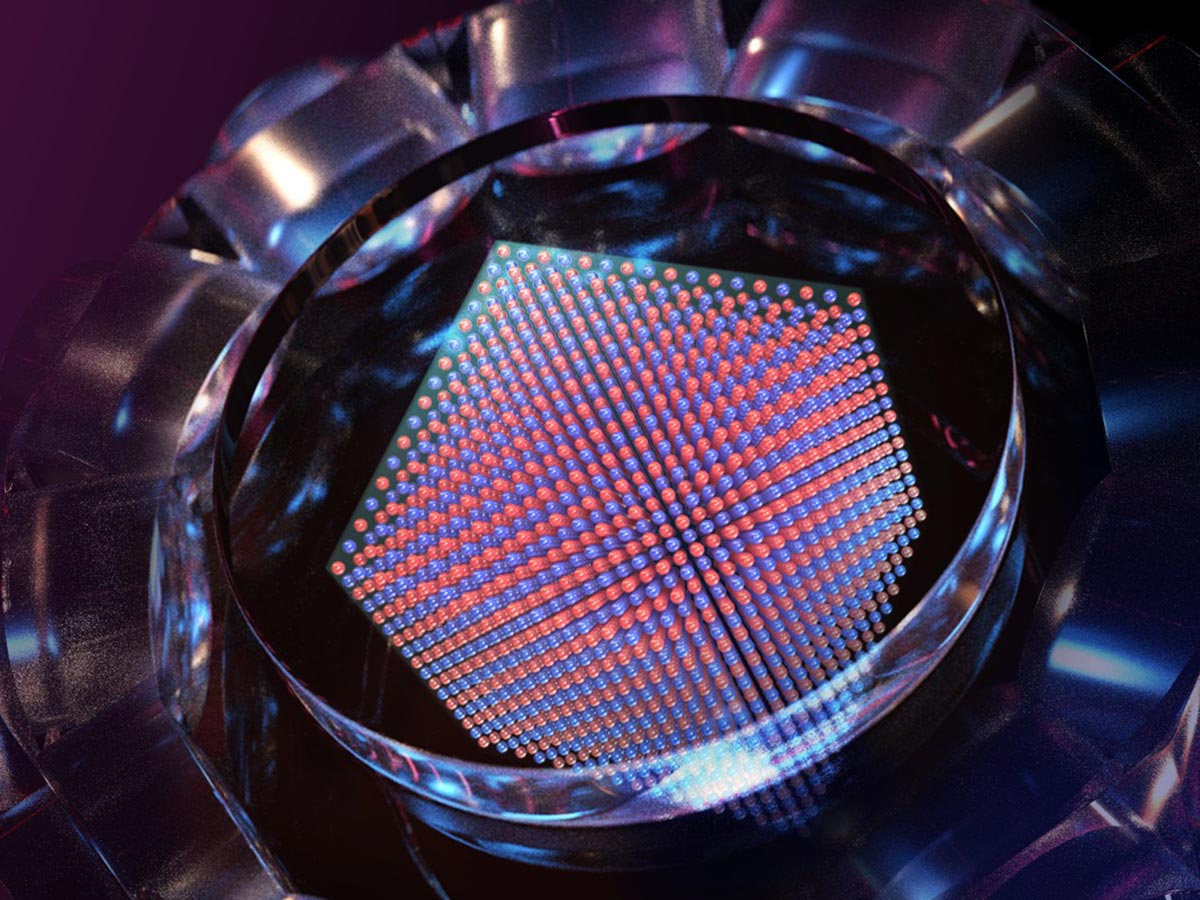
Researchers have successfully observed an antiferromagnetic phase transition in a quantum simulator, a significant step toward understanding the physics of high-temperature superconductivity.
This breakthrough demonstrates the simulator’s capability to handle the complex fermionic Hubbard model, outperforming current computational methods and paving the way for further advancements in quantum materials.
Breakthrough in Quantum Simulation
In a study published on July 10 in Nature, a research team led by Prof. Jianwei Pan, Prof. Yuao Chen, and Prof. Xingcan Yao from the University of Science and Technology of China (USTC) of the Chinese Academy of Sciences has, for the first time, observed the antiferromagnetic phase transition within a large-scale quantum simulator of the fermionic Hubbard model (FHM). This study highlights the advantages of quantum simulation.
It marks an important first step toward obtaining the low-temperature phase diagram of the FHM and understanding the role of quantum magnetism in the mechanism of high-temperature superconductivity.
Understanding High-Temperature Superconductors
Strongly correlated quantum materials such as high-temperature superconductors are of scientific importance and have potential economic benefits. However, the physical mechanisms underlying these materials remain unclear, posing challenges to their large-scale preparation and application. The FHM, a simplified representation of electron behaviors in a lattice, captures a wide range of physics related to strong correlations, akin to those observed in quantum materials, and is therefore believed to potentially offer solutions to understanding the mechanism of high-temperature superconductivity.
The study of FHM faces challenges. There is no exact analytical solution for this model in two and three dimensions, and due to high computational complexity, even the most advanced numerical methods can explore only limited parameter spaces. Moreover, theoretical studies suggest that even a universal digital quantum computer would struggle to accurately solve this model.
Advancements in Quantum Simulation Techniques
It is widely held that quantum simulation, employing ultracold fermionic atoms in optical lattices, can be the key to mapping out the low-temperature phase diagram of the FHM. To this end, realizing the antiferromagnetic phase transition and reaching the ground state of the FHM at half-filling constitute the foremost steps.
Such an achievement would validate two key capabilities of the quantum simulator: the establishment of a large-scale, spatially homogeneous optical lattice for uniform Hubbard parameters, and maintaining a system temperature significantly below Néel temperature, the antiferromagnetic phase transition temperature, both of which are essential for exploring the role of quantum magnetic fluctuations in the mechanism of high-temperature superconductivity.
However, the difficulty in cooling fermionic atoms and inhomogeneity introduced by a standard Gaussian-profile lattice laser have hindered the realization of antiferromagnetic phase transition in previous quantum simulation experiments. To address these challenges, the team, based on their earlier achievements of the preparation and investigation of homogeneous strongly interacting Fermi gases in a box potential (Science, Nature), developed an advanced quantum simulator by combining the generation of a low-temperature homogeneous Fermi gas in a box trap with the demonstration of a flat-top optical lattice with uniform site potentials.
Groundbreaking Observations in Quantum Mechanics
This quantum simulator contains approximately 800,000 lattice sites, about four orders of magnitude larger than current experiments with several dozen sites, and features uniform Hamiltonian parameters with temperatures significantly below the Néel temperature.
Leveraging this setup, the team precisely tuned the interaction strength, temperature, and doping concentration to approach their respective critical values, and directly observed conclusive evidence of the antiferromagnetic phase transition, i.e., the power-law divergence of the spin structure factors, with a critical exponent of 1.396 from the Heisenberg universality.
Implications and Future Directions
This work advances the understanding of quantum magnetism and lays the foundation for further solving the FHM and obtaining its low-temperature phase diagram. Notably, the experimental results deviating from the half-filling condition have already surpassed the capabilities of current classical computing, demonstrating quantum simulation advantages in addressing key scientific problems.
Reference: “Antiferromagnetic phase transition in a 3D fermionic Hubbard model” by Hou-Ji Shao, Yu-Xuan Wang, De-Zhi Zhu, Yan-Song Zhu, Hao-Nan Sun, Si-Yuan Chen, Chi Zhang, Zhi-Jie Fan, Youjin Deng, Xing-Can Yao, Yu-Ao Chen and Jian-Wei Pan, 10 July 2024, Nature.
DOI: 10.1038/s41586-024-07689-2
Never miss a breakthrough: Join the SciTechDaily newsletter.
Follow us on Google and Google News.
2 Comments
The study of FHM faces challenges. There is no exact analytical solution for this model in two and three dimensions, and due to high computational complexity, even the most advanced numerical methods can explore only limited parameter spaces. Moreover, theoretical studies suggest that even a universal digital quantum computer would struggle to accurately solve this model.
Very good!
Please ask researchers to think deeply:
1. How do you confirm that the material you observed in the experiment is definitely a two-dimensional material?
2. What is the difference between two-dimensional materials and three-dimensional materials?
3. Where is the rigor of science?
4. What is the difference between theory and practice?
5. Why do the fermionic atoms have up and down spins?
and so on.
Please witness the exemplary collaboration between theoretical physicists and experimentalists (https://zhuanlan.zhihu.com/p/701032654).
The fundamental theories of physics have long been misled by the Physical Review Letters.I hope researchers are not misled by the erroneous theories in the Physical Review Letters (PRL). Scientific research guided by correct theories can help humanity avoid detours, failures, and pretension.
Science and pseudoscience are not determined by a publication (such as the journal Nature, Physical Review Letters, et al.), an organization or a person, nor by you or me, but by mathematics the final say. Physical models must be based on mathematics or mathematical models in order to be scientific, convincing, and in accordance with natural laws.
Miassite the only known natural superconducting mineral has to be studied endlessly, the quantum of it’s evolution has the greatest chance of success.