

A new model connects observations of Venus with the optical properties of the liquid inside its cloud droplets.
Venus’s clouds look pale yellow from afar, but the liquid inside their droplets could be much darker than their appearance suggests. A new study has calculated how strongly that liquid would need to absorb light to explain mysterious ultraviolet markings that have puzzled scientists for about a century.
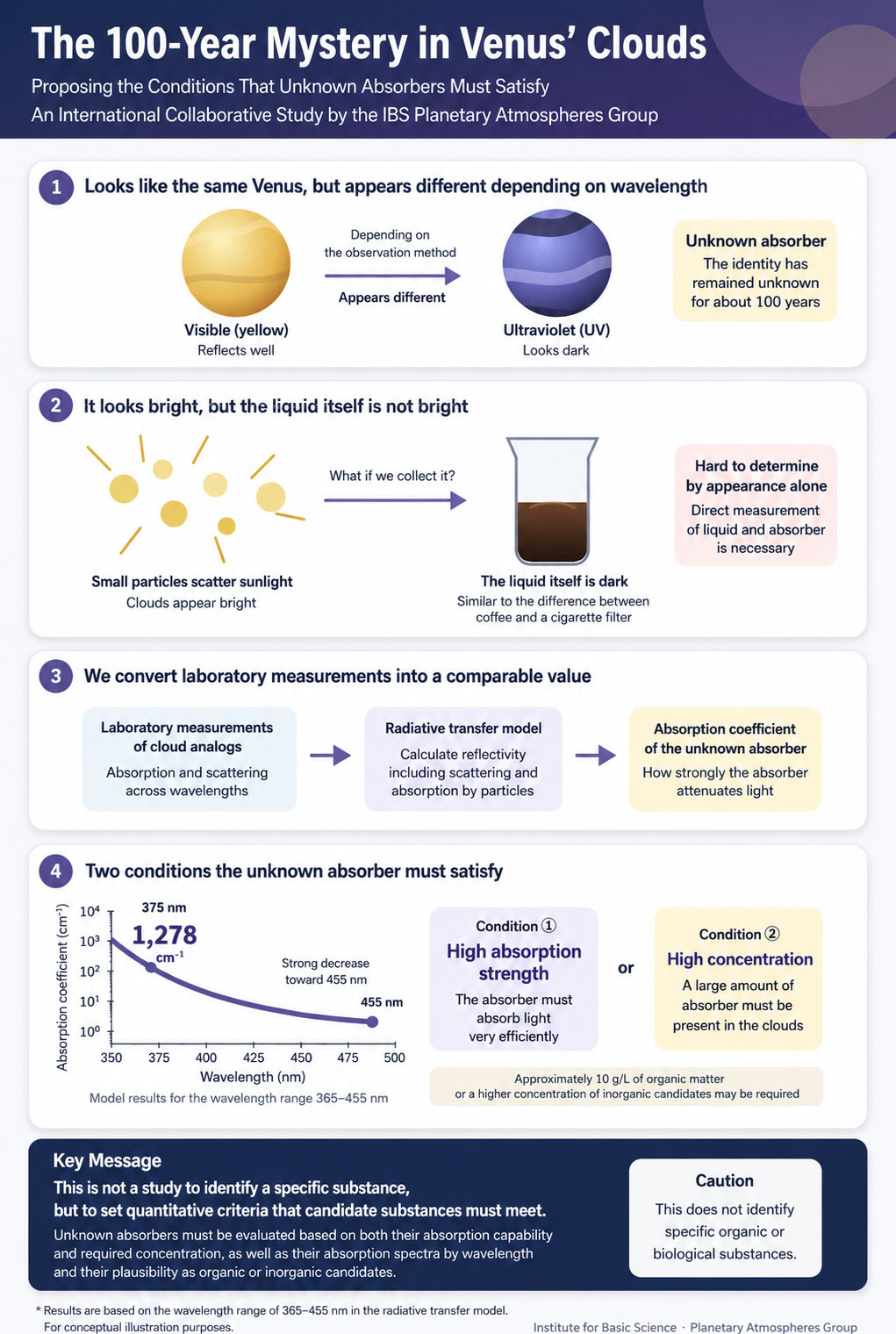
The dark and bright patterns appear in ultraviolet images of Venus and move with the planet’s upper sulfuric acid clouds. Something in those clouds absorbs ultraviolet and blue light, but researchers still do not know what that material, commonly called the unknown absorber, actually is.
Instead of trying to identify the absorber directly, an international team asked a different question: What would the liquid inside Venus’s cloud droplets look like if it could be collected and examined in a laboratory?
“Our model effectively asks what would happen if we could collect that cloud material into a cuvette and put it into a laboratory spectrometer,” said lead author Jan Spacek of the Foundation for Applied Molecular Evolution, USA. “This is important, as light absorption in a bulk liquid may be correlated with the concentration of light-absorbing material in the solution.”
Venus’s pale clouds may hide dark liquid
The distinction between how a cloud looks and how its material would look when collected together is important. Tiny particles can scatter light so efficiently that a cloud appears much brighter than the material itself.
Cigarette smoke offers a familiar example. The smoke appears white because its extremely small particles scatter light efficiently, yet collecting those particles produces a dense, dark, tar-like material. Venus’s cloud droplets have a particle-size distribution similar to cigarette smoke, suggesting that their pale appearance could conceal a much more strongly absorbing liquid.
To determine how strongly that liquid would need to absorb light, the researchers combined observations of Venus with a radiative-transfer model. The calculations accounted for repeated scattering and absorption of sunlight by cloud droplets and molecules in the atmosphere.
“The key is that Venus’s cloud particles scatter sunlight very efficiently, so the brightness observed from space cannot be directly compared with the absorption of a bulk liquid measured in the laboratory,” said Dr. Yeon Joo Lee of the Planetary Atmospheres Group within the Institute for Basic Science (IBS), South Korea, who performed the radiative-transfer model calculations in the study. “By accounting for the scattering and absorption by the cloud particles and atmosphere, the model allows us to estimate how strongly the liquid of cloud droplets itself must absorb light.”
The mystery absorber must be unusually strong
The researchers then translated observations of Venus into a standard laboratory measure called an absorption coefficient, which describes how strongly a material absorbs light.
Across wavelengths from 365 to 455 nanometers, the model found that the required absorption was especially strong near the ultraviolet end of the range. At 375 nanometers, the calculated decadic absorption coefficient reached about 1,278 inverse centimeters.
That places a demanding requirement on whatever substance produces the effect. The unknown absorber must either absorb light very efficiently, occur at a very high concentration, or combine both properties.
One possibility is a class of strongly absorbing carbon-based molecules known as conjugated organics. In this context, however, “organic” simply means that a compound contains carbon. It does not mean that the material was produced by life.
Molecules with absorption strengths similar to efficient porphyrinoid pigments would need to occur at concentrations of roughly 10 grams per liter, about 1.3 ounces per gallon, to match the modeled effect. The researchers are not proposing that chlorophyll, heme, or any particular biological pigment is present in Venus’s clouds. Those molecules are used only as familiar examples of substances that absorb light very efficiently.
Sulfuric acid challenges organic explanations
The shape of Venus’s absorption spectrum creates another challenge for potential explanations.
When simple organic compounds are exposed to concentrated sulfuric acid, they can form chemically complex, dark, tar-like mixtures. Those mixtures tend to absorb broadly across the visible spectrum, making them appear brown or black.
That does not match the pattern inferred for Venus. Instead, the modeled absorption falls steeply between 365 and 455 nanometers.
“If the observed light absorption is due to conjugated organic matter, the relatively sharp absorption profile is consistent with a chemically defined absorber that resists conversion into the tar-like mixture we typically observe with organics dissolved in concentrated sulfuric acid,” Spacek said.
If the absorber is organic, it would therefore need to remain chemically distinct under the extreme conditions inside Venus’s sulfuric acid clouds rather than simply becoming a broadly absorbing mixture.
“Paradoxically, by placing additional constraints on the unknown absorber, we might have made the mystery even more intriguing,” said Janusz J. Petkowski of Wroclaw University of Science and Technology, Poland.
Inorganic explanations face their own difficulties.
“The model places a demanding constraint on any proposed absorber,” said Paul B. Rimmer of the University of Cambridge, UK. “Many of the proposed inorganic candidates would need to be present at very high concentrations to match the required absorption.”
Future missions could test the candidates
The findings do not show that Venus’s clouds contain life, nor do they demonstrate that the unknown absorber is organic. Instead, they establish quantitative requirements that any proposed explanation must satisfy, including how efficiently the material absorbs light, how concentrated it must be, where it occurs in the atmosphere, and whether it is compatible with a realistic cloud-particle size distribution.
Those requirements can now be tested in laboratory experiments and, eventually, with measurements made directly inside Venus’s clouds.
The Morning Star Missions to Venus initiative is developing ways to investigate Venusian cloud chemistry directly, including searches for complex organic molecules and measurements related to the unknown absorber. An instrument called the Autofluorescence Nephelometer is designed to search cloud particles for fluorescence expected to be associated with organic molecules and is planned for a Rocket Lab mission to Venus.
The study, published in Astrobiology, narrows one of Venus’s longest-standing mysteries without solving it. Scientists still do not know what creates the planet’s ultraviolet markings, but they now have clearer quantitative limits on what the responsible material would have to be.
Reference: “A Model of UV–Blue Absorbance in Bulk Liquid of Venusian Cloud Aerosols Is Consistent with Efficient Organic Absorbers at High Concentrations” by Jan Spacek, Paul B. Rimmer, Janusz J. Petkowski and Yeon Joo Lee, 30 April 2025, Astrobiology.
DOI: 10.1177/15311074261477502
This research was partially funded by Breakthrough Initiatives. Y.J.L. was supported by the Institute for Basic Science (IBS-R035-C1).
Never miss a breakthrough: Join the SciTechDaily newsletter.
Follow us on Google and Google News.