
Researchers compare observations with leading climate models to identify errors and help improve future climate predictions.
Some simulations put too many low clouds over the Southern Ocean, yet still underestimate how much heat reaches the surface below. Observations from an Antarctic research voyage suggest that fixing the cloud count alone will not solve the problem.
Clouds influence the climate by controlling how much sunlight reaches Earth and by absorbing and emitting heat. Over the Southern Ocean, a region central to regulating Earth’s climate, errors in either process can distort weather forecasts and projections of future warming.
Why cloudier models still underestimate heat
Researchers from Japan’s National Institute of Polar Research and Nagoya University investigated the mismatch using measurements from the research icebreaker R/V Shirase during the 64th Japanese Antarctic Research Expedition, known as JARE64. In December 2022 and March 2023, the ship’s instruments continuously recorded cloud properties, atmospheric temperature and humidity, radiation at the surface, and concentrations of aerosols, tiny airborne particles that can influence cloud formation.
The team compared these observations with ERA5 and MERRA-2, two widely used atmospheric reanalysis datasets that combine observations with numerical models to reconstruct atmospheric conditions, and with the CAM-ATRAS climate model. The findings were published in Geophysical Research Letters.
All three broadly reproduced cloud patterns over the Southern Ocean. ERA5 and MERRA-2, however, consistently produced low clouds more often than the observations showed. CAM-ATRAS came closest to the measurements for both cloud occurrence and cloud phase, meaning whether clouds contain liquid droplets or ice.
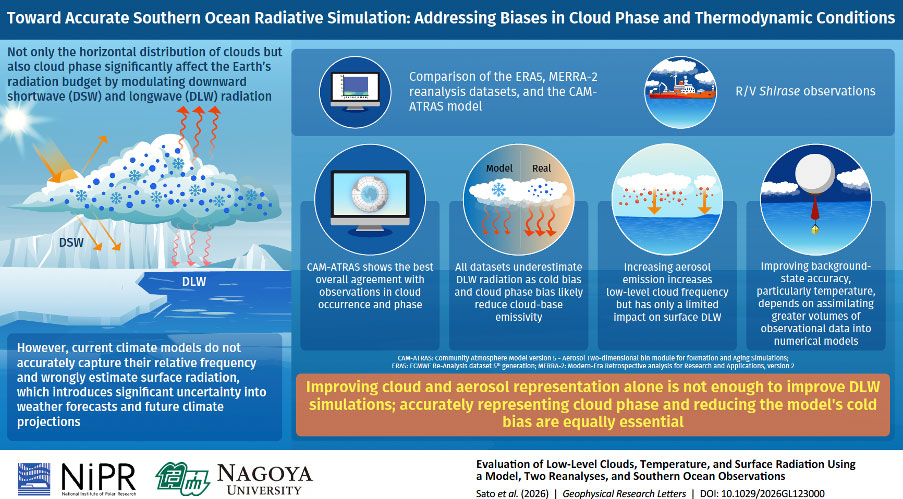
Despite those differences, all three underestimated downward longwave radiation, the heat emitted by the atmosphere and clouds toward the surface. Excess ice in the simulated clouds reduced the heat they emitted downward. The models also had a cold bias, meaning their temperatures were lower than observed, which contributed to the shortfall. Both cloud phase and atmospheric temperature therefore helped explain why simulations with abundant low clouds still delivered too little heat.
Professor Jun Inoue explains, “Numerical models have been reported to exhibit poor skill in reproducing clouds. In particular, over the Southern Ocean and Antarctica, where cloud representation remains especially challenging, cloud-related biases have been shown to increase errors in the surface energy budget through biases in the radiative budget.”
Aerosol concentrations offered another way to investigate the mismatch. ERA5 and MERRA-2 contained higher concentrations than the ship observed, prompting the researchers to test increased Southern Hemisphere aerosol emissions in CAM-ATRAS. More aerosols produced more low clouds, but had only a limited effect on surface radiation.
Antarctic observations could help correct cold biases
Improving how models represent cloud droplets and ice, aerosol interactions with clouds, and atmospheric conditions could reduce uncertainty in predictions of warming, sea ice change, and climate variability. The researchers call for expanded observations across the Southern Ocean and Antarctica, including temperature measurements to help address the cold bias.
Assistant Professor Kazutoshi Sato notes, “Because observations over Antarctica remain sparse, numerical models still contain substantial uncertainties in their representation of the Antarctic atmosphere. Therefore, incorporating existing but currently underutilized observations into numerical models may provide an effective solution. For example, assimilating observations from the PANSY radar at Japan’s Syowa Station, which are not yet routinely used in numerical weather prediction systems, could help reduce model biases and improve forecast accuracy.”
Reference: “Evaluation of Low-Level Clouds, Temperature, and Surface Radiation Using a Model, Two Reanalyses, and Southern Ocean Observations” by Kazutoshi Sato, Jun Inoue and Hitoshi Matsui, 31 July 2026, Geophysical Research Letters.
DOI: 10.1029/2026GL123000
This work was supported by the 64th Japanese Antarctic Research Expedition (JARE64 AJ1005) and JSPS KAKENHI (Grants JP18H05053, JP19K14802, JP20H04963, JP22H03722, JP22K14103, JP23H00515, JP23H00523, JP23K18519, JP23K24976, JP24H02225, JP24H02339, JP24H02341, JP25H00002, JP26K00780, and JP26K03065), the 4th Research Announcement on the Earth Observations of the Japan Aerospace Exploration Agency (JAXA), the MEXT Arctic Challenge for Sustainability II (ArCS II; JPMXD1420318865) and 3 (ArCS-3; JPMXD1720251001) Projects; the Environment Research and Technology Development Fund 2-2301 (JPMEERF20232001) and 2–2602 (JPMEERF20262002) of the Environmental Restoration and Conservation Agency; and National Institute of Polar Research (NIPR) through Special Collaboration Project (B25-02), and the National Institute of Polar Research (NIPR) under MEXT.
Never miss a breakthrough: Join the SciTechDaily newsletter.
Follow us on Google and Google News.