
Concrete usually adds to the world’s carbon burden, but a new formula absorbed CO2 while becoming stronger than a conventional mix.
Researchers at Mepco Schlenk Engineering College in India developed the concrete by combining two naturally derived materials: porous zeolite and bamboo biochar. Tests described in Carbon Research suggest the blend could give infrastructure a second function, allowing it to capture some carbon dioxide while continuing to carry structural loads.
Conventional cement production releases CO2 both from the fuel needed to heat raw materials and from the chemical conversion of limestone. The new approach does not eliminate those emissions, but it explores how concrete itself could be redesigned to absorb carbon while using less conventional cement and aggregate.
Natural Additives Reshape Concrete
Led by Srinivasan Revathi, the researchers tested M35 grade concrete, a material used in infrastructure exposed to moderate traffic. They replaced either 25% or 50% of the fine aggregate with zeolite, then substituted 0.5%, 1%, or 1.5% of the cement with bamboo biochar.
Zeolite contains networks of microscopic pores that can trap gas molecules, while bamboo biochar is a porous, carbon-rich material produced by heating biomass with limited oxygen. These properties made both substances promising candidates for increasing CO2 uptake, but the team also needed to ensure that the additions would not weaken the finished concrete.
Each mixture underwent tests of compressive strength, split tensile strength, water absorption, and impact resistance. The strongest overall performer contained 50% zeolite and 1% bamboo biochar (dubbed ZB5).
The Strongest Formula Emerges
ZB5 reached a compressive strength of 38.49 MPa (5,582 psi), exceeding conventional concrete by 7.48%. Its split tensile strength rose to 4.39 MPa (637 psi), a 15% improvement over the standard mixture.
The researchers linked these gains to the complementary properties of the two additives. Zeolite’s aluminosilicate framework and the hardness of bamboo biochar helped form a denser cement matrix, showing that greater porosity for carbon capture did not necessarily require sacrificing strength.
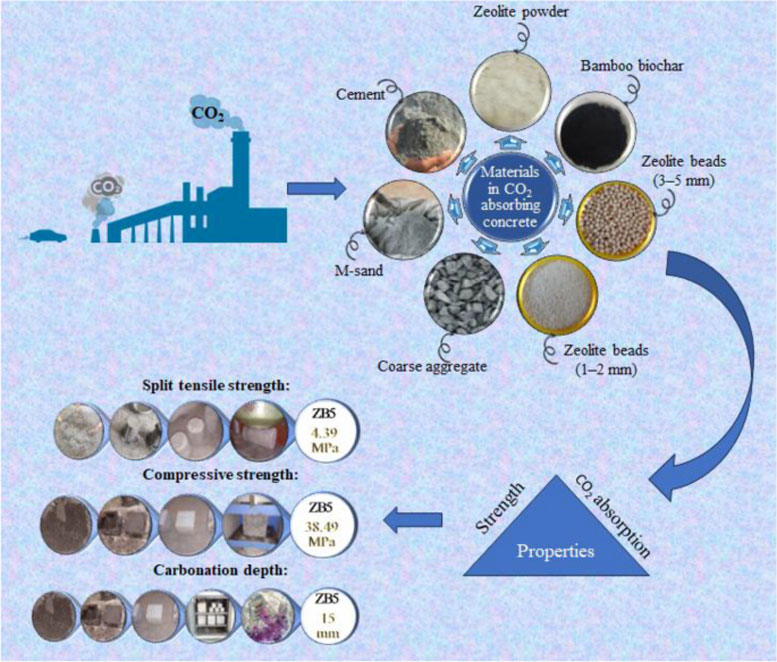
The same formula also produced the best carbon uptake. In a controlled carbonation chamber, ZB5 absorbed 1.2 grams (0.04 ounces) of CO2 per day. After seven days, carbonation had reached 15 mm (0.6 inches) into the material. The team attributed this performance to the zeolite’s microporous structure and the biochar’s high carbon content.
Concrete Becomes a Carbon Sink
The findings show how a material normally treated as a passive structural component could also participate in carbon management. The chamber results do not yet establish how much CO2 the concrete would capture throughout decades of outdoor use, but they provide an early demonstration of its combined structural and environmental potential.
Srinivasan Revathi, corresponding author from the Department of Civil Engineering, said, “Our work demonstrates a dual-benefit approach. We are not just creating a stronger concrete, but we are transforming a common building material into an active tool for environmental remediation. By integrating zeolite and bamboo biochar, we can build structures that not only stand strong but also actively cleanse the air of excess carbon dioxide, paving the way for truly sustainable infrastructure in high-emission areas like urban roadways and industrial zones.”
The researchers suggest that the material could eventually be used in concrete pavements, highway parapet walls, sewer pipelines, and other infrastructure exposed to elevated CO2 levels. Its ability to replace portions of both cement and fine aggregate could also broaden its environmental value, although a full assessment would need to consider manufacturing, transportation, durability, and the source of the additives.
Long-Term Performance Comes Next
The current results are a proof of concept rather than evidence that the concrete is ready for widespread construction. Longer studies will be needed to determine whether its strength and carbon absorption persist under changing temperatures, moisture, traffic, and other real-world conditions.
Future experiments will examine additional types of biochar, different grades of concrete and mortar, and pre-soaked biochar that may alter the material’s behavior. Those tests will help establish whether the promising laboratory formula can be scaled into a reliable option for commercial and industrial infrastructure.
Reference: “Effect of zeolite and bamboo biochar as CO2 absorbant in concrete” by Srinivasan Revathi, Dobson Alice Elizabeth Tania, Sutharson Ancy Shadin and Jegatheesan Keerthana, 30 April 2024, Carbon Research.
DOI: 10.1007/s44246-024-00116-1
Never miss a breakthrough: Join the SciTechDaily newsletter.
Follow us on Google and Google News.