

The desk you work at may have more influence on productivity than you think, with research involving over 10,000 employees linking standing desks to greater daily computer activity.
For anyone who spends most of the workday in front of a computer, sitting for hours can leave the back aching, the neck stiff, and energy running low by midafternoon. Standing up and moving around can help break up that routine, which is part of the appeal of height-adjustable desks. These workstations let employees switch between sitting and standing without stepping away from their work, offering a simple way to reduce physical strain and spend less time in one position.
Now, a large study from Texas A&M University suggests that sit-stand desks may offer another advantage. Employees using them averaged about 43 more minutes of active computer use each day than those working at traditional desks. Over a year, that difference could represent nearly $9,000 in potential productivity value per employee.
The research, published in Theoretical and Applied Ergonomics, was co-led by Dr. Mark Benden, a professor at Texas A&M’s School of Public Health, and Dr. Tricia Salzar, Regional Ergonomist for the U.S. Army Public Health Command Region, West.
A 171-hour annual gap in computer activity
Rather than relying on a small laboratory experiment, the researchers examined how people used their computers during ordinary workdays. “We analyzed a huge dataset of more than 10,000 workers over a yearlong period, comparing the total computer use of traditional desk users and height-adjustable desk users,” Benden said.
The team combined employee comfort surveys with software measurements of computer activity, including keystrokes, words typed, mouse clicks, and typing errors. This allowed the researchers to examine both how workers felt about their workstations and how actively they used their computers.
“It was important that we collected subjective measurements, like employee survey responses of their comfort and objective measurements of computer activity through software, to analyze how people engaged with their work,” Benden said.
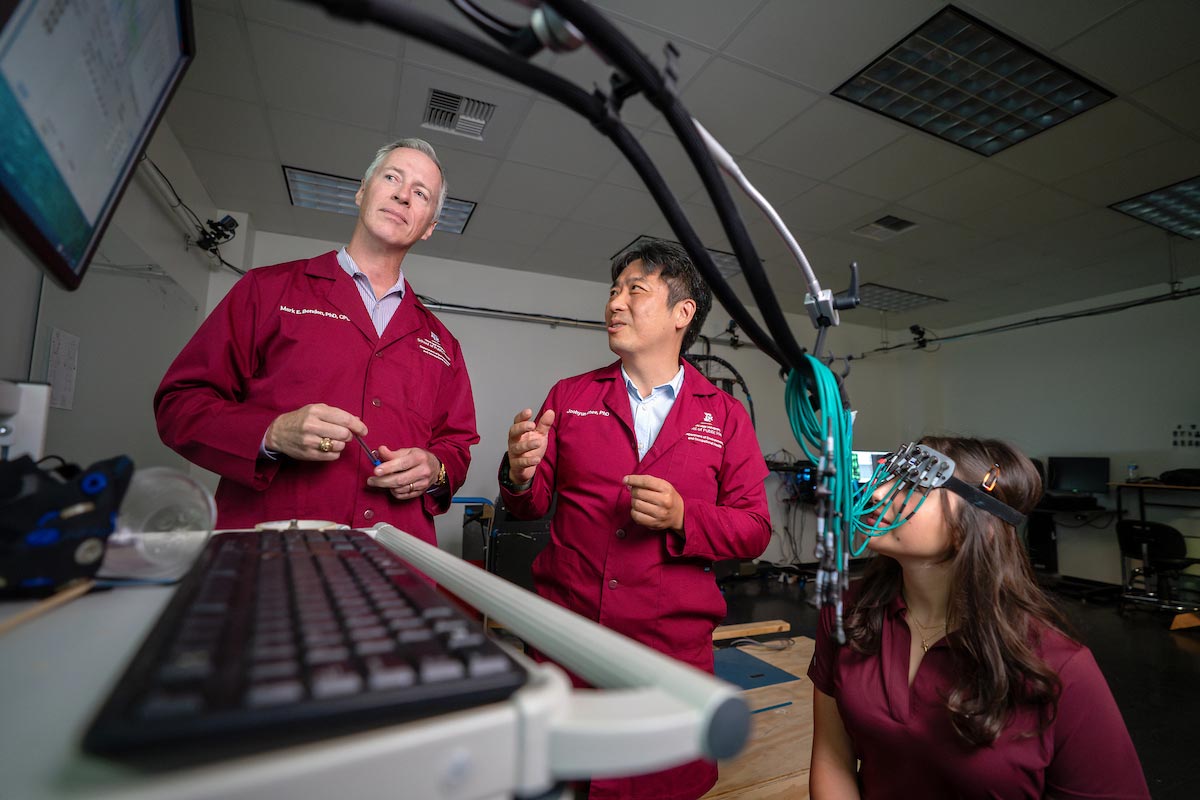
Employees with sit-stand desks averaged 3.66 hours of active computer time per day, compared with 2.95 hours among those using conventional desks. That difference of approximately 43 minutes may seem modest during a single workday, but the researchers calculated that it amounted to roughly 171 additional hours annually, equivalent to more than four 40-hour workweeks.
The difference also extended beyond time spent using a computer. Employees with adjustable desks generally typed more words and recorded more keystrokes, suggesting that the additional activity was accompanied by greater measurable output.
“The data showed that people aren’t just engaging with their work, they are producing output in a meaningful way,” Benden said.
Using a standardized hourly wage of approximately $52, the researchers calculated that those 171 additional hours could represent nearly $9,000 in annual productivity value for each employee. The figure is an estimate based on computer activity and hourly wages, rather than a demonstrated increase in company profits or a financial return that accounts for the cost of purchasing the desks.

“Our findings were exciting because they suggest that height-adjustable desks can directly influence overall work output and economic organizational productivity,” Benden said.
The results are encouraging, although the comparison does not establish that the desks themselves caused the difference in activity. The measurements also do not directly show whether employees experienced less back pain, reduced fatigue, or better concentration. Those remain potential benefits rather than outcomes established by the reported computer-use findings.
The overlooked influence of workplace design
Still, the results add to a broader discussion about how the spaces people work in can influence their daily experience. Employers often look to new software, training, and management strategies to improve performance, while the physical surroundings receive less attention.
“It’s what we call the ‘workplace effect,’” Benden said. “The direct impact that the physical work environment has on the behavior, health, psychological well-being, and even engagement and performance of employees.”
A sit-stand desk is a relatively straightforward example of that idea. Instead of requiring someone to remain seated throughout the day, it allows them to adjust their position as their comfort and tasks change. For workers who spend much of their time at a computer, that flexibility may make long workdays more manageable.
“It can have a profound effect,” Benden said. “Alternating between different working positions promotes better health outcomes by reducing physical strain and encouraging movement for those who might otherwise spend most of their workday sedentary.”
The possibility of easing physical discomfort while supporting more sustained energy and longer periods of focused work makes adjustable desks appealing to employees. For employers, the potential benefit is a workforce that can remain productive while working in a more comfortable environment.
“It has a cumulative, positive effect for both employers and employees,” Benden said.
Benden believes these findings demonstrate why workplace design deserves a larger role in conversations about employee health and organizational performance.
“The design of the workplace itself can be a powerful driver of human health and performance, including better engagement, productivity, and organizational success,” Benden said.
“The implications are hard to ignore,” Benden said. “When we design workplaces around employees and their needs, better health, better performance, and better organizational outcomes follow.”
Understanding that relationship has been a major focus of Benden’s career. A former Army Reserve officer, engineer, healthcare professional, inventor, and internationally recognized researcher, he has spent decades investigating how work environments affect the people who use them.
“We spend a lot of time at work,” Benden said. “It’s my passion to make sure that workers feel supported in their workplace, built on informed and guided scientific evidence.”
He currently directs the Center for Worker Health at Texas A&M, which brings together engineering, management, and technology through interdisciplinary research, innovation, and education. Its work focuses on developing practical improvements in worker health and efficiency, while helping students turn their ideas into real-world applications.
“The Center partners with industry nationwide, to develop innovative, impactful systems and practices that have a direct effect on worker health and efficiency,” Benden said. “We also train students and give them the platform to be as creative as possible to turn new ideas into impactful applications.”
AI brings new questions about workspaces
The research is also expanding beyond furniture and ergonomics. As artificial intelligence becomes a more common part of office work, Benden is interested in how these technologies might interact with the physical environments in which employees perform their jobs.
“Artificial intelligence is becoming increasingly integrated into daily work,” Benden said. “Just as we’ve studied how the physical environment affects human health and performance, we’re interested in understanding how emerging AI technologies could influence the physical workspace and outcomes of organizations.”
For organizations considering changes to their offices, the findings suggest that improving the everyday experience of working at a computer may be worth examining alongside investments in new technology. Whether the goal is to reduce physical strain, encourage movement, or support productivity, even something as familiar as a desk could have a role to play.
“The next breakthrough may not come from working harder, but from designing workspaces and systems that help people work smarter and more efficiently,” Benden said.
Reference: “Improved Computer Utilization Associated with Height Adjustable Workstations in a Large Office Population” by Tricia Lynn Salzar, Matthew Lee Smith, Adam Pickens, Gang Han and Mark Edward Benden, 19 September 2026, Theoretical and Applied Ergonomics.
DOI: 10.3390/tae2030021
Never miss a breakthrough: Join the SciTechDaily newsletter.
Follow us on Google and Google News.