
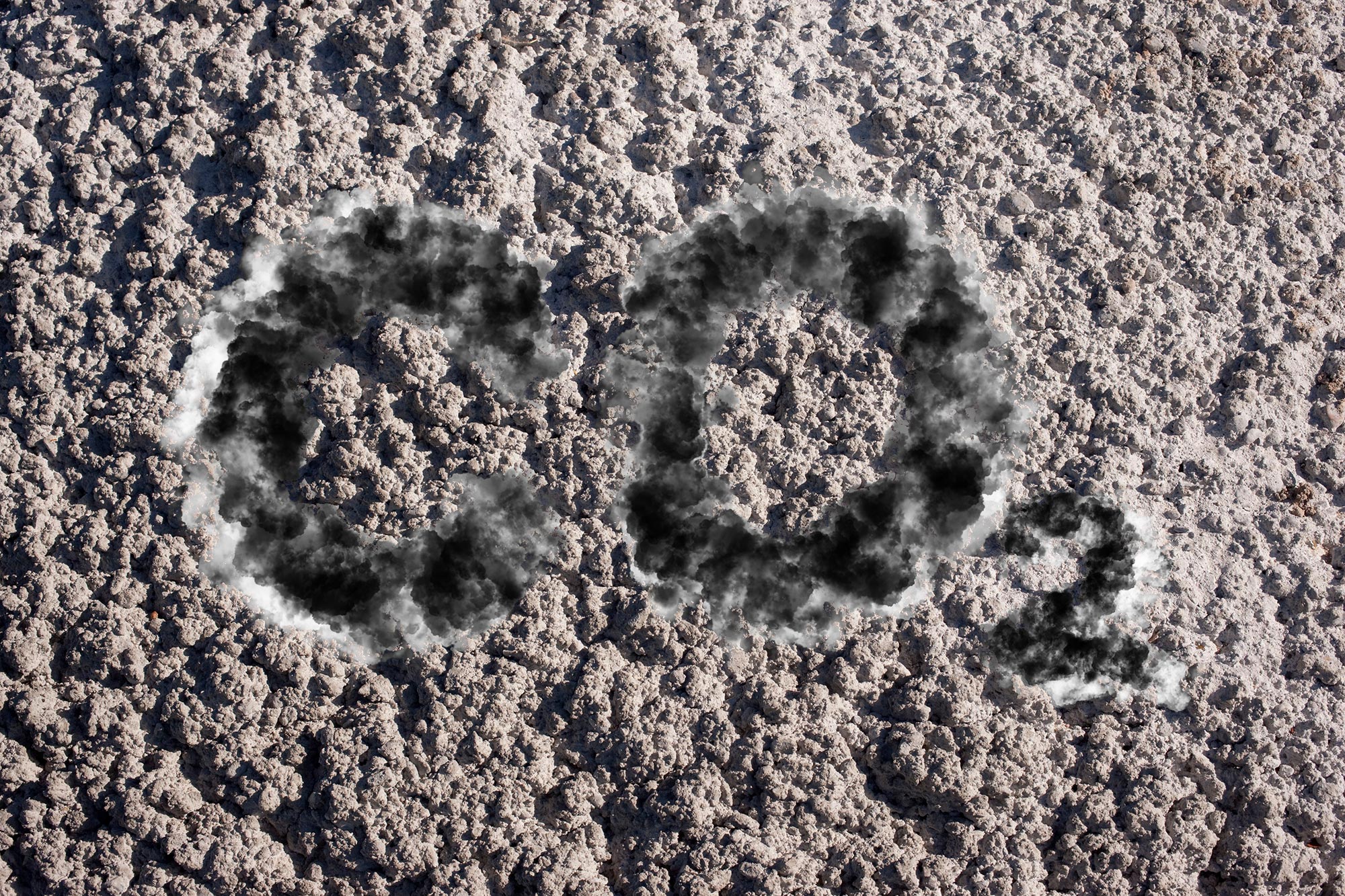
Researchers have created a low-lead method to convert CO₂ into solid metal oxalates.
Researchers at the University of Michigan have contributed to the development of a method that transforms carbon dioxide, an industrial waste product that contributes to atmospheric pollution, into a valuable material: precursors for cement.
U-M chemist Charles McCrory and his research team, in collaboration with Jesús Velázquez’s lab at the University of California, Davis, and Anastassia Alexandrova’s lab at the University of California, Los Angeles, have created a process that captures carbon dioxide and converts it into metal oxalates. These compounds can then serve as key ingredients in the production of cement.
“This research shows how we can take carbon dioxide, which everyone knows is a waste product that is of little-to-zero value, and upcycle it into something that’s valuable,” said McCrory, associate professor of chemistry and macromolecular science and engineering. “We’re not just taking carbon dioxide and burying it; we’re taking it from different point sources and repurposing it for something useful.”
The research was spurred by McCrory’s participation in the Center for Closing the Carbon Cycle. 4C is an Energy Frontier Research Center funded by the U.S. Department of Energy, Office of Science, Basic Energy Sciences, and is led by Jenny Yang at University of California, Irvine. One of the goals of 4C is to explore methods for capturing and converting carbon dioxide into valuable fuels and products.
A Cleaner Alternative to Traditional Cement
The most common type of cement is Portland cement, which is typically made from limestone and minerals such as calcium silicates. Producing this Portland cement has a relatively large energy cost and carbon footprint, McCrory said. McCrory and colleagues were looking into ways to take carbon dioxide and convert it into materials that can be used for production of alternative cements.
One type of material that can be used as an alternative cement precursor are metal oxalates, simple salts. Researchers know that lead can be used as a catalyst—a substance that helps facilitate a chemical reaction—that can convert carbon dioxide into metal oxalates. But the process requires large amounts of lead catalysts, which is an environmental and human health hazard.
The 4C team was able to use polymers to control the environment immediately surrounding the lead catalysts, shaving the amount of lead needed in this process down to parts per billion—a trace impurity level of lead found in many commercial porous graphite and carbon materials.
McCrory specializes in controlling the microenvironment—the chemical environment and coordination environment—around catalyst sites. By controlling the microenvironment, McCrory can tune the activity of the catalyst. The researchers showed that by controlling the microenvironment surrounding the lead catalyst in the chemical reaction that converts carbon dioxide to oxalate, they can vastly reduce the amount of lead needed for the process.
Electrochemical Conversion Process
To produce the oxalate from carbon dioxide, the researchers use a set of electrodes. At one electrode, carbon dioxide is converted to oxalate, which is an ion dissolved in the solution. The other electrode is a metal electrode that’s being oxidized and releasing metal ions that bind with the oxalate ion and precipitate it out of solution as a metal oxalate solid.
“Those metal ions are combining with the oxalate to make a solid, and that solid crashes out of the solution,” McCrory said. “That’s the product that we collect and that can be mixed in as part of the cement-making process.”
Velázquez is a co-lead author of the study and associate professor of chemistry at UCD. His group originated the idea of using trace amounts of lead to drive the oxalate-synthesis reactions and examined the mechanisms behind the chemical reaction of carbon dioxide into oxalate.
“Metal oxalates represent an underexplored frontier—serving as alternative cementitious materials, synthesis precursors and even carbon dioxide storage solutions,” he said.
Alexandrova is also a co-lead author of the study and professor of chemistry and materials science at UCLA. Her team performed calculations to confirm the hypothesis that this mechanism would work.
“Catalysts are often discovered by accident, and successful industrial formulations are often very complicated. These cocktail catalysts are discovered empirically through trial and error,” Alexandrova said. “In this work, we have an example of a trace lead impurity actually being a catalyst. I believe there are many more such examples in practice catalysis, and also that this is an underexplored opportunity for catalyst discovery.”
Real CO₂ Capture With Practical Benefits
McCrory says once the carbon dioxide is converted into the metal oxalate solid, it won’t be rereleased into the atmosphere as carbon dioxide again under normal conditions.
“It’s a true capture process because you’re making a solid from it,” he said. “But it’s also a useful capture process because you’re making a useful and valuable material that has downstream applications.”
McCrory says researchers should be able to scale up one part of the process: researchers are working on electrolysis for carbon dioxide on a large scale. Next steps will be to further study how to scale up the portion of the process that produces the solid product.
“We are a ways away, but I think it’s a scalable process,” McCrory said. “Part of the reason we wanted to reduce the lead catalyst to parts per billion is the challenges of scaling up a catalyst with massive amounts of lead. It wouldn’t be environmentally reasonable, otherwise.”
Reference: “Selective Electrochemical Reduction of CO2 to Metal Oxalates in Nonaqueous Solutions Using Trace Metal Pb on Carbon Supports Enhanced by a Tailored Microenvironment” by Rowan S. Brower, Brian Wuille Bille, Shawn Chiu, Joseph T. Perryman, Libo Yao, Faridat O. Agboola, Cocoro A. Nagasaka, Yinuo Xie, Richard Gomez-Caballero, Ankita Kumari, Elizabeth K. Neumann, Anastassia N. Alexandrova, Charles C. L. McCrory and Jesus M. Velázquez, 19 May 2025, Advanced Energy Materials.
DOI: 10.1002/aenm.202501286
Funding: U.S. Department of Energy, Office of Science, Basic Energy Sciences
Never miss a breakthrough: Join the SciTechDaily newsletter.
Follow us on Google and Google News.
4 Comments
This is why we need to fully support our universities
This process might produce an obscure niche product, but I won’t be looking to buy bags of metal oxalate cement at The Home Depot soon. Spreading science pork money around in some fancy-named bill bloviated by some political party may be just as bad as slashing science grants by the next party. I hope The People get some benefit from all that money.
LOL, the “University of Michigan” wrote this nonsense? No wonder an “author” didn’t want their name on this tripe. And I quote…
“…carbon dioxide, an industrial waste product that contributes to atmospheric pollution,”
There is absolutely nothing about that sentence which is true. Carbon Dioxide is, by matter of SCIENTIFIC FACT, the gas which gives LIFE to this planet. It is CO2 which FEEDS THE RAINFORESTS. It is CO2 which FEEDS THE OCEANIC PLANKTON. It is CO2 which MAKES CROPS GROW.
To classify CO2 as “atmospheric pollution” is to ATTACK THE RAINFORESTS. To classify CO2 as “atmospheric pollution” is to ATTACK THE OCEANS. To classify CO2 as “atmospheric pollution” is to ATTACK HUMANITY ITSELF, and all the living creatures of the planet.
Here at “scitechdaily”, CLEARLY there is no respect for ACTUAL science. Anyone that has studied CO2 and global climate understands that increases in global CO2 FOLLOWS WARMING, it does not PRECEED IT. WARMING CAUSES INCREASES IN CO2, CO2 DOES NOT CAUSE INCREASES IN WARMING. The idea that CO2 has “magic gas properties” that somehow prevents photonic (heat) radiation from being directed back into space is ABJECT LUNACY. This is based on ABSOLUTE THERMODYNAMIC LAW, not “bs climate change theory”. An absorbed photon will re-emit in a random direction. PERIOD. That law is IMMUTABLE.
Where do you people get off peddling this nonsense and calling it “science”? I’m beginning to realize the only book you people have ever read IN YOUR LIVES was Edward Bernays’ “Propaganda”.
People taking this nonsense at face value have 0 critical thinking skills and 0 knowledge of ACTUAL science. This is bunk. It’s crap. It’s nonsense of the highest order, and it should be treated as such.
I am ashamed of the University of Michigan. If you have children there, pull them out now.
I am ashamed of scitechdaily. Its “editorial board” should seriously consider new leadership for the website, and they themselves should consider careers in other fields.
An industrial waste product. An atmospheric pollutant. What nonsense. CO2 feeds the planet. Without CO2, there is no food. Without CO2, there is no O2! CO2 FOLLOWS WARMING, it does NOT PRECEED IT, and every REAL SCIENTIST knows this as absolute fact. For shame. Seriously, for shame.
Excellent article