
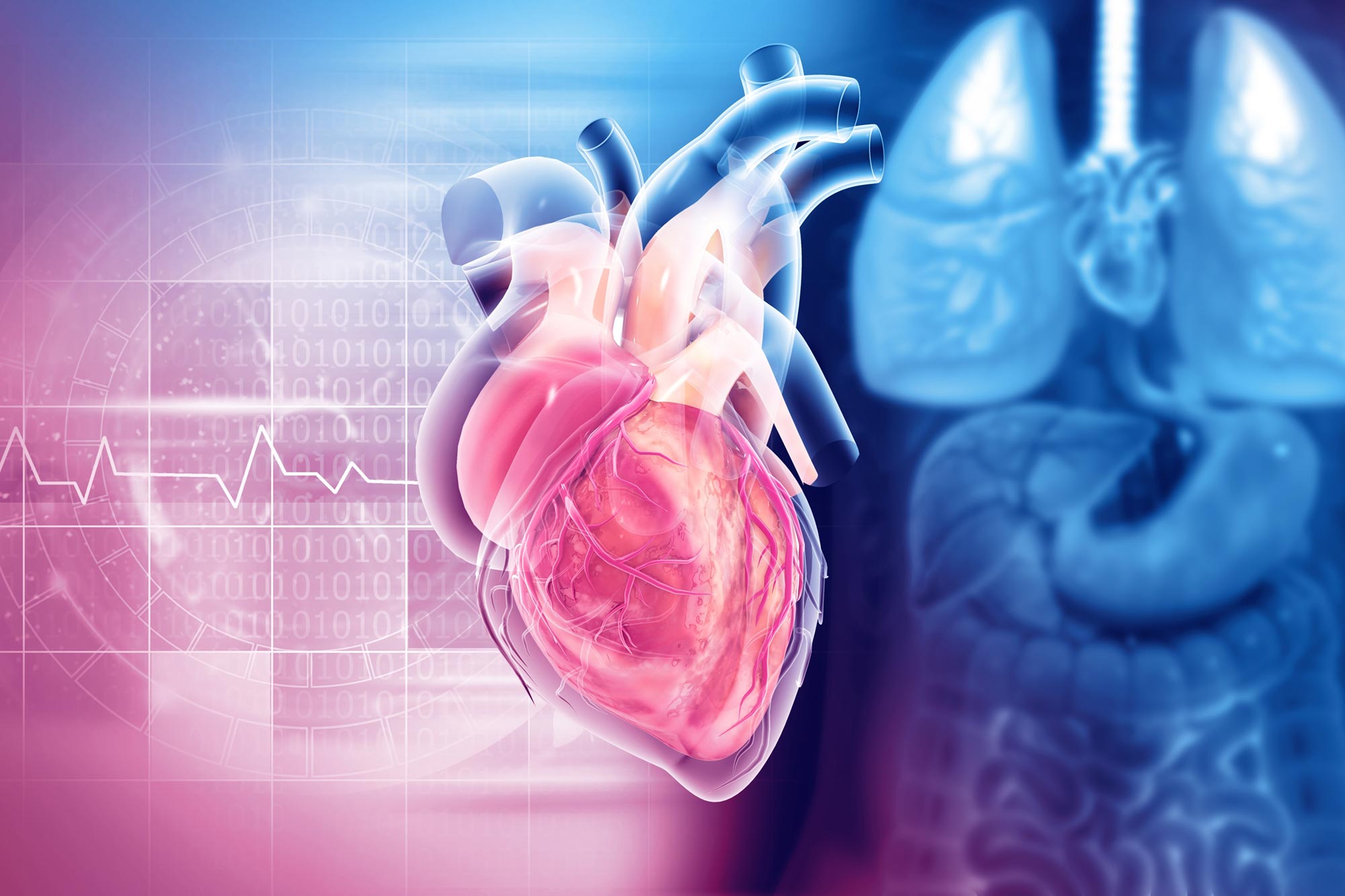
A new generation of quantum sensors could improve medical diagnostics.
Diamond-based quantum sensors could make it easier to record the heart’s activity without attaching electrodes to the skin. Physicists at Johannes Gutenberg University Mainz (JGU) have used a tiny diamond to measure the heart’s magnetic field, building their sensor into a fiber-based instrument designed as a portable endoscope.
The approach measures heart activity differently from an electrocardiogram, or ECG. An ECG uses electrode patches on the skin to detect the heart’s electrical activity. Its readings can be affected by differences in how body tissues conduct electricity, and injuries such as burns can prevent clinicians from placing electrodes where they are needed.
Magnetocardiography, or MCG, instead detects the magnetic fields produced by heart activity. It requires no skin contact, and tissue conductivity has little influence on the measurements. Recording these signals, however, requires extremely sensitive instruments. MCG has historically depended on costly, complex technologies such as superconducting quantum interference devices, known as SQUIDs, and optically pumped magnetometers, or OPMs.
These established technologies still outperform the diamond sensors in sensitivity and in their ability to distinguish a signal from background noise. The new work, published in Science Advances, explores whether the practical advantages of diamonds could help bring magnetic measurements into more medical settings as their performance improves.
Room-temperature sensing with a tiny diamond
The JGU sensor’s diamond is shaped like a pyramid with its tip cut off and has a volume of less than 0.5 cubic millimeters. Its small size makes it easy to transport, and unlike SQUID and OPM systems, the diamond sensor operates at room temperature. It can therefore be placed directly against the skin at different locations, potentially allowing researchers to map the body’s magnetic signals in greater detail. One possible application is reconstructing the heart’s electrical conduction system in three dimensions.
“NV magnetometers are characterized by fast initialization, excellent biocompatibility, and stable operation over a wide temperature range. This makes them particularly attractive for biomedical applications,” said Dr. Arne Wickenbrock, who coordinates the DIAQNOS project in Mainz.
NV stands for nitrogen-vacancy, a particular defect in a diamond’s crystal structure. In an NV center, a nitrogen atom takes the place of a carbon atom, with an empty position immediately beside it. Researchers can examine the energy levels of these centers to make precise measurements of magnetic and electric fields, temperature, and mechanical stress. In this study, the diamond serves as a magnetometer, an instrument that measures magnetic fields.
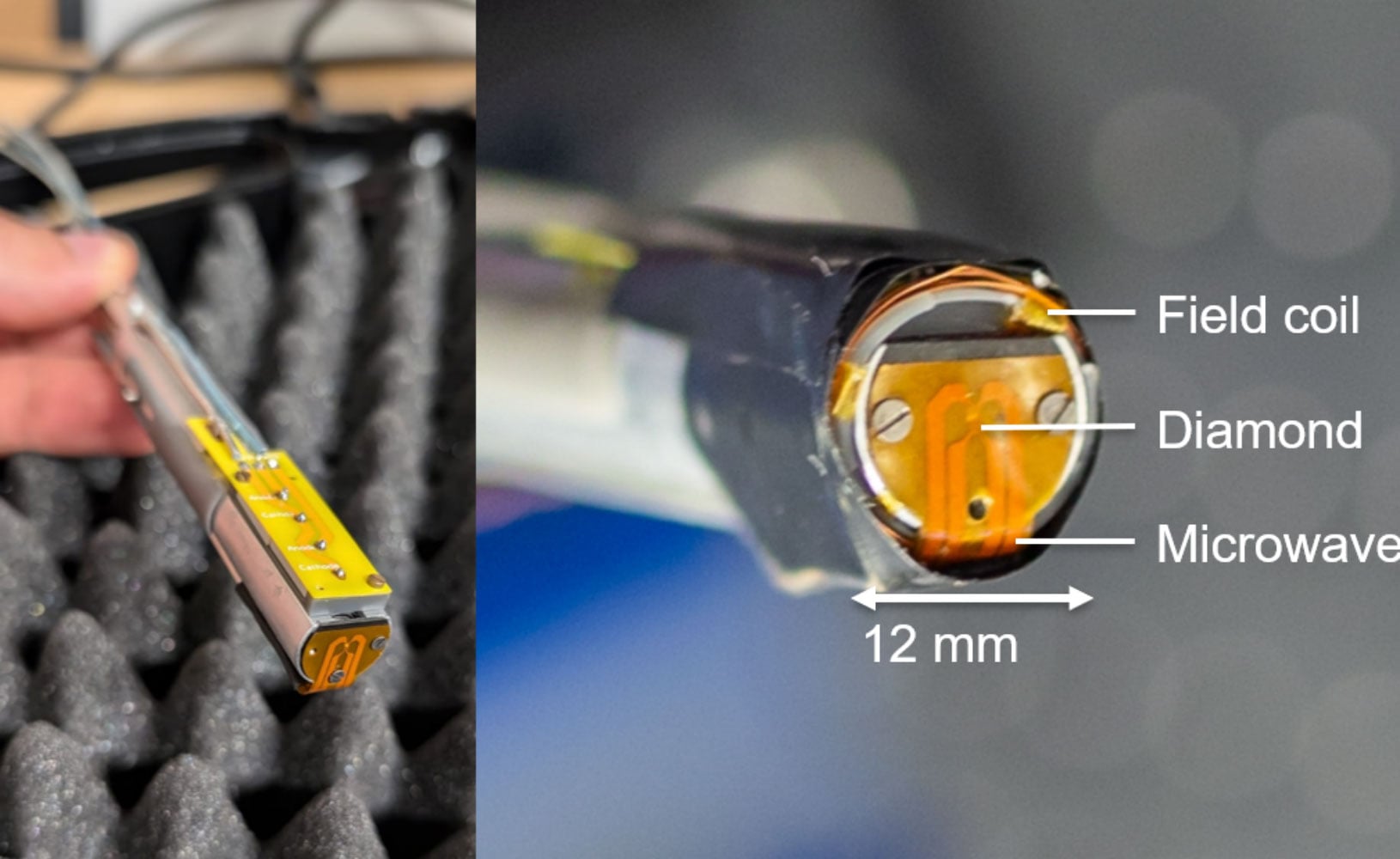
Muhib Omar developed the JGU sensor during his doctoral research in the group led by Prof. Dmitry Budker, a member of the PRISMA++ Cluster of Excellence and the Helmholtz Institute Mainz. Omar is also the coordinating author of the study.
“These results are the product of over ten years of development work,” explained Wickenbrock.
The research forms part of DIAQNOS, short for Diamond-based Quantum Sensing for Neurosurgery, a flagship project funded by the German Federal Ministry of Research, Technology, and Space. For the study, researchers measured the heart’s magnetic field using three systems developed independently by project partners at JGU, the Universities of Stuttgart and Freiburg, and the startup Q.ANT GmbH.
The JGU instrument differs from the other two in how it handles the measurement. It operates without a magnetic bias field, an externally applied magnetic field. The other systems use such fields to filter out magnetic interference from the surroundings. Together, the measurements demonstrated the potential for medical applications while identifying improvements still needed to make them practical.
Amplifying the heart’s magnetic signal
One route to better performance is to concentrate more of the magnetic field into the tiny diamond. Structures called flux concentrators gather magnetic flux into the sensing region, strengthening the signal. The small volume of NV sensors allows amplification by more than a factor of 100, and combining the detectors with these structures could eventually produce recordings with ECG-like quality.
Developing flux concentrators that work at room temperature is one of Omar’s main research areas.
“Adapting magnetic structures to optimally concentrate the magnetic field lines from a source within the diamond is the path to bringing these quantum technologies into practical use,” Omar said.
Toward portable brain monitoring
The broader goal is to develop sensors for magnetic signals from both the heart and the brain. Potential future applications include the early detection of myocarditis, an inflammation of the heart muscle, and epilepsy.
“We work closely with neurosurgeons to ensure that our technologies do not remain confined to the laboratory but find clear practical applications. Our primary goal is to develop highly sensitive sensors that function outside the laboratory and can fulfill important societal needs,” Wickenbrock said.
The sensors’ ability to measure a wide range of field strengths, suppress noise, and accommodate different sizes and arrangements also creates possibilities for further biomedical applications. For some of these, researchers would measure how a magnetic field changes between two locations rather than measuring it at a single point.
Two spatially separated sensors can form a gradiometer, which records the difference in magnetic field between them. This approach has applications in cancer surgery and supports monitoring nerve activity during operations in environments without magnetic shielding. Its sensitivity to changes in the field across space could also help separate a fetus’s heart signal from the mother’s without an invasive procedure.
NV gradiometers could eventually enable portable, room-temperature systems for magnetoencephalography, which records magnetic signals from the brain. Such systems could support neurological diagnosis and future brain-computer interfaces, which use brain activity to communicate with external devices.
Reference: “Human cardiac measurements with diamond magnetometers” by Muhib Omar, Magnus Benke, Shaowen Zhang, Jixing Zhang, Yihua Wang, Michael Kuebler, Pouya Sharbati, Ara Rahimpour, Arno Gück, Maryna Kapitonova, Devyani Kadam, Carlos René Izquierdo Geiser, Jens Haller, Arno Trautmann, Katharina Jag-Lauber, Robert Rölver, Thanh-Duc Nguyen, Leonardo Gizzi, Michelle Schweizer, Mena Abdelsayed, Ingo Wickenbrock, Andrew M. Edmonds, Matthew Markham, Peter A. Koss, Oliver Schnell, Ulrich G. Hofmann, Tonio Ball, Jürgen Beck, Dmitry Budker, Joerg Wrachtrup and Arne Wickenbrock, 16 September 2026, Science Advances.
DOI: 10.1126/sciadv.aeg5281
This work was supported by the EU, project HEU-RIA-MUQUABIS-101070546; by the DFG, project FKZ: SFB 1552/1 465145163; and by the German Federal Ministry of Research, Technology and Space (BMFTR) within the Quantumtechnologien program via the DIAQNOS project (project no. 13N16455).
Never miss a breakthrough: Join the SciTechDaily newsletter.
Follow us on Google and Google News.