
Close Menu
    Facebook X (Twitter) Instagram
    SciTechDaily
    • Biology
    • Chemistry
    • Earth
    • Health
    • Physics
    • Science
    • Space
    • Technology
    Facebook X (Twitter) Pinterest YouTube RSS
    SciTechDaily
    Home»Technology»“Designer Electrons” Have Tunable Properties
    Technology

    “Designer Electrons” Have Tunable Properties

    By SLAC National Accelerator LaboratoryMarch 14, 2012No Comments5 Mins Read
    Facebook Twitter Pinterest Telegram LinkedIn WhatsApp Email Reddit
    Share
    Facebook Twitter LinkedIn Pinterest Telegram Email Reddit
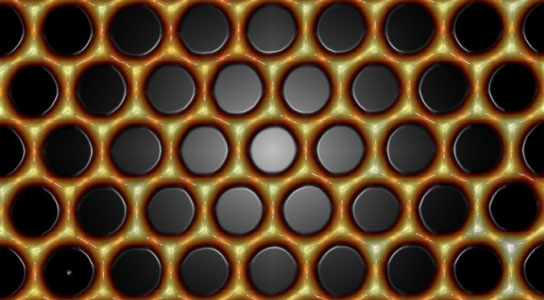
    Molecular Graphene
    Precisely positioned carbon monoxide molecules (black) guide electrons (yellow-orange) into a nearly perfect honeycomb pattern called molecular graphene. Electrons in this structure have graphene-like properties; for example, unlike ordinary electrons, they have no mass and travel as if they are moving at the speed of light in a vacuum. To make this structure, scientists from Stanford and SLAC National Accelerator Laboratory used a scanning tunneling microscope to move individual carbon monoxide molecules into a hexagonal pattern on a perfectly smooth copper surface. The carbon monoxide repels the free-flowing electrons on the copper surface, forcing them into a graphene-like honeycomb pattern. Credit: Hari Manoharan / Stanford University.

    The first ever electrons with tunable properties were observed at the SLAC National Accelerator Laboratory. By repositioning the carbon monoxide molecules that were placed on a perfectly smooth copper surface, the team was able to tune the electrons’ properties.

    Researchers from Stanford University and the U.S. Department of Energy’s SLAC National Accelerator Laboratory have created the first-ever system of “designer electrons” – exotic variants of ordinary electrons with tunable properties that may ultimately lead to new types of materials and devices.

    “The behavior of electrons in materials is at the heart of essentially all of today’s technologies,” said Hari Manoharan, associate professor of physics at Stanford and a member of SLAC’s Stanford Institute for Materials and Energy Sciences, who led the research. “We’re now able to tune the fundamental properties of electrons so they behave in ways rarely seen in ordinary materials.”

    Their first examples, reported today (March 14) in the journal Nature, were hand-crafted, honeycomb-shaped structures inspired by graphene, a pure form of carbon that has been widely heralded for its potential in future electronics. Initially, the electrons in this structure had graphene-like properties; for example, unlike ordinary electrons, they had no mass and traveled as if they were moving at the speed of light in a vacuum. But researchers were then able to tune these electrons in ways that are difficult to do in real graphene.
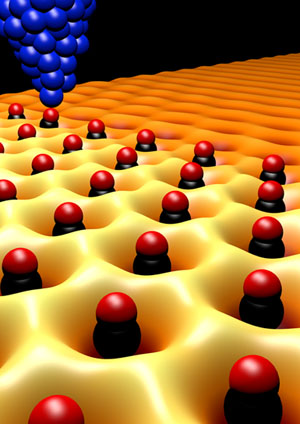
    specific hexagonal pattern of carbon monoxide molecules
    This graphic shows the effect that a specific pattern of carbon monoxide molecules (black/red) has on free-flowing electrons (orange/yellow) atop a copper surface. Ordinarily the electrons behave as simple plane waves (background). But the electrons are repelled by the carbon monoxide molecules, placed here in a hexagonal pattern. This forces the electrons into a honeycomb shape (foreground) mimicking the electronic structure of graphene, a pure form of carbon that has been widely heralded for its potential in future electronics. The molecules are precisely positioned with the tip of a scanning tunneling microscope (dark blue). Credit: Hari Manoharan / Stanford University.

    To make the structure, which Manoharan calls molecular graphene, the scientists use a scanning tunneling microscope to place individual carbon monoxide molecules on a perfectly smooth copper surface. The carbon monoxide repels the free-flowing electrons on the copper surface and forces them into a honeycomb pattern, where they behave like graphene electrons.

    To tune the electrons’ properties, the researchers repositioned the carbon monoxide molecules on the surface; this changed the symmetry of the electron flow. In some configurations, electrons acted as if they had been exposed to a magnetic or electric field. In others, researchers were able to finely tune the density of electrons on the surface by introducing defects or impurities. By writing complex patterns that mimicked changes in carbon-carbon bond lengths and strengths in graphene, the researchers were able to restore the electrons’ mass in small, selected areas.

    “One of the wildest things we did was to make the electrons think they are in a huge magnetic field when, in fact, no real field had been applied,” Manoharan said. Guided by the theory developed by co-author Francisco Guinea of Spain, the Stanford team calculated the positions where carbon atoms in graphene should be to make its electrons believe they were being exposed to magnetic fields ranging from zero to 60 Tesla, more than 30 percent higher than the strongest continuous magnetic field ever achieved on Earth. The researchers then moved carbon monoxide molecules to steer the electrons into precisely those positions, and the electrons responded by behaving exactly as predicted – as if they had been exposed to a real field.

    “Our new approach is a powerful new test bed for physics,” Manoharan said. “Molecular graphene is just the first in a series of possible designer structures. We expect that our research will ultimately identify new nanoscale materials with useful electronic properties.”

    Reference: “Designer Dirac fermions and topological phases in molecular graphene” by Kenjiro K. Gomes, Warren Mar, Wonhee Ko, Francisco Guinea and Hari C. Manoharan, 14 March 2012, Nature.
    DOI: 10.1038/nature10941

    Additional authors included Kenjiro K. Gomes, Warren Mar and Wonhee Ko of the Stanford Institute for Material and Energy Sciences. Francisco Guinea is a researcher at the Madrid Materials Science Institute. The research was supported by the U.S. Department of Energy’s Office of Basic Energy Sciences, the National Science Foundation and the Spanish Ministry of Science & Innovation.

    Never miss a breakthrough: Join the SciTechDaily newsletter.
    Follow us on Google and Google News.

    Electricity Electrons Graphene Magnetism Nanotechnology SLAC National Accelerator Laboratory
    Share. Facebook Twitter Pinterest LinkedIn Email Reddit

    Related Articles

    Exploring Graphene-Based THz Devices

    Graphene Center Laboratory is State of the Art “Nano-Factory”

    Increasing Solar Cell Efficiency With Graphene

    Bismuth-Antimony Material Shares Graphene’s Unusual Properties

    2-D Boron has Potential Advantages over Carbon Nanotubes

    Mapping the Pathways of Electrical Charge From Molecule to Molecule

    Making Graphene-Based Supercapacitors With DVD Discs

    Graphene Submerged in Electrically Neutral Liquid Sets Mobility Record

    Researchers Discover Electrical Switch for Magnetic Current

    Leave A Reply Cancel Reply

    • Facebook
    • Twitter
    • Pinterest
    • YouTube

    Don't Miss a Discovery

    Subscribe for the Latest in Science & Tech!

    Trending News

    Bone-Strengthening Discovery Could Reverse Osteoporosis

    Scientists Uncover Hidden Trigger Behind Stem Cell Aging

    Scientists Find Way to Reverse Fatty Liver Disease Without Changing Diet

    Could Humans Regrow Limbs? New Study Reveals Promising Genetic Pathway

    Scientists Reveal Eating Fruits and Vegetables May Increase Your Risk of Lung Cancer

    Scientists Reverse Brain Aging With Simple Nasal Spray

    Scientists Uncover Potential Brain Risks of Popular Fish Oil Supplements

    Scientists Discover a Surprising Way To Make Bread Healthier and More Nutritious

    Follow SciTechDaily
    • Facebook
    • Twitter
    • YouTube
    • Pinterest
    • Newsletter
    • RSS
    SciTech News
    • Biology News
    • Chemistry News
    • Earth News
    • Health News
    • Physics News
    • Science News
    • Space News
    • Technology News
    Recent Posts
    • Europe’s Most Active Volcano Just Got Stranger – Here’s Why Scientists Are Rethinking It
    • Why Are Giant Ants Letting Tiny Ants Crawl All Over Them?
    • Revolutionary Technique Sends Healthy Mitochondria Exactly Where They’re Needed
    • This Student Recreated the Universe in a Bottle. What She Discovered Could Help Reveal How Life Started on Earth
    • Alzheimer’s Symptoms May Start Outside the Brain, Study Finds
    Copyright © 1998 - 2026 SciTechDaily. All Rights Reserved.
    • Science News
    • About
    • Contact
    • Editorial Board
    • Privacy Policy
    • Terms of Use

    Type above and press Enter to search. Press Esc to cancel.